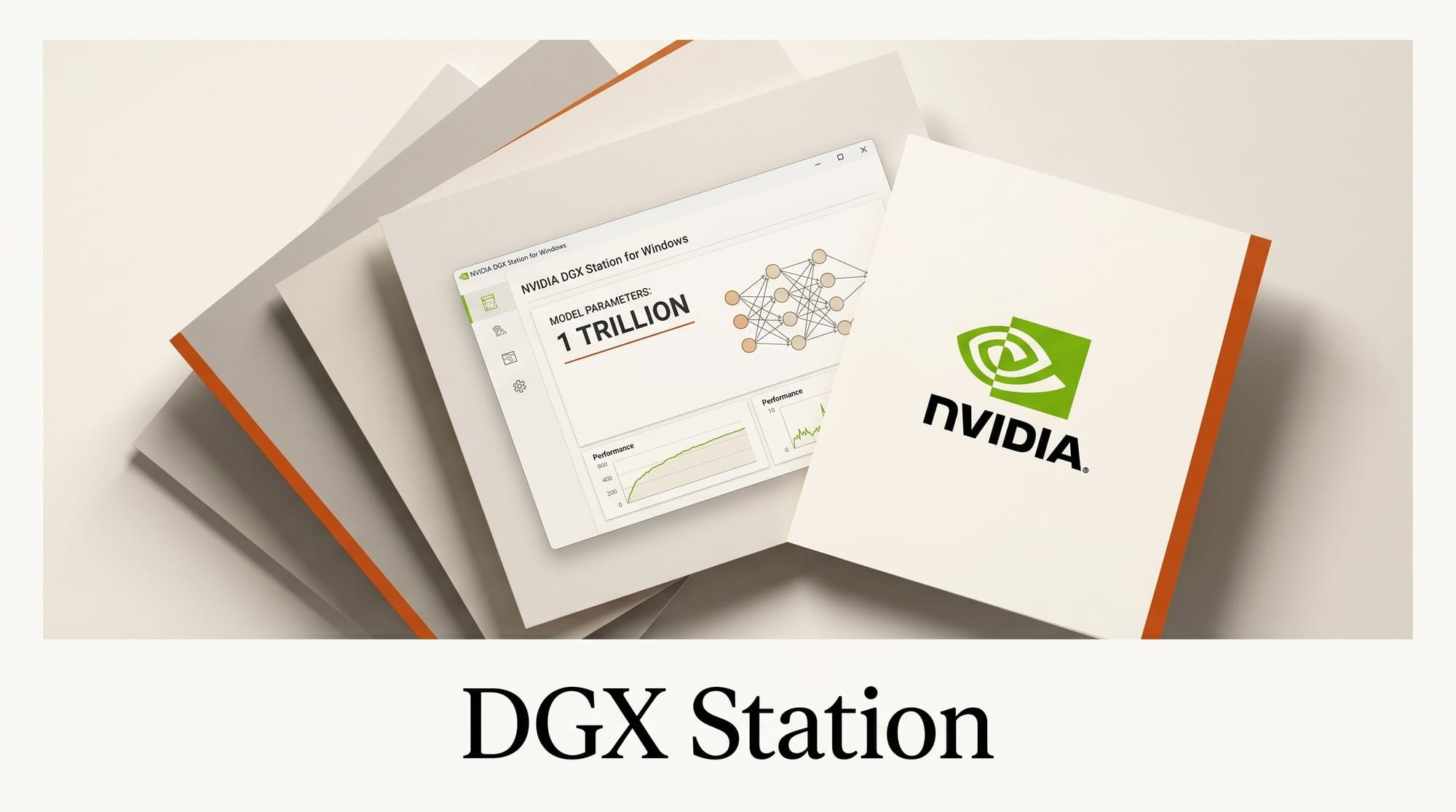
NVIDIA announced DGX Station for Windows at Computex 2026 on June 1, putting a GB300 Grace Blackwell Ultra chip and 748GB of memory into a desktop workstation that runs trillion-parameter models locally. Shipping Q4 2026 from ASUS, Dell, GIGABYTE, HP, MSI, and Supermicro.
What Happened
Jensen Huang unveiled DGX Station during the Taipei keynote as the first desktop-class workstation built around Grace Blackwell Ultra. The system pairs a GB300 chip with 748GB of unified memory, delivering 20 petaflops of FP4 performance, and runs full Windows 11.
NVIDIA framed it explicitly for "developers, researchers, and creators who need to run AI workloads that today require a cloud GPU pod." The system supports inference on models up to 1 trillion parameters without offloading to disk.
It ships alongside NVIDIA OpenShell, a Windows agentic runtime that accelerates llama.cpp and vLLM by 2x through tighter Grace Blackwell scheduling.
Why It Matters for Creators
Cloud GPU rates for an H200 pod now run $4-12 per hour. A creator running a daily Stable Diffusion 4 training job, weekly LoRA fine-tunes, or interactive Wan 3.0 video generation can burn through $500-2000 per month. DGX Station's local-only operation turns that into a one-time hardware purchase with zero ongoing inference cost.
The 748GB memory is the differentiator: today's high-end workstation cards (RTX 6000 Ada, 48GB) can hold 70B models comfortably but choke on 405B or above. DGX Station handles DeepSeek V4, Llama 5 405B, and the upcoming Nemotron 3 Ultra (550B) without quantization tricks.
Key Details
Chip: GB300 Grace Blackwell Ultra
Memory: 748GB unified
Performance: 20 petaflops FP4
OS: Windows 11 with NVIDIA OpenShell runtime
Max model size: 1 trillion parameters local inference
Launch: Q4 2026
Partners: ASUS, Dell, GIGABYTE, HP, MSI, Supermicro
What to Do Next
Pricing is not yet announced, but compared to the previous DGX Station (~$74K), this generation is expected to land in the $40-60K range for OEM SKUs. If your team currently spends $30K+ per year on cloud GPU time for fine-tuning, the math closes inside two years.
Three things to do before Q4: benchmark your current cloud spend to set a payback target, confirm your data residency requirements (DGX Station means your training data never leaves your office), and shortlist the two or three models you would run locally that you currently can't.
Partner SKU details will appear on NVIDIA's DGX Station page through Q3.
This story was covered by Creative AI News.
Subscribe for free to get the weekly digest every Tuesday.