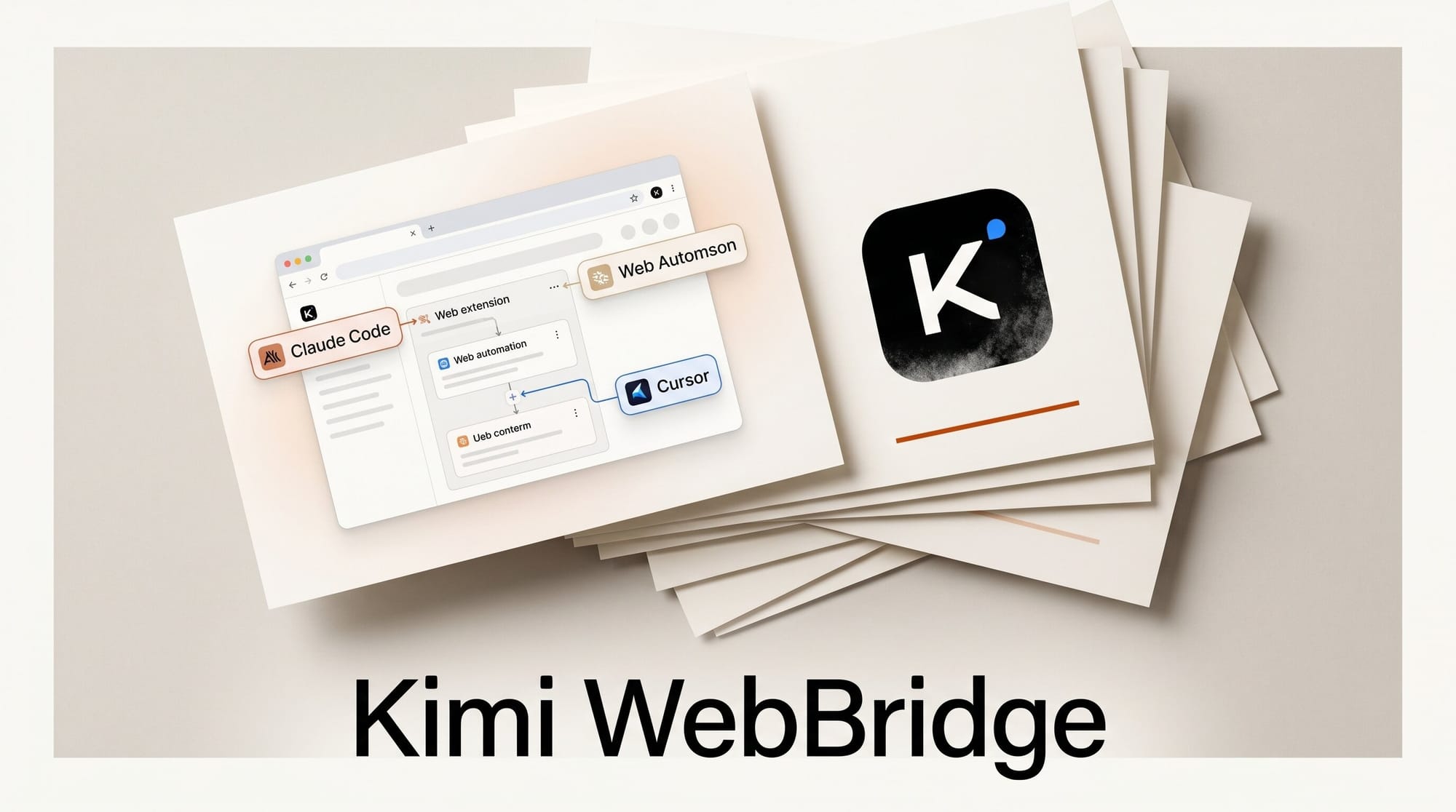
Moonshot AI released Kimi WebBridge on May 14, a browser extension that lets coding agents like Claude Code, Cursor, and Codex drive your local Chrome or Edge session through the Chrome DevTools Protocol. Logins, cookies, and page content stay on your machine; the agent only sees what you forward to it. Moonshot positioned it as an agent-agnostic layer rather than a Kimi-only feature, which is the bit that matters for anyone already running a non-Kimi stack.
How to Wire WebBridge Into Your Existing Agent Stack
Install the extension from the Chrome Web Store (Edge is also supported), then run the small local service Moonshot ships alongside it. Once paired, point any of the six supported clients at the local endpoint and prompt your agent in natural language. From Claude Code, that looks like "open the three open PRs on github.com/myorg/myrepo, copy the failing CI logs, and summarize the common error" with no manual tab-switching. From Cursor, the same prompt scopes to whatever workspace you have open. Because the agent reaches the page through your authenticated browser, it inherits your sessions for paywalled tools, internal dashboards, and gated docs without you re-entering credentials anywhere new.
Why It Matters
Browser automation for AI agents has, until now, mostly meant cloud services that load your page in their own headless Chromium and ask you to hand over credentials. WebBridge inverts that: the browser stays local, the credentials never leave, and the agent talks to the page through the same Chrome DevTools Protocol developers use for debugging. For creators who research with paid subscriptions (Are.na, Pinterest Pro, Domestika, paywalled trend reports, Discord servers behind invite walls), that removes the main blocker to letting an agent collect references or summarize threads in bulk.
Key Details
WebBridge ships with first-day support for Kimi Code CLI, Claude Code, Cursor, OpenAI Codex, Hermes, and OpenClaw, per Moonshot's launch page. The architecture pairs a small local service with the browser extension; the agent issues high-level commands like "click", "type", "scroll", or "extract" and the service translates them into DevTools Protocol calls. Decrypt's coverage noted Amazon product browsing, LinkedIn job scanning, and cross-retailer price comparison as the example workflows Moonshot demonstrated; Open Source For You added that the underlying Kimi K2.6 model claims 300 parallel sub-agents across 4,000 coordinated steps, which is what powers the longer browser sequences without breaking context.
What to Do Next
If you already have Claude Code or Cursor in your stack, install WebBridge today and try one short workflow you currently do by hand: collecting the top 20 reference images from a Pinterest board into a markdown file, or pulling pricing pages from three competing tools into a comparison table. The pairing flow takes a few minutes, and you keep the option to fall back to the agent's own web tools when WebBridge is overkill.