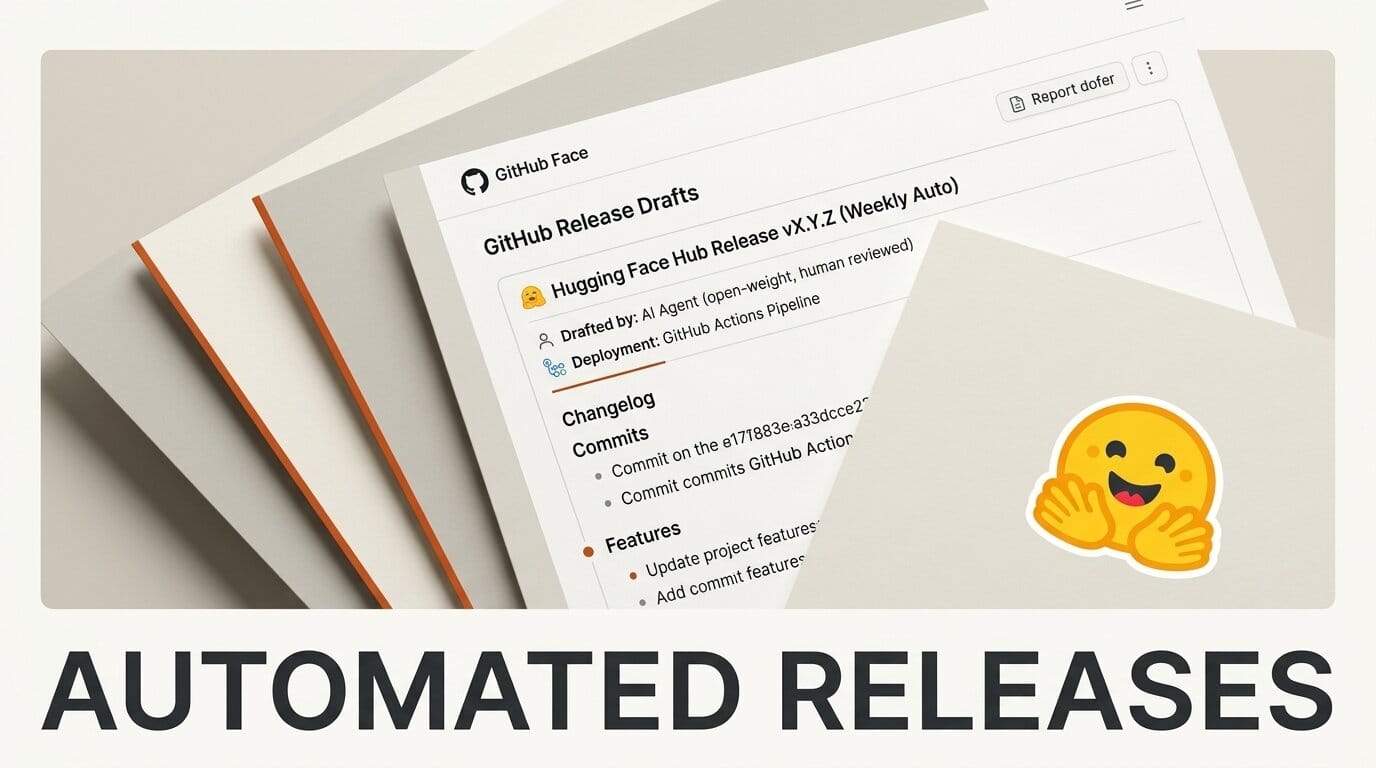
Hugging Face now ships its huggingface_hub Python library every week using a GitHub Actions pipeline that drafts release notes with an open-weight AI model and keeps a human reviewer in the loop. The team detailed the setup on June 23, 2026, replacing a manual process that used to consume roughly half a day of work spread across several days and capped releases at one every four to six weeks.
What Happened
Hugging Face automated the slow, mechanical parts of cutting a release: version bumping, tagging, downstream testing, and publishing to PyPI. The new release workflow then hands the changelog to an AI agent that drafts structured release notes and a Slack announcement from the merged pull requests. A maintainer reviews the draft before anything goes public. The result is a weekly cadence instead of a monthly one, with faster feedback for contributors who now get an automatic "shipped in vX.Y.Z" comment on their merged PRs.
Why It Matters
The interesting part is not the automation itself but the verification design. The pipeline treats the AI as untrusted: it extracts every PR number from the commit history as ground truth, then checks that the model's draft references exactly those PRs, no missing items and no invented ones. If the draft does not match, the workflow re-prompts the model to fix it. That trust-but-verify pattern is the reusable lesson here, and it applies to any creator wiring a language model into a workflow where hallucinated output would cause real damage. The whole stack leans on open tooling, including OIDC-based PyPI Trusted Publishing, so other maintainers can copy it.
Key Details
- Model: The notes are drafted by GLM-5.2, an open-weight model from Z.ai served through Hugging Face Inference Providers.
- Agent runtime: The agent runs on OpenCode, an open-source agent runtime, orchestrated entirely inside GitHub Actions.
- Cost: A full release covering 20 to 40 pull requests costs about $0.25 in inference for both the release notes and the Slack announcement.
- Human gate: No release ships without a maintainer reviewing the AI-drafted notes first.
What to Do Next
If you maintain a package or run any recurring AI-assisted task, steal the verification idea: define a deterministic source of truth, generate with the model, then validate the output against that truth and re-prompt on a mismatch instead of trusting the first answer. You can build the agent half of this on OpenCode and point it at any open-weight model. Start with one low-risk artifact, like a changelog or a weekly summary, where a human still signs off before publishing, and expand only once the validation step proves reliable.