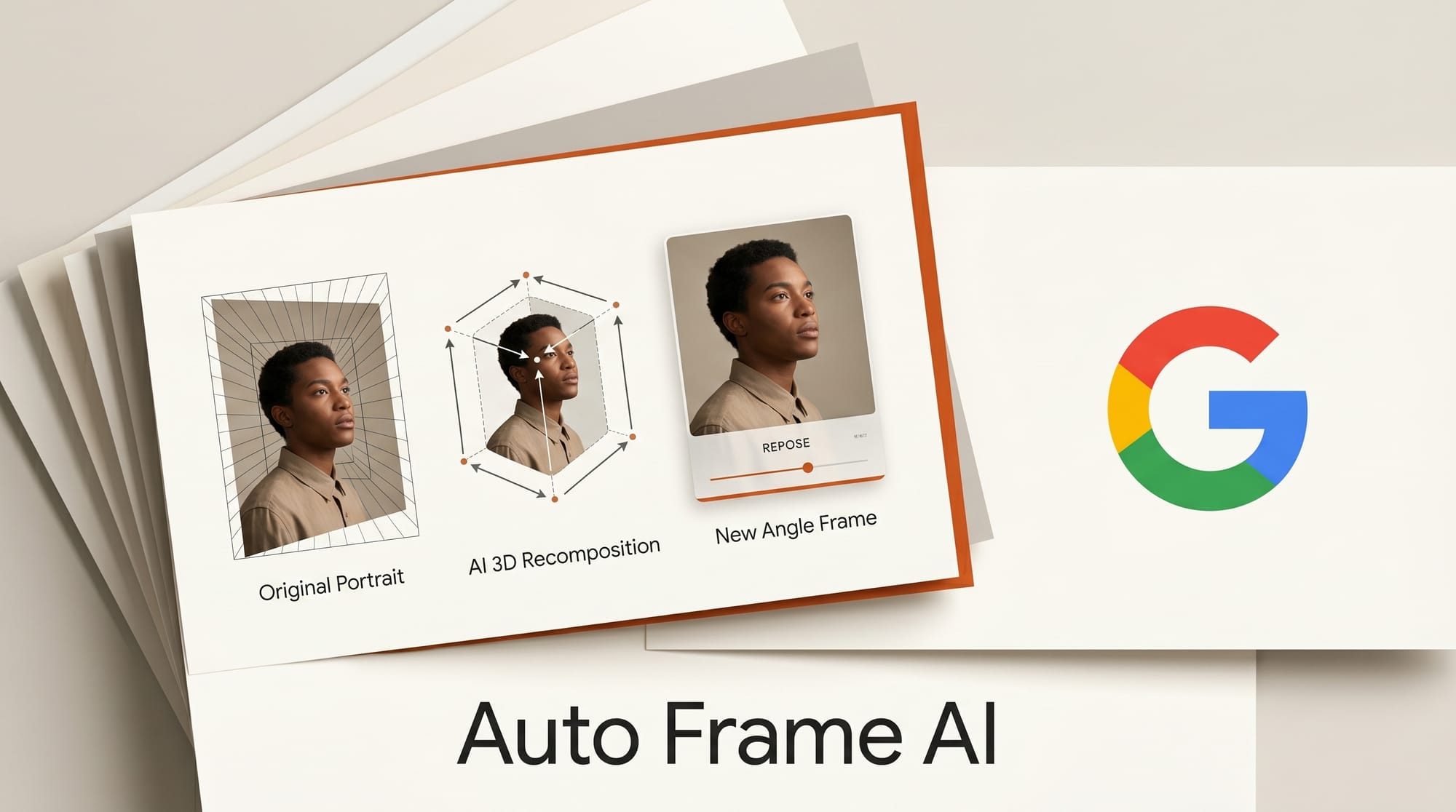
Google Photos launched a new Auto Frame capability on April 22, 2026, that uses AI to recompose portrait photos from a different camera angle. The feature uses Google DeepMind's image models to reconstruct perspectives that the original camera never captured after they were taken. The feature is now live in Google Photos and uses a combination of 3D scene reconstruction and a latent diffusion model to produce a new perspective while preserving the subject.
What Happened
Google DeepMind and Platforms & Devices engineers Marcos Seefelder and Pedro Velez published the technical details behind Auto Frame in a Google Research blog post on April 22, 2026. The feature is described as "fully automatic" and is already available inside the Google Photos Auto frame suggestion pipeline.
Auto Frame works on portrait photos that contain people. When eligible photos appear in your library, Google Photos may offer an Auto frame alternative that adjusts the camera angle, fixes perspective distortion, and fills in any gaps with generative AI.
Why It Matters
For photographers, the most common post-shoot frustration is framing that cannot be recovered with a simple crop. A wide-angle selfie that makes the nose look too large, a portrait where the top of someone's head is clipped, or a group shot taken from the wrong height are all problems that cropping cannot fix because the lost content was never captured. Auto Frame solves this at the pixel level by synthesizing what the camera would have seen from a better position.
This marks a meaningful shift from AI photo editing, which adjusts what was captured, to AI photo reconstruction, which generates what could have been captured. The output is a second rendition alongside the original, not a destructive edit.
Key Details
- Two-stage pipeline: Stage 1 estimates a 3D point map of the scene including camera focal length per pixel. Stage 2 uses a latent diffusion model trained on image pairs with known camera parameters to fill the newly revealed areas.
- Perspective correction: The system detects wide-angle distortion common in selfies and moves the virtual camera back to restore natural facial proportions, without cropping the subject.
- Non-destructive: The adjusted version appears as an Auto frame suggestion in Google Photos alongside the original. The original photo is always preserved.
- Availability: Live now in Google Photos as part of the Auto frame feature set.
- Limitations: Currently focused on portrait and people photos. Generative fill quality depends on scene complexity.
What to Do Next
Open Google Photos and look for the Auto frame suggestion chip on portrait photos in your library. The feature activates automatically on eligible images without any manual steps. If you do not see suggestions yet, the rollout may be reaching your account over the coming days.
Google Photos is a free download on Android via Google Play. For photographers tracking how AI is transforming Google's photo tools, see our earlier coverage of Gemini using your personal Photos library to generate personalized images.
The full technical writeup, including model architecture diagrams, is available on the Google Research blog.