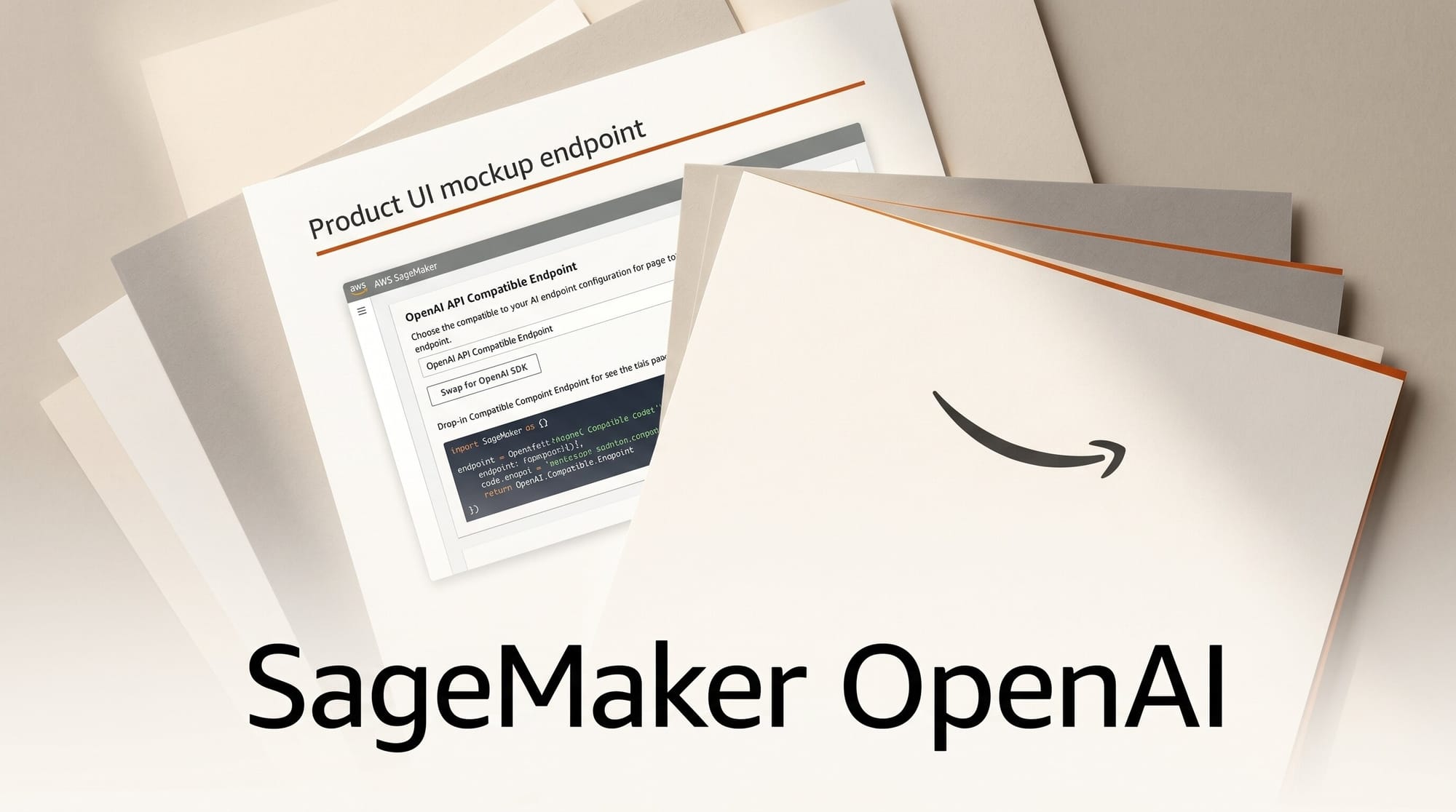
AWS announced OpenAI-compatible API support for Amazon SageMaker AI endpoints on May 21, 2026. Developers can now point the standard OpenAI Python or JavaScript SDK at a SageMaker-hosted model and get back chat completion responses in the familiar OpenAI schema, with no custom adapter layer required.
The launch follows AWS's recent push to host more open-weight model families on SageMaker, including the GPT-OSS models added to SageMaker JumpStart in March, and removes the last major glue-code barrier between OpenAI-SDK-first applications and self-hosted inference on AWS.
How to integrate this in your stack
If your application already calls the OpenAI Python SDK, the migration looks like a one-line change. Set the client's base_url to your SageMaker endpoint's OpenAI-compatible URL and swap the API key for a signed SageMaker invocation token. Existing code that uses client.chat.completions.create() with messages and streaming keeps working against your custom-hosted model.
For teams running multiple models behind one API surface, this replaces hand-rolled translation gateways like the community aws-samples Bedrock access gateway with a first-party AWS pathway. The same client code now hits OpenAI's hosted models, Bedrock's foundation models, and your own SageMaker endpoints with only the base URL changing.
Why it matters for creators building tools
Open-weight models keep getting better, but every OpenAI-SDK-based agent framework, RAG library, or workflow runner historically required custom adapter code to talk to SageMaker. That friction kept most builders on hosted APIs even when a fine-tuned model on their own infrastructure would have been faster or cheaper. With OpenAI-compatible endpoints, agent frameworks like LangChain's ChatOpenAI integration, LlamaIndex, and Strands work against SageMaker out of the box.
The pattern also collapses cost. A model swap from a hosted frontier API to a SageMaker-hosted Llama, Qwen, or GPT-OSS variant is now a config change, not a refactor. For creative AI tools running large inference volumes (image captioning pipelines, transcript generation, batch summarization), this is the difference between testing self-hosting in an afternoon versus a full sprint.
Key details
The compatibility layer maps OpenAI chat completion requests to SageMaker realtime endpoints, supporting standard parameters such as temperature, max_tokens, and streaming, and preserving the messages array structure. Authentication uses SageMaker's existing IAM-based signing rather than bearer tokens, which is invisible if you use the official AWS SDK for the underlying transport.
The launch slots alongside AWS's broader OpenAI integration push this year, which now includes GPT-OSS agentic workflows on Bedrock AgentCore and Bedrock-hosted OpenAI weights. SageMaker's endpoint approach gives builders dedicated capacity and instance-level control that the on-demand Bedrock pathway does not.
What to do next
If you already self-host on SageMaker, the integration is worth a same-day pilot. Route one staging environment through the new compatible endpoint, verify response parity against your current adapter, and identify which OpenAI SDK parameters your stack actually depends on. If you have not deployed on SageMaker before, this is the first launch that makes a JumpStart-deployed open-weight model genuinely interchangeable with OpenAI's hosted API at the code level. The cost arithmetic for a high-volume creative AI workflow now favors a serious pilot, especially for batch inference jobs where token-per-dollar matters more than ultra-low first-token latency.