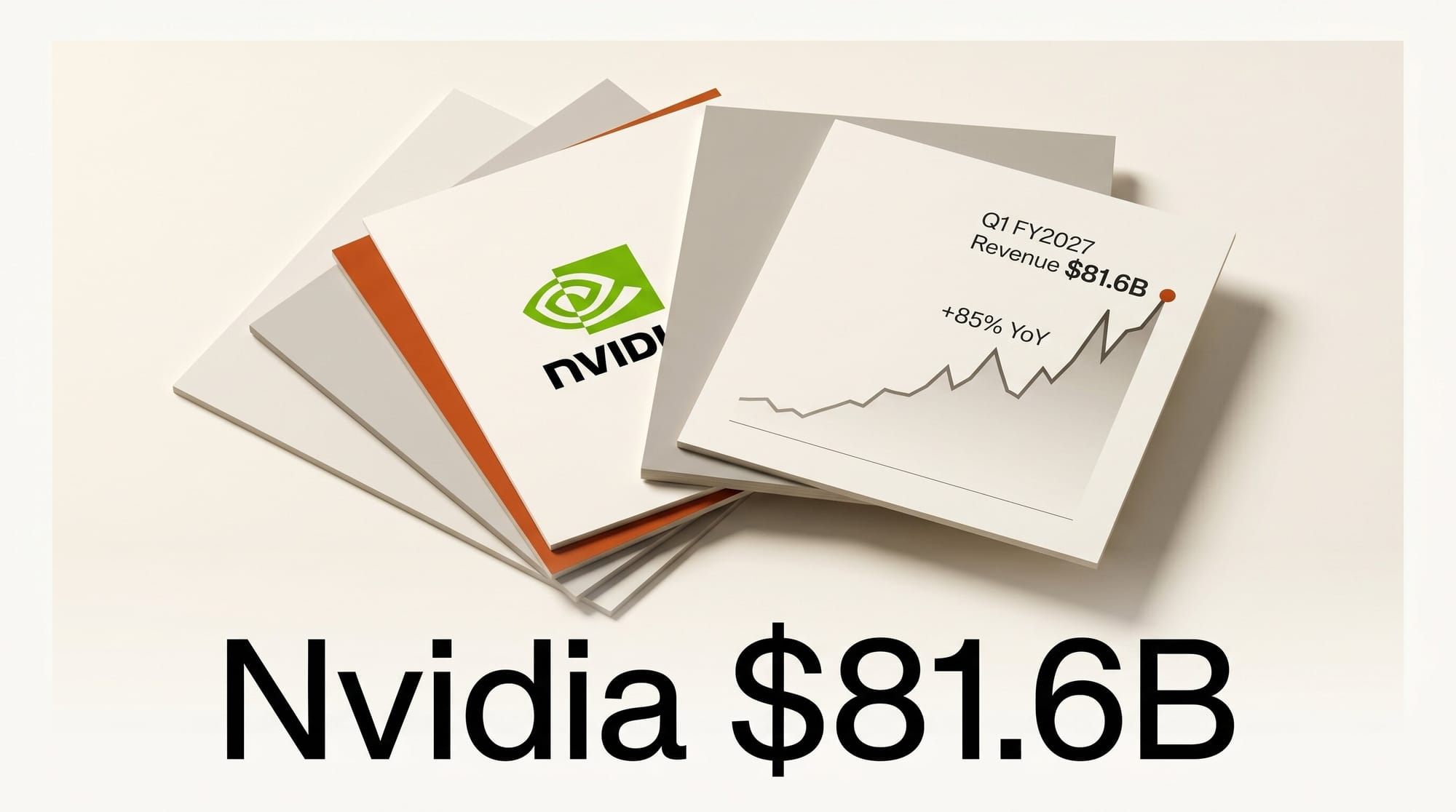
Nvidia reported Q1 FY2027 revenue of $81.6 billion on May 20, 2026, up 85% year-over-year and a new quarterly record. Data center compute revenue of $75.2 billion, up 92%, now represents 92% of total company revenue. Every major AI image generator, video diffusion model, and 3D generation pipeline runs on Nvidia infrastructure, and that infrastructure is scaling faster than any prior technology build-out in history.
What Happened
Nvidia's Q1 FY2027 results set records on every major financial metric. The company posted $81.6 billion in revenue with net income of $58.3 billion (GAAP), up 211% year-over-year. CEO Jensen Huang described the moment as "the largest infrastructure expansion in human history," specifically referencing the global build-out of AI data centers he calls "AI factories." See the full details in the official earnings release.
Q2 FY2027 guidance came in at $91 billion (plus or minus 2%), indicating the pace of growth is not slowing. The company also approved an $80 billion share repurchase program and increased its quarterly dividend 25x, from $0.01 to $0.25 per share.
The Numbers Behind Creative AI Infrastructure

| Segment | Q1 FY2027 Revenue | Year-over-Year Change |
|---|---|---|
| Total Revenue | $81.6 billion | +85% |
| Data Center (total) | $75.2 billion | +92% |
| Data Center Compute | $60.4 billion | +77% |
| Data Center Networking | $14.8 billion | +199% |
| Gaming / Edge Computing | $6.4 billion | +29% |
| Gross Margin | 74.9% (GAAP) | +2.3 pts YoY |
| Q2 FY2027 Guidance | $91.0 billion | +11% QoQ est. |
The 199% growth in data center networking revenue stands out. Faster GPU interconnects mean AI models can be served at higher throughput and lower latency, which directly translates to faster responses in tools like Midjourney, Stable Diffusion API endpoints, Sora, Runway, and every other cloud-based creative AI service.
Alongside the financial results, Nvidia committed $90 billion to AI ecosystem deals, backing developers, cloud providers, and infrastructure firms while taking equity positions in AI companies. Jensen Huang positioned Nvidia as simultaneously customer, supplier, and shareholder across the AI supply chain, a strategy designed to deepen industry reliance on Nvidia hardware and software at every layer from chips to cloud services.
What This Means for Creative AI Tools

The scale of Nvidia's data center build-out affects every paid AI creative tool. When Nvidia ships more H100, H200, and GB200 GPUs, companies like Stability AI, Black Forest Labs, Runway, and OpenAI can train larger models and serve more concurrent users without waitlists or quality degradation.
Jensen Huang's statement that "agentic AI has arrived, doing productive work, generating real value" is not just investor language. It signals that the companies buying Nvidia compute are shifting from experimental AI to production AI at scale. For creators, the tools available today were trained on a fraction of the compute that will be available for the next generation of models.
The RTX PRO 4500 Blackwell Server Edition GPU announced alongside Q1 results targets professional visualization workflows directly. Studios evaluating a GPU refresh cycle now have a clear option with Blackwell-architecture hardware that supports DLSS 5 and the full Nvidia AI SDK stack.
DLSS 4.5 and DLSS 5: AI-Powered Neural Rendering for Creators
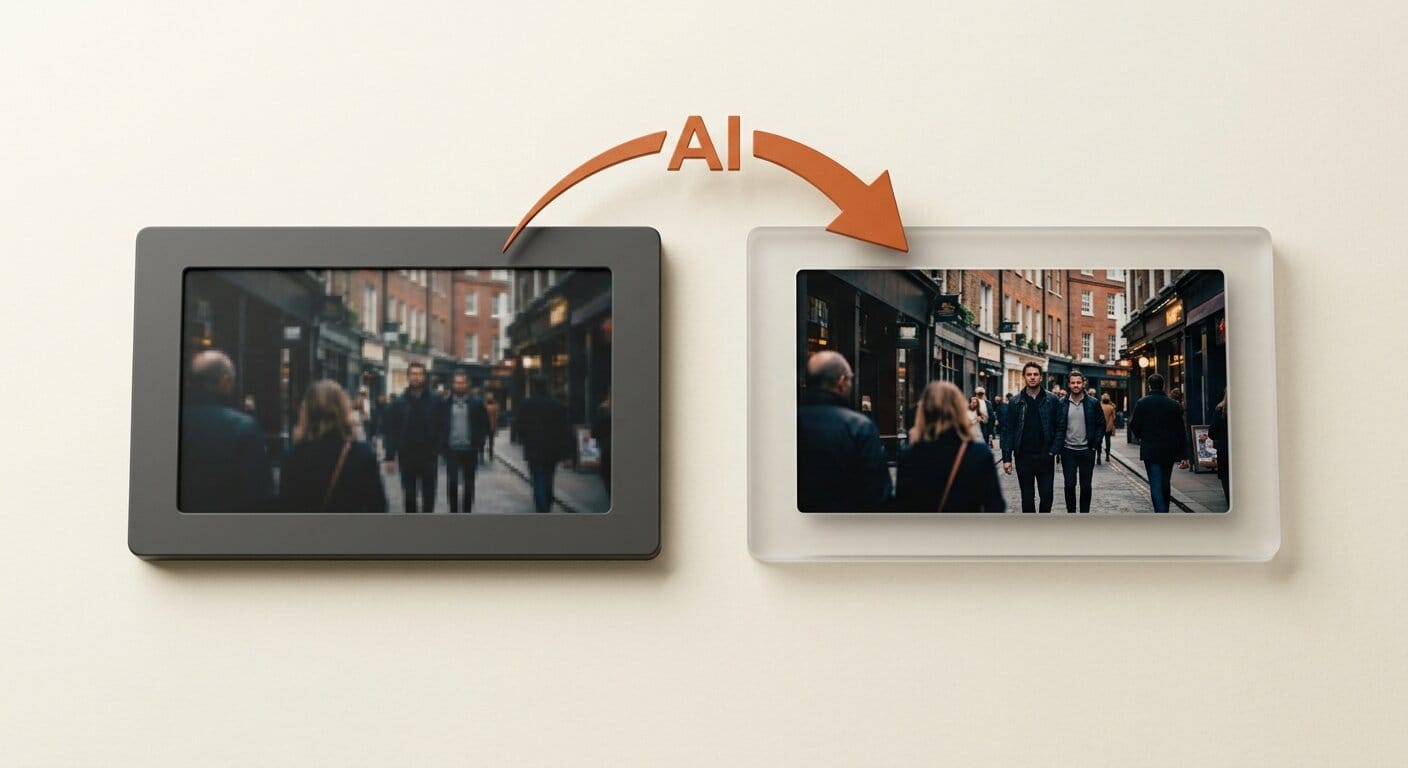
DLSS 4.5, launched at CES 2026, is available now. It uses AI to generate 23 out of every 24 displayed pixels, enabling high-resolution output from lower base render resolutions. Games and real-time 3D applications gain significant performance headroom without sacrificing visual quality.
DLSS 5 (arriving fall 2026) takes a different approach. Rather than upscaling, it performs neural rendering: the AI model ingests per-frame color and motion vectors from the game engine, then enriches the scene with photoreal lighting and material interactions absent from the original geometry. Subsurface scattering on skin, light-material interactions on hair and fabric, and consistent environmental illumination are handled by the AI layer, not the rasterizer.
According to the official DLSS 5 announcement, developers get detailed controls over intensity, color grading, and scene masking, giving artists the ability to preserve creative intent while the AI handles photorealistic enhancement. Tom's Guide called it "the GPT moment for graphics." Initial supported titles include Starfield, Resident Evil Requiem, Assassin's Creed Shadows, and Hogwarts Legacy, with major publishers including Bethesda, CAPCOM, and Ubisoft signed on.
What Creators Should Do Next
- Game developers and real-time artists: Evaluate your DLSS 4 integration now. DLSS 5 uses the same Streamline SDK framework, so the upgrade path from 4.5 to 5 is designed to be additive rather than a full pipeline rewrite. Early adopters during the fall 2026 launch window will have AI-enhanced visuals before competitors. CORSAIR's technical overview covers the rendering architecture in depth.
- AI image and video creators: The data center investment surge means compute capacity constraints will ease over the next two to four quarters. Tools running on Nvidia infrastructure (Runway, Kling, Stable Diffusion cloud APIs) should see improved throughput and new model releases backed by higher training budgets.
- 3D and simulation studios: The RTX PRO 4500 Blackwell Server Edition targets professional visualization workflows directly. If your studio is evaluating a GPU refresh, timing it to the Blackwell Server lineup gives DLSS 5 hardware compatibility and the broader Nvidia AI platform. Check the Nvidia GeForce news hub for the latest supported games and SDK updates.
- All creators using cloud AI tools: The 199% networking revenue growth reflects the shift to faster AI inference clusters. This is the infrastructure layer that will enable real-time AI creative tools, not just offline generation. Expect lower latency and higher-quality outputs across every major AI platform as this capacity comes online through 2026 and 2027.
Frequently Asked Questions
Does DLSS 5 require a new Nvidia GPU?
DLSS 5 is optimized for RTX 40 and RTX 50 (Blackwell) series GPUs, which include the Tensor Cores needed for real-time neural rendering at full performance. Earlier DLSS versions continue to work on RTX 20 and 30 series hardware. If you are on an older GPU, DLSS 4.5 with Multi Frame Generation is the best option available now.
When does DLSS 5 launch and how do I get access?
DLSS 5 is scheduled for fall 2026. It will be delivered through the Nvidia app and via game-specific updates for supported titles. DLSS 4.5 with Dynamic Multi Frame Generation is available today for RTX 40 series GPUs and above through the Nvidia app.
How does Nvidia's revenue growth affect AI tool pricing for creators?
High demand for Nvidia GPUs has kept cloud AI compute prices elevated over the past two years. As the scale of new data center capacity comes online through 2026 and 2027, increased supply should stabilize or reduce inference costs. The companies building AI creative tools will have more resources to invest in model quality rather than managing compute scarcity.
What is the RTX PRO 4500 Blackwell Server Edition?
It is a professional visualization GPU in Nvidia's Blackwell server family, designed for workstation and cloud-hosted creative workflows. It supports real-time ray tracing, the full DLSS stack, and Nvidia's AI SDK suite used by professional 3D, simulation, and visual effects applications. It targets studios running remote workstation infrastructure rather than individual desktop users.
What does "agentic AI" mean for creative workflows?
Agentic AI refers to systems that break complex tasks into sub-tasks, execute them in sequence, and adapt based on intermediate results. In creative workflows, this means tools that can orchestrate multi-step generation processes autonomously: draft a layout, refine selected regions, generate variations, and integrate feedback without manual prompting at each step. Nvidia's infrastructure build-out is specifically sized to support this kind of compute-intensive, multi-step workload at scale, which is why the company is investing so heavily in networking alongside raw compute.