Meshy AI announced a direct integration with Formlabs Form Now on April 14, 2026, debuting at RAPID+TCT 2026 in Boston. The partnership shrinks the gap between an AI-generated 3D model and a manufactured physical part to under five minutes from prompt to order, with delivery in as little as 48 hours. It is the first time a generative AI 3D platform has connected text-to-3D creation directly to professional-grade SLA and SLS printing fulfillment.
Background
Meshy has spent two years scaling its text-to-3D and image-to-3D pipeline. The platform reports over 10 million creators and more than 100 million models generated to date. Its core value has always been speed of generation: a clean, riggable mesh in roughly 30 seconds from a single prompt. The persistent gap was what happened after generation. Most AI-generated meshes were not slicer-ready. Cleanup, geometry repair, scale calibration, and material selection required either CAD experience or a willingness to send broken files to a print farm and hope.
Formlabs is the production-grade end of the desktop 3D printing market. Its Form Now on-demand service runs SLA and SLS printers out of a Billerica, Massachusetts facility and ships finished parts globally. Until this integration, sending an AI-generated model to Form Now required exporting an STL, opening it in third-party repair software, fixing manifold errors, validating wall thicknesses, and uploading to the Form Now portal as a separate flow.
Deep Analysis
The Workflow Collapse: Five Minutes From Prompt To Order
The integration eliminates four discrete tools from the previous pipeline. A creator opens Meshy, enters a prompt or uploads a reference image, generates a mesh, clicks "Print with Form Now," picks a material and color, and confirms the order. That is the full workflow. Meshy handles automatic mesh repair and geometry optimization before handoff. Formlabs handles fulfillment.
The five-minute figure is the headline because it crosses a usability threshold. Anything that takes more than ten minutes from creative impulse to order placement gets pushed to "I'll deal with it later" and frequently dies in the backlog. Five minutes is short enough that a tabletop game designer can iterate three figurine concepts during a lunch break and have all three on the way to print before the meeting after.
The 48-hour turnaround on the Formlabs side closes the loop. Iteration cycles that used to span weeks (design, repair, validate, send to print farm, wait for quote, wait for fabrication, wait for shipping) now span days. That changes what kinds of products are economically feasible to prototype.
Why The 97% Slicer Pass Rate Matters
The headline workflow only works if the generated meshes actually print. Most AI-generated 3D output fails at the slicer stage: non-manifold geometry, inverted normals, floating fragments, walls thinner than the printer's resolution, internal cavities that trap uncured resin. A typical raw text-to-3D mesh sent unprepared to an SLA printer succeeds maybe 40 to 60 percent of the time, and that is being generous.
Meshy reports a 97% slicer pass rate on character and figurine models after its automatic repair pass. That number is the actual technical achievement here. Without it, the five-minute workflow is a marketing line. With it, the workflow is a real production tool.
The pass rate is highest on the model categories Meshy was trained on (characters, figurines, props). Industrial parts and functional mechanical components will have lower rates. But for the consumer creator market the integration is targeting (tabletop gaming, collectibles, hobbyist prototyping), 97% is the kind of reliability that turns "novelty" into "tool."
The Hardware Ecosystem: Formlabs, xTool, Snapmaker, Flashforge
The Formlabs deal is the headline, but Meshy named three additional hardware partners in the same announcement: xTool (laser cutting), Snapmaker (multi-tool printers), and Flashforge (FDM). Bambu Lab is also part of the ecosystem via Bambu Studio export support. Full-color 3D printing partnerships are scheduled for later in 2026.
The breadth signals strategy. Meshy is not betting on a single fabrication technology. It is positioning the platform as the AI front-end to whatever physical-output chain a creator can access. SLA and SLS via Formlabs for production-grade parts. FDM via Flashforge or Bambu for cheap prototyping at home. Laser cutting via xTool for flat fabrication. The same generated mesh, depending on the use case, can route to the right machine.
The competitor here is not another AI 3D tool. It is the existing manual workflow that requires a human to choose the right export, run the right repair tool, and deliver to the right machine. Meshy is consolidating that decision-making inside the AI layer.
From Screen To Studio: AI 3D's Manufacturing Moment
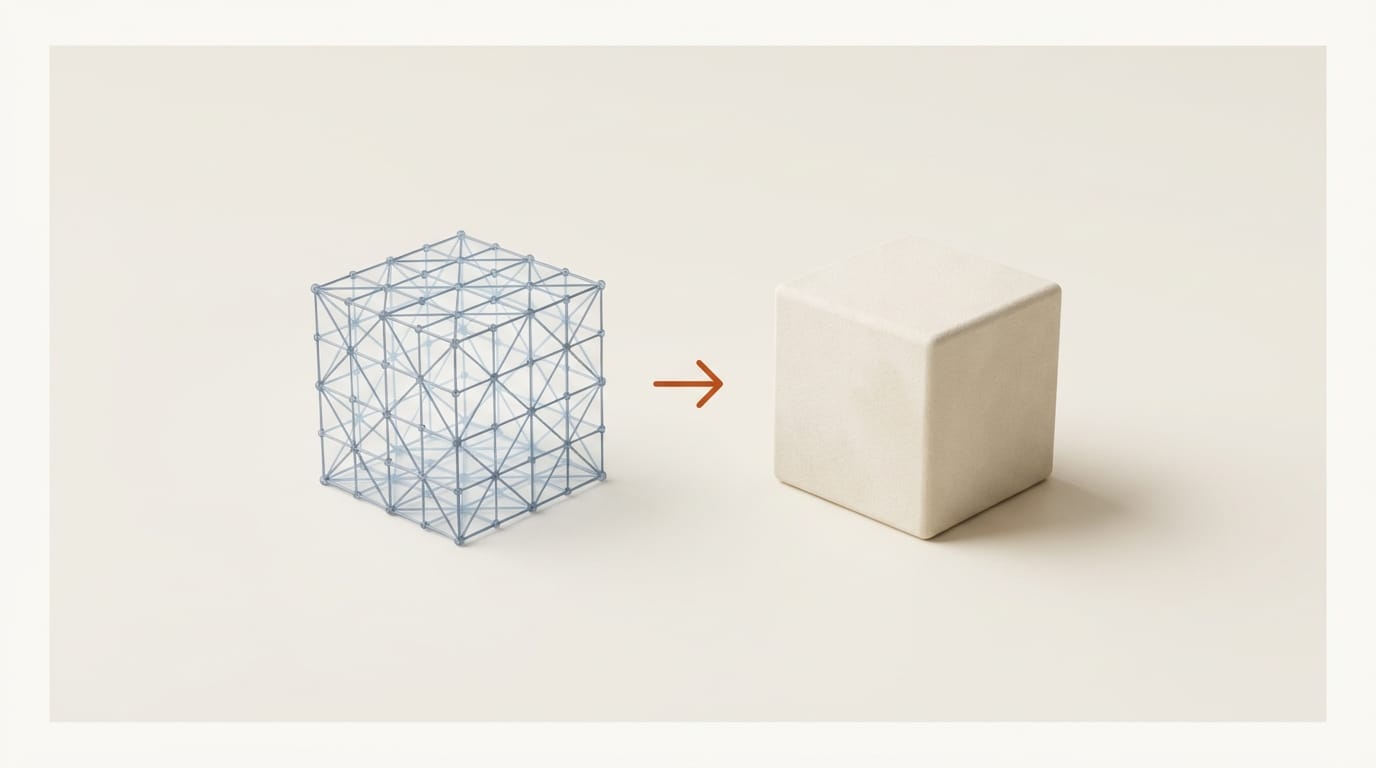
Until recently, AI-generated 3D models lived inside the screen. They populated game scenes, animated characters, decorated VR environments. The path to a physical object required someone with CAD experience to convert and clean before any printer touched the file.
That barrier is collapsing fast. The Meshy and Formlabs partnership is the most polished example, but it is part of a broader trend. Tripo, OpenArt, and Autodesk Wonder 3D have all announced or shipped variants of the same idea: AI generation feeding directly into manufacturing or fabrication workflows. The market signal is clear. Generative 3D is moving from a creative novelty to a production tool, and the path to physical is the differentiator the next generation of platforms will compete on.
For the creator economy specifically, this matters because it unlocks new product categories. Custom miniatures sold to order. Personalized props for content creators. Small-batch design objects from independent studios. Anything that previously required a CAD-trained collaborator now requires only a prompt and a credit card.
Impact on Creators
The most immediate impact is on tabletop gaming creators, miniature painters, prop designers, and figurine collectors. The complete pipeline from prompt to physical part is now accessible to anyone willing to spend a few minutes in Meshy and the price of a Formlabs print order. No CAD skill required. No third-party repair software. No wait for a print farm quote.
Beyond the consumer creator market, product designers and rapid prototyping teams get a faster iteration loop. Concept-to-physical in days instead of weeks changes how often a team can test ideas in physical form. That compresses development cycles for hardware startups, design studios, and educational settings where touchable iteration matters.
The integration also lowers the floor for who can make physical products at all. The barrier was never the printer. Formlabs and others have been accessible for years. The barrier was the gap between creative intent and a machine-ready file. That gap just got a lot smaller.
Key Takeaways
- Meshy AI now offers direct text-to-physical printing through Formlabs Form Now. Full workflow under five minutes from prompt to order.
- Turnaround is as fast as 48 hours from order to delivery. SLA and SLS printing fulfilled from Billerica, Massachusetts.
- Meshy reports 97% slicer pass rate on character and figurine models after automatic mesh repair, removing the most common failure mode in AI-to-print workflows.
- Hardware partners include Formlabs (SLA/SLS), xTool (laser cutting), Snapmaker (multi-tool), and Flashforge (FDM). Full-color 3D printing partnerships planned for later in 2026.
- Export formats supported: STL, OBJ, GLB, FBX, and 3MF. Free tier offers 100 monthly credits to test the pipeline.
- Meshy reports over 10 million creators and 100 million models generated to date.
What to Watch
Two signals will tell us whether AI-to-manufacturing becomes the next competitive frontier in generative 3D. The first is volume. If Meshy publishes order volume through the Form Now integration in the next quarter, that data will indicate whether casual creators actually convert from generation to physical output, or whether the workflow stays in the "interesting demo" tier.
The second is competitive response. If Tripo, OpenArt, or Autodesk Wonder 3D announce comparable manufacturing partnerships in the next two months, the entire AI 3D market is repositioning around physical output as the differentiator. If they do not, Meshy carves out a defensible niche as the production-grade AI 3D platform. Either outcome reshapes the category. For the broader landscape, see our State of AI 3D Generation and Spatial Computing analysis.