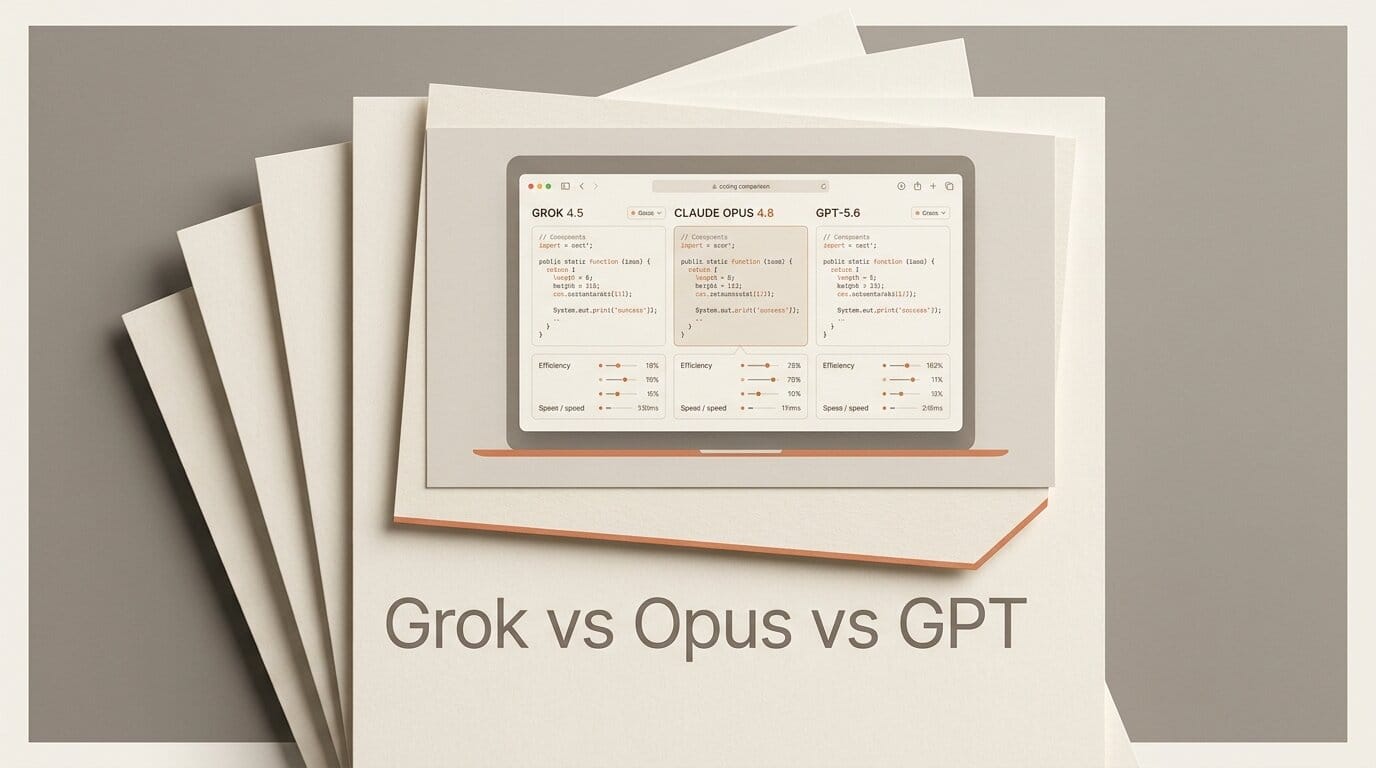
If you write code with an AI model, three frontier options now sit within a few points of each other on the hardest agentic benchmarks: Grok 4.5 from SpaceXAI and Cursor, Claude Opus 4.8 from Anthropic, and GPT-5.6 Sol from OpenAI. The short verdict: Grok 4.5 is the value play (Opus-class coding at a fraction of the token cost), Opus 4.8 is the reliability anchor for long agentic runs, and GPT-5.6 Sol is the raw ceiling on terminal-style tasks. The numbers below come from each vendor's own launch materials and third-party writeups, so treat cross-model comparisons as directional, not lab-controlled: benchmarks like Terminal-Bench are sensitive to harness and methodology, and Grok 4.5's published table notes that some competitor scores are self-reported.
Quick Picks
Pick Grok 4.5 if you live inside Cursor and care about cost per task. It resolves a competitive share of SWE-Bench Pro while using roughly 4.2 times fewer tokens than Opus 4.8 at max effort, and it costs $2 per million input tokens.
Pick Claude Opus 4.8 if your workflow is long, multi-file, and unforgiving of drift. It leads the active SWE-Bench Pro leaderboard and holds the highest SWE-Bench Verified score of the three, which is the set most people still trust for real bug-fixing.
Pick GPT-5.6 Sol if you want the highest agentic-terminal ceiling and can absorb premium output pricing, especially the Sol Ultra high-effort mode.
The Benchmarks, Head to Head

All three models were built for agentic coding, not chat, so the benchmarks that matter are the ones that measure resolving real repository issues and driving a terminal to completion. Here is how the published numbers line up.
| Metric | Grok 4.5 | Claude Opus 4.8 | GPT-5.6 Sol |
|---|---|---|---|
| SWE-Bench Pro | 64.7% | 69.2% | Not disclosed |
| Terminal-Bench 2.1 | 83.3% | 74.6% | 88.8% (Ultra 91.9%) |
| SWE-Bench Verified | Not disclosed | 88.6% | Not disclosed |
| Context window | 500K tokens | 200K standard | Not disclosed |
| Speed | ~80 tokens/sec | Not disclosed | Up to 750/sec on Cerebras |
| Input price /M | $2.00 | $5.00 | $5.00 |
| Output price /M | $6.00 | $25.00 | $30.00 |
SWE-Bench Pro: Opus still leads on hard repos
On SWE-Bench Pro, the enterprise-grade set of harder, longer repository tasks, Opus 4.8 lands at 69.2% and holds the top active slot, roughly 5 points ahead of Grok 4.5's 64.7%. GPT-5.6 Sol has not published a directly comparable Pro number at launch, so on this specific set the honest read is Opus first, Grok a close second. What makes Grok's number notable is not the score but the efficiency behind it, which the pricing section unpacks.
Terminal-Bench 2.1: GPT-5.6 Sol takes the ceiling
Flip to Terminal-Bench 2.1, which grades a model's ability to operate a shell end to end, and the order changes. GPT-5.6 Sol posts 88.8%, with the Sol Ultra high-effort mode reaching 91.9%, ahead of Grok 4.5's 83.3% and well ahead of Opus 4.8's 74.6%. This is the benchmark most sensitive to harness differences, so the gap between Sol and Grok is real but narrower in practice than the headline suggests. The takeaway: for autonomous terminal loops, Sol currently sets the bar.
SWE-Bench Verified: the set that still anchors trust
On the original 500-problem SWE-Bench Verified set, Opus 4.8 reports 88.6%. Neither Grok 4.5 nor GPT-5.6 Sol foregrounded a Verified score in launch materials, which is telling: Verified is the most-scrutinized coding benchmark, and Anthropic continues to lead the disclosures there. If your definition of a good coding model is one that closes real GitHub issues cleanly, Verified is the number to weight, and Opus owns it among these three.
Speed, Context, and Token Efficiency

Raw benchmark parity means the practical differences decide the pick. Grok 4.5 ships a 500K-token context window, the largest of the three, which matters when you point an agent at a sprawling monorepo and want it to hold the whole thing in view. It serves at about 80 tokens per second, fast enough for interactive editing without feeling like a batch job.
GPT-5.6 Sol's throughput story is different: OpenAI is running Sol on Cerebras hardware at up to 750 tokens per second for select customers, which turns long agentic runs into near-instant loops when you have access. Opus 4.8 does not headline a speed number and is the most deliberate of the three, trading latency for stability on long tasks.
The efficiency gap is where Grok 4.5 separates from the pack. On SWE-Bench Pro tasks it uses roughly 4.2 times fewer tokens than Opus 4.8 at maximum effort to reach a comparable result. Fewer tokens per task compounds: it lowers cost, shortens latency, and stretches a fixed context budget further across a session.
When Each Model Wins

Grok 4.5 wins for the working developer inside Cursor, where it is available on desktop, web, iOS, the CLI, and the SDK across individual and team plans. It was trained on trillions of tokens of Cursor interaction data, so it behaves like a model that has watched real people wrestle with real codebases. It also powers Grok Build, SpaceXAI's terminal coding agent, and the standalone Grok 4.5 launch details cover its rollout in full. If you run many small-to-medium agentic tasks per day, its token efficiency and $2 input price make it the cheapest way to get near-frontier coding output.
Claude Opus 4.8 wins the reliability contest. Its SWE-Bench Verified and Pro leads mean it drifts less on the long, multi-file refactors where a single wrong assumption cascades. Teams that let an agent run for tens of minutes without a human in the loop tend to trust Opus for exactly this reason, and it is the model to reach for when correctness outranks cost.
GPT-5.6 Sol wins the ceiling. Its Terminal-Bench lead, and the 91.9% Sol Ultra mode, make it the strongest choice for fully autonomous terminal agents that need to plan, execute, and self-correct across a shell. The catch is price and access: Sol carries the highest output cost of the three and rolled out to the public on July 9 after a staged preview, as our GPT-5.6 Sol, Terra, and Luna breakdown details.
Pricing and ROI
Cost is where the comparison stops being academic. Grok 4.5 is $2 per million input tokens, $0.50 cached, and $6 per million output tokens, with a faster variant at $4 and $18. Opus 4.8 is $5 in and $25 out. GPT-5.6 Sol is $5 in and $30 out, while its cheaper siblings Terra ($2.50/$15) and Luna ($1/$6) exist for lighter work. Put those against the efficiency data and the picture sharpens: Grok 4.5 is both the cheapest per token and the leanest per task, so for high-volume agentic coding it can cost a fraction of what Opus or Sol run to reach a similar result. Opus and Sol earn their premium only when their reliability or ceiling actually changes the outcome, which for hard, long-horizon work they often do. The rational stack for many teams is Grok 4.5 as the default and Opus or Sol as the escalation model when a task justifies it.
What to Watch
Three things will move this ranking fast. First, independent leaderboards: most of these scores are vendor-published, and neutral runs on SWE-Bench Verified and Terminal-Bench will either confirm or compress the gaps. Second, availability: Grok 4.5 is not in the EU until mid-July, GPT-5.6 Sol is still expanding from its staged rollout, and access shapes which model teams can actually standardize on. Third, the escalation-routing pattern: as token costs diverge this widely, the interesting workflow is no longer picking one model but routing cheap tasks to Grok 4.5 and hard ones to Opus or Sol automatically. The frontier coding race in mid-2026 is less about a single winner than about which model you make your default and which you keep in reserve.
Frequently Asked Questions
Is Grok 4.5 really Opus-class at coding?
On SWE-Bench Pro it trails Opus 4.8 by about 5 points (64.7% vs 69.2%), so it is close but not ahead on the hardest set. On Terminal-Bench 2.1 it leads Opus. The fairer framing is that Grok 4.5 delivers near-Opus coding quality at a fraction of the token cost, which is the claim that actually holds up.
Which model is cheapest for heavy coding use?
Grok 4.5, by a wide margin. It has the lowest input and output prices of the three and uses roughly 4.2 times fewer tokens than Opus 4.8 at max effort on SWE-Bench Pro tasks, so cost per completed task is dramatically lower for high-volume work.
Do these benchmark numbers compare apples to apples?
Not perfectly. The scores come from each vendor's own materials, and benchmarks like Terminal-Bench are sensitive to the harness used. Treat the rankings as directional and weight SWE-Bench Verified, the most-scrutinized set, most heavily when the numbers disagree.
Where can I use each model today?
Grok 4.5 is live in Cursor, Grok Build, and the SpaceXAI API console, with EU access expected mid-July. Opus 4.8 is available through Anthropic's API and Claude apps. GPT-5.6 Sol reached public availability on July 9 through OpenAI, following a staged preview.
Should I pick one model or route between them?
For most teams the highest-ROI setup is routing: make Grok 4.5 the default for its cost and speed, then escalate to Opus 4.8 for long, correctness-critical refactors or to GPT-5.6 Sol for autonomous terminal work. The token-cost spread between them is now wide enough that routing saves real money.