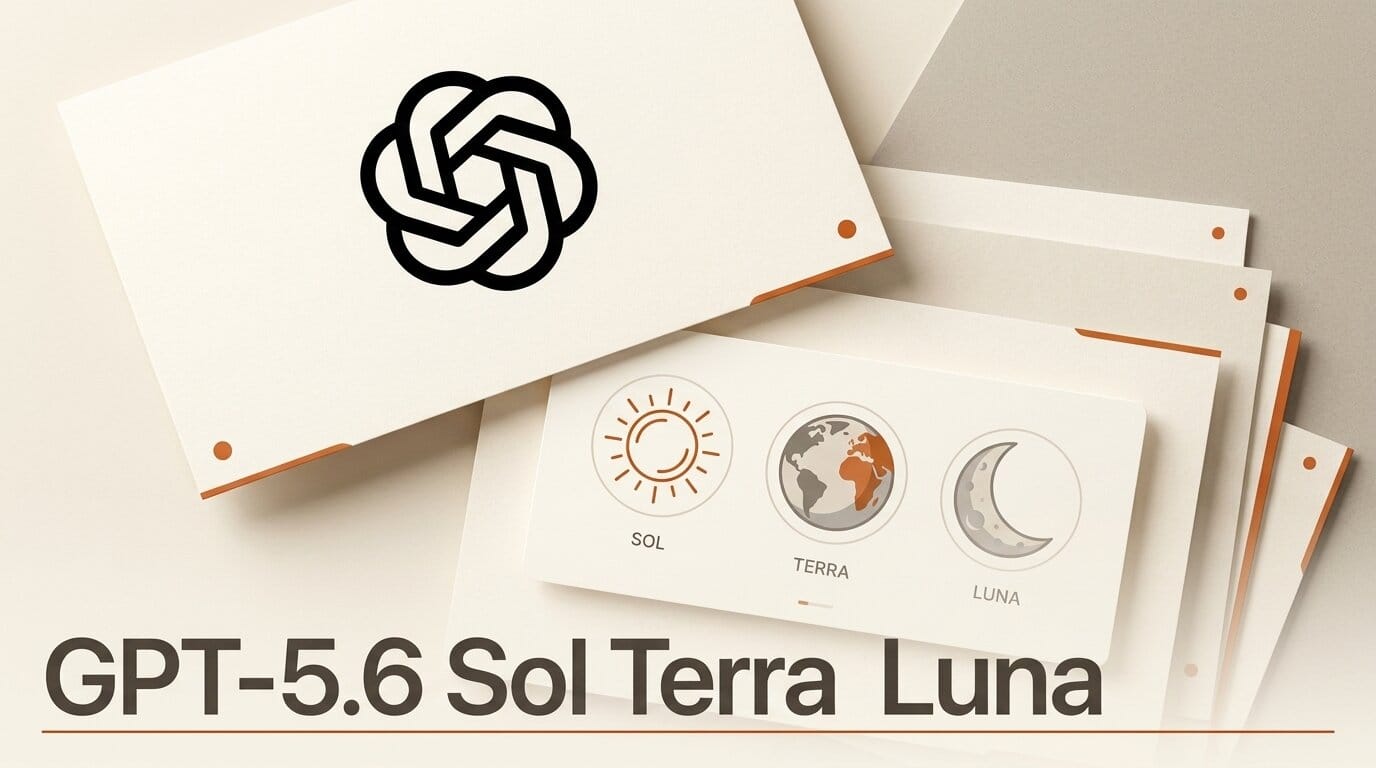
OpenAI moved its GPT-5.6 family to general availability on July 9, 2026, and for the first time the release is not a single model. GPT-5.6 ships as three named tiers, Sol, Terra, and Luna, that share a generation but sit at different points on the capability-versus-cost curve. Sol is the flagship at $5 per million input tokens and $30 per million output tokens, Terra is the balanced everyday tier at $2.50 and $15, and Luna is the cost-efficient option at $1 and $6. According to MarkTechPost's launch analysis, the tiers are designed to advance on their own cadence rather than being retired together, which changes how creators and developers should think about picking a model.
This is the biggest structural change to OpenAI's lineup since the GPT-5 series launched. Instead of guessing whether the "mini" or "full" variant fits a task, you now choose a durable tier by workload. Below is the full breakdown: what each tier is for, how they benchmark against Claude Fable 5 and GPT-5.5, the new Responses API features that ship alongside them, and a practical guide to choosing a tier for real creative and coding workflows.
What OpenAI shipped
The number in GPT-5.6 identifies the generation. Sol, Terra, and Luna identify capability tiers that persist across generations. OpenAI frames Sol as the highest reasoning ceiling, Terra as the balanced default, and Luna as the lightweight, lowest-cost variant. All three are available in the API at general availability, in ChatGPT for Plus, Pro, Business, and Enterprise, and inside the new ChatGPT Work desktop app and Codex across Free, Go, and paid tiers.
The launch followed a limited preview that opened June 26, 2026, and public availability began July 9 after a government capability review. Availability is already broad: OpenAI's official GPT-5.6 announcement lists Chat, Work, Codex, and API access on day one, and GitHub shipped all three tiers to Copilot the same day.

Sol vs Terra vs Luna: the tier comparison
Two capability modes worth knowing. Sol adds a new max reasoning effort level that gives it the most time to reason on a single hard problem, above the existing effort tiers. Reach for it when correctness on a gnarly bug or a multi-constraint plan matters more than speed. Ultra mode takes a different path, using internal subagents to break a task apart and work beyond a single pass, aimed at long multi-part jobs like refactoring across a codebase or running a research-and-synthesize loop end to end.
The three tiers are best understood by the job each is built for. Sol targets complex reasoning over large codebases and long-running agentic work. Terra is the strong all-round choice for everyday interactive and agentic coding. Luna handles smaller, faster tasks where cost and latency matter most. Per the GitHub Copilot changelog, Sol is restricted to Copilot Pro+, Max, Business, and Enterprise, while Terra and Luna are available on Pro as well.
| Tier | Role | Input / Output (per 1M tokens) | Best for |
|---|---|---|---|
| Sol | Flagship, highest reasoning ceiling | $5 / $30 | Large codebases, long agentic runs |
| Terra | Balanced default | $2.50 / $15 | Everyday interactive and agentic coding |
| Luna | Lightweight, cost-efficient | $1 / $6 | Fast, high-volume, smaller tasks |
The pricing spread is deliberate. Luna costs one fifth of Sol on input and output, so a workflow that fans out thousands of short calls can drop to Luna without the per-token bill exploding, then escalate to Sol only for the hard reasoning step. Independent pricing breakdowns from Finout and Crypto Briefing both confirm the same three-tier rate card.
Benchmarks: where each tier lands
The tiers degrade gracefully. Even Luna stays close to Sol on most agentic evals, which is what makes the cheap tier usable for real work rather than a toy. The headline result is that Sol leads the Artificial Analysis Coding Agent Index, edging out Claude Fable 5, while still trailing Claude Mythos 5 on raw SWE-Bench Pro.
| Benchmark | Sol | Terra | Luna | Reference |
|---|---|---|---|---|
| AA Coding Agent Index v1.1 | 80 | 77.4 | 74.6 | Claude Fable 5: 77.2 |
| SWE-Bench Pro | 64.6% | 63.4% | 62.7% | Claude Mythos 5: 80.3% |
| Terminal-Bench 2.1 | 88.8% | 87.4% | 84.7% | GPT-5.5: 85.6% |
| Agents' Last Exam | 52.7% | 50.4% | 50.3% | Fable 5: 40.5% |
Two things stand out. First, Sol's Terminal-Bench 2.1 score of 88.8% beats GPT-5.5 by more than three points, and OpenAI's new multi-agent "ultra" mode lifts that to 91.9% by running four agents in parallel. Second, the gap between Sol and Luna on the Coding Agent Index is only about five points, so for most day-to-day tasks Luna's fivefold cost saving is the better trade. Live benchmark tracking is available at Artificial Analysis.

What is new in the Responses API
The tier structure is the headline, but the API changes matter just as much for anyone building agents. GPT-5.6 introduces programmatic tool calling in the Responses API: instead of the model emitting one tool call at a time and waiting, it writes JavaScript that runs in an isolated V8 runtime with no network access, orchestrating multiple tools in a single turn. Named early customers reported token reductions of 38% to 63.5%, because the back-and-forth chatter between model and tools collapses into one code block.
Alongside it, the Responses API now keeps reasoning state across turns instead of discarding it. Previously each turn started cold and the model rebuilt its chain of thought from scratch. Persisted reasoning means a multi-turn agent carries its intermediate work forward, cutting both latency and repeated token spend on long tasks. Prompt caching also became more predictable, with explicit cache breakpoints and a 30-minute minimum cache life. Cache writes bill at 1.25 times the uncached input rate, and cache reads keep the 90% discount.
There is also a multi-agent beta in the Responses API, the same "ultra" mode that powers the Terminal-Bench jump, so the parallel-agent pattern is not locked to ChatGPT Work and Codex.

How to choose a tier for your workflow
Here is a practical way to map the three tiers onto real creative and development work, so you are not paying flagship rates for tasks that do not need them.
- Start on Terra for interactive work. Everyday coding, drafting, and agentic sessions run well on the balanced tier at $2.50 in and $15 out. It matches GPT-5.5-class quality without Sol's premium.
- Escalate to Sol only for the hard step. Reserve the flagship for large-codebase refactors, long autonomous runs, and reasoning-heavy planning where the extra points on the Coding Agent Index change the outcome.
- Route high-volume calls to Luna. Classification, extraction, short generations, and any fan-out pattern belong on the $1 / $6 tier. The quality gap is small and the cost saving is fivefold.
- Turn on programmatic tool calling for multi-tool agents. If your agent calls three or more tools per task, the V8 orchestration path can cut your token bill by a third or more.
- Use cache breakpoints for repeated context. Long system prompts and shared document context should sit behind an explicit cache breakpoint to claim the 90% read discount.
This tiering also changes budgeting. Because Sol, Terra, and Luna advance independently, a workflow you build today against Terra should keep improving as that tier is upgraded, without a forced migration to a differently-priced model. For coding-tool users, GPT-5.6 now sits directly against options like the Grok 4.5 coding model that shipped days earlier, and OpenAI's broader push continues from its recent full-duplex voice release.
Frequently asked questions
What do Sol, Terra, and Luna mean?
They are the three capability tiers of GPT-5.6, named after the Sun, Earth, and Moon. Sol is the flagship with the highest reasoning ceiling, Terra is the balanced everyday tier, and Luna is the fastest, lowest-cost option. Unlike a version number, the tier names persist across future generations.
How much does GPT-5.6 cost?
Per million tokens: Sol is $5 input and $30 output, Terra is $2.50 and $15, and Luna is $1 and $6. Cache reads receive a 90% discount, and cache writes bill at 1.25 times the uncached input rate with a 30-minute minimum cache life.
Is GPT-5.6 better than Claude for coding?
It depends on the benchmark. Sol leads the Artificial Analysis Coding Agent Index at 80, ahead of Claude Fable 5 at 77.2, but Claude Mythos 5 still leads raw SWE-Bench Pro at 80.3% versus Sol's 64.6%. For agentic terminal work, Sol's 88.8% on Terminal-Bench 2.1 is the strongest in the family.
What is programmatic tool calling?
A new Responses API feature where the model writes JavaScript that runs in a sandboxed V8 runtime with no network access, orchestrating several tools in one turn instead of emitting one call at a time. Early customers reported token reductions of 38% to 63.5%.
Can I use GPT-5.6 in GitHub Copilot?
Yes. All three tiers are available in Copilot as of July 9, 2026. Sol requires a Pro+, Max, Business, or Enterprise plan, while Terra and Luna are also available on Pro. Enterprise and Business admins must enable the GPT-5.6 policy in Copilot settings, since it is off by default.
Which tier should I default to?
Terra for most interactive and agentic coding, Luna for high-volume or latency-sensitive tasks, and Sol only for the hardest reasoning steps such as large-codebase refactors and long autonomous runs. The small quality gap between Luna and Sol makes the cheaper tiers the right default for most work.