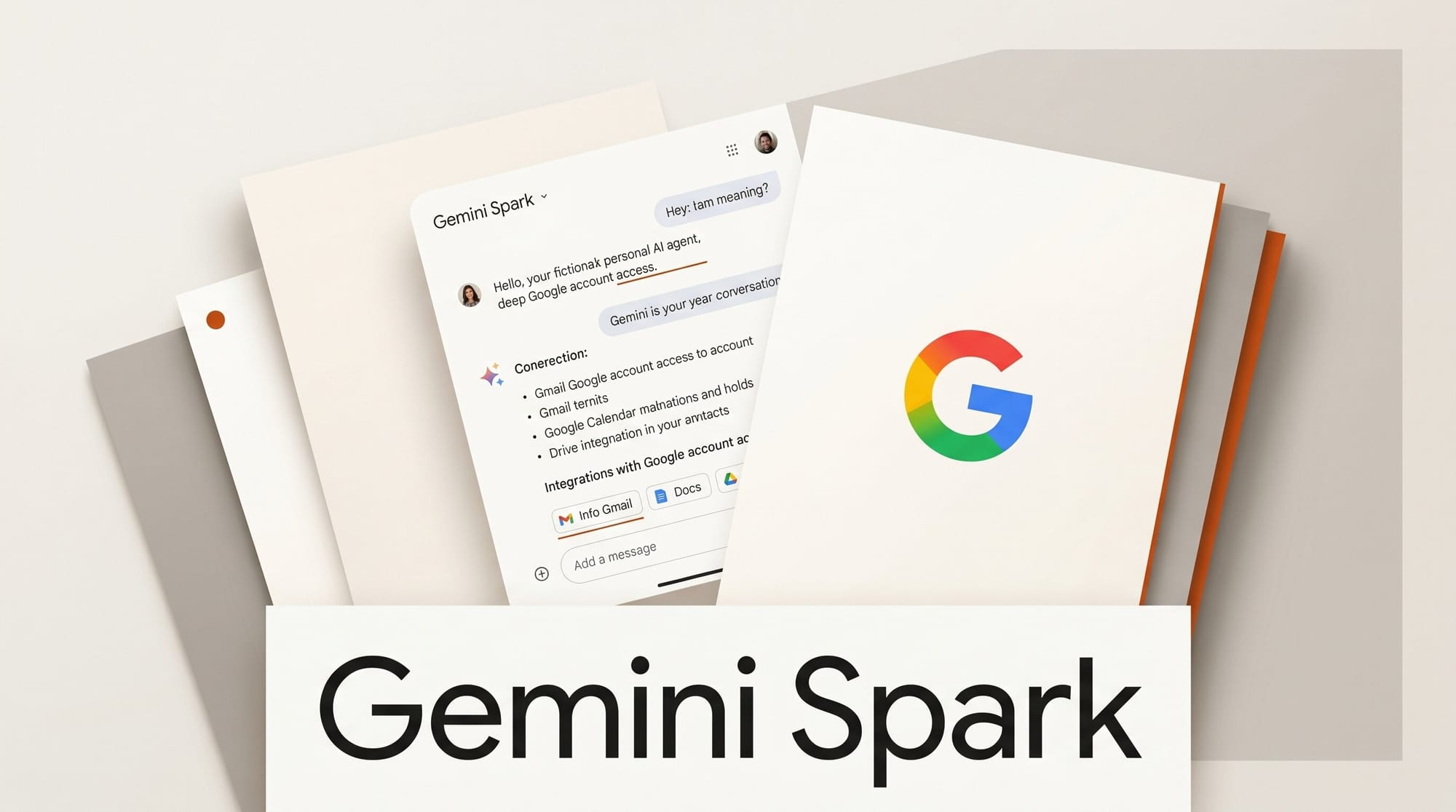
Google gave The Verge's David Pierce early access to Gemini Spark, the company's new always-on AI agent rolling out to Google AI Ultra subscribers, and the results are simultaneously the most impressive and most unsettling demonstration of personal AI yet. Spark knew the reviewer's dog's name, his children's ages, his wife's food preferences, and concert tickets he had never explicitly mentioned , all drawn from years of Gmail, Google Photos, and Calendar data. The agent is currently listed as "coming soon" on the Google AI Ultra plan at $99 per month, with early access going to select users now. For creators who live in Google Workspace, Spark represents a fundamental shift in what an AI assistant can actually know about your work and life without being told anything.
What Gemini Spark Can Do

Spark operates differently from standard AI assistants. It sits persistently in the background, connected to your full Google account: Gmail, Drive, Calendar, Photos, and your search history. When you assign it a task, it draws on all of that data simultaneously, with no manual context required.
Pierce tested three workflows. First, inbox management: Spark scanned Gmail, identified marketing emails, and produced an organized document with direct unsubscribe links grouped by category. Second, project backlog: it combed his Google Docs and surfaced tasks he had noted but never completed. Third, trip planning: given only a destination and travel dates, Spark built a multi-day itinerary that included hotel pet fees, his dog Frida's name (found in vet confirmation emails), his infant son's free park entry status, his older son's ticket requirements, a Saturday night concert pulled from a Ticketmaster confirmation in Gmail, and his wife's onion allergy.
The agent can interact with external websites on your behalf. It navigated directly to Airbnb when asked to find accommodation, but Airbnb's authentication system blocked it from completing a booking. Google's roadmap for Spark includes full device operation: controlling apps on your computer , which would put it in direct competition with OpenAI Codex Computer Use, but with years of personal context already loaded in.
The Personal Intelligence Edge
Google calls the underlying data model "Personal Intelligence": treating every email, photo, document, and search query as input for more accurate AI responses. For Spark, that data is not just available as reference material; it is actively synthesized for every task.
This gives Google a structural advantage that competitors cannot easily replicate. OpenAI, Anthropic, and Microsoft are building capable AI agents, but they do not hold years of personal correspondence, location history, or purchase receipts by default. Spark's contextual accuracy came directly from that data moat: knowing the babysitter situation from email threads, inferring nap schedules from calendar patterns, surfacing parking details from PDF attachments.
For creative professionals, this means Spark could track client email threads, surface overdue project deadlines from Drive documents, identify patterns in your schedule, and plan production timelines based on what it finds in your inbox: without manual input at each step. That capability is real today, not a roadmap promise.
AI Agent Comparison: Personal Data Access

| Agent | Personal Data Access | Web Actions | Device Control | Plan Tier |
|---|---|---|---|---|
| Gemini Spark | Gmail, Drive, Calendar, Photos, Search history | Yes (web browsing on your behalf) | Coming soon | Google AI Ultra ($99/mo) |
| OpenAI Codex | Files you explicitly upload or connect | Yes (Computer Use) | Yes (Mac and Windows) | ChatGPT Pro (top tier) |
| Microsoft Copilot | Microsoft 365: email, OneDrive, Teams | Limited | Via Windows integration | Microsoft 365 Copilot (enterprise) |
| Claude (Anthropic) | Files and context you provide per session | Via integrations (MCP) | Via third-party connectors | Claude Pro and above |
How to Use Gemini Spark for Creator Workflows
If you are on the Google AI Ultra plan or access the early rollout, here is how to integrate Spark into a creative production workflow:
- Client inbox audit. Prompt Spark to review the past 30 days of emails from a specific client domain and summarize open items, unresolved requests, and pending deliverables. It reads full thread context, not just subject lines.
- Project deadline surface. Ask Spark to scan Drive for documents related to a project name and pull out any dates or action items mentioned. This works on briefs, contracts, and revision notes.
- Shoot or production scheduling. Give Spark a project, location, and window. It can cross-reference your calendar, check for conflicts from accepted invitations, and incorporate location notes saved in Drive.
- Invoice and payment tracking. If payment confirmations arrive via Gmail, Spark can surface which clients have paid and which have outstanding invoices without a separate spreadsheet.
- Availability check. When a client asks for a deadline or meeting time, Spark can review your calendar and email history with that client simultaneously, accounting for commitments the client may not know about.
The key to using Spark effectively today is treating it as a search-and-summarize layer over your existing Google data rather than a task-execution engine. Synthesis is its current strength. Actions: booking, sending, creating: work but typically require confirmation at each step.
The Privacy Trade-off Every Creator Must Evaluate

Pierce's review frames the tension clearly: "We actually are paying for it. And we, our correspondence, our photos, our very lives, are both the raw material and the end product, everything constantly mined and sorted and fed back to us in new ways."
For creators, the stakes are specific. Client confidentiality, unpublished work, and business contracts all live in Gmail and Drive. Spark's access to synthesize across your full account is not selective , covering personal and professional data equally. Google's privacy controls at myaccount.google.com/privacy let you audit and adjust what data Google stores, but using Spark at full capability means accepting comprehensive access as the foundation of the product's value.
Creators who use G Suite for client work should evaluate what they are comfortable with before enabling Spark. The capability is genuinely impressive. The data it draws on is not limited to personal emails: it includes business communications, draft assets, contract terms, and anything else tied to your Google account. The line between "helpful assistant" and "comprehensive data layer" is thinner here than with any previous Google product.
That said, competitors like Gemini's standard interface and Microsoft Copilot are building toward similar capabilities. Google is simply further ahead on personal data integration. The question is not whether personal-AI agents will exist , which one, and on whose terms.
What to Do Next
Gemini Spark is not yet available to all Google AI Ultra subscribers. If you are on the plan, check Gemini settings for early access options. If you are evaluating whether the upgrade makes sense, the $99 per month price includes 20 TB of storage, YouTube Premium, and $40 in monthly Google Cloud credits alongside Spark access: making the cost more defensible than a pure AI subscription.
For creators already in Google Workspace, Spark will likely become the default AI layer over time. Understanding what it can access now gives you time to organize your Drive and email labels in ways that align with how an AI agent would search them. For those deploying Gemini in production pipelines, the DeepMind research team has published alignment studies on agentic Gemini behavior worth reviewing before building at scale. The full Verge review is the best existing hands-on account of what Spark can and cannot do today.
Frequently Asked Questions
What is Gemini Spark and how is it different from regular Gemini?
Gemini Spark is Google's always-on AI agent that actively mines Gmail, Drive, Calendar, Photos, and Search history to complete tasks on your behalf. Regular Gemini is a conversational assistant you prompt manually. Spark is an autonomous agent that takes actions, synthesizes your full account data without prompting, and can interact with external websites. It is rolling out to the Google AI Ultra plan at $99 per month.
Is Gemini Spark available now?
Spark is listed as "coming soon" on the Google One AI plans page, but Google is providing early access to select users and press. Full rollout timing has not been announced. The AI Ultra plan currently includes "Gemini Agent" (US only, English only), which is the immediate predecessor functionality. Spark appears to be the expanded version.
What data does Gemini Spark access?
Spark draws on everything in your Google account: Gmail messages and attachments, Google Drive files, Docs and Sheets, Google Calendar events and acceptances, Google Photos metadata, and Search history. In the Verge review, it surfaced the reviewer's dog name from vet confirmation emails, concert tickets from a Ticketmaster PDF in Gmail, and family members' names and ages: none of which the reviewer had explicitly shared with the AI.
Can Gemini Spark book travel or make purchases?
Not reliably yet. In testing, Spark navigated to Airbnb and attempted to find accommodation, but Airbnb's authentication system blocked completion. It offered alternatives instead. Device-level control and authenticated purchasing are on the roadmap but not consistently available in the current rollout.
How does Gemini Spark compare to OpenAI Codex for creative work?
The two have different strengths. Codex Computer Use executes tasks directly on your computer: writing code, manipulating files, automating desktop applications: starting with minimal personal context. Spark excels at synthesizing your personal history and Google account data to provide contextually accurate responses, but computer control is still developing. Creators who need desktop automation lean toward Codex; those who need deep personal data integration in their workflow will find Spark more immediately useful for research, scheduling, and communication tasks.