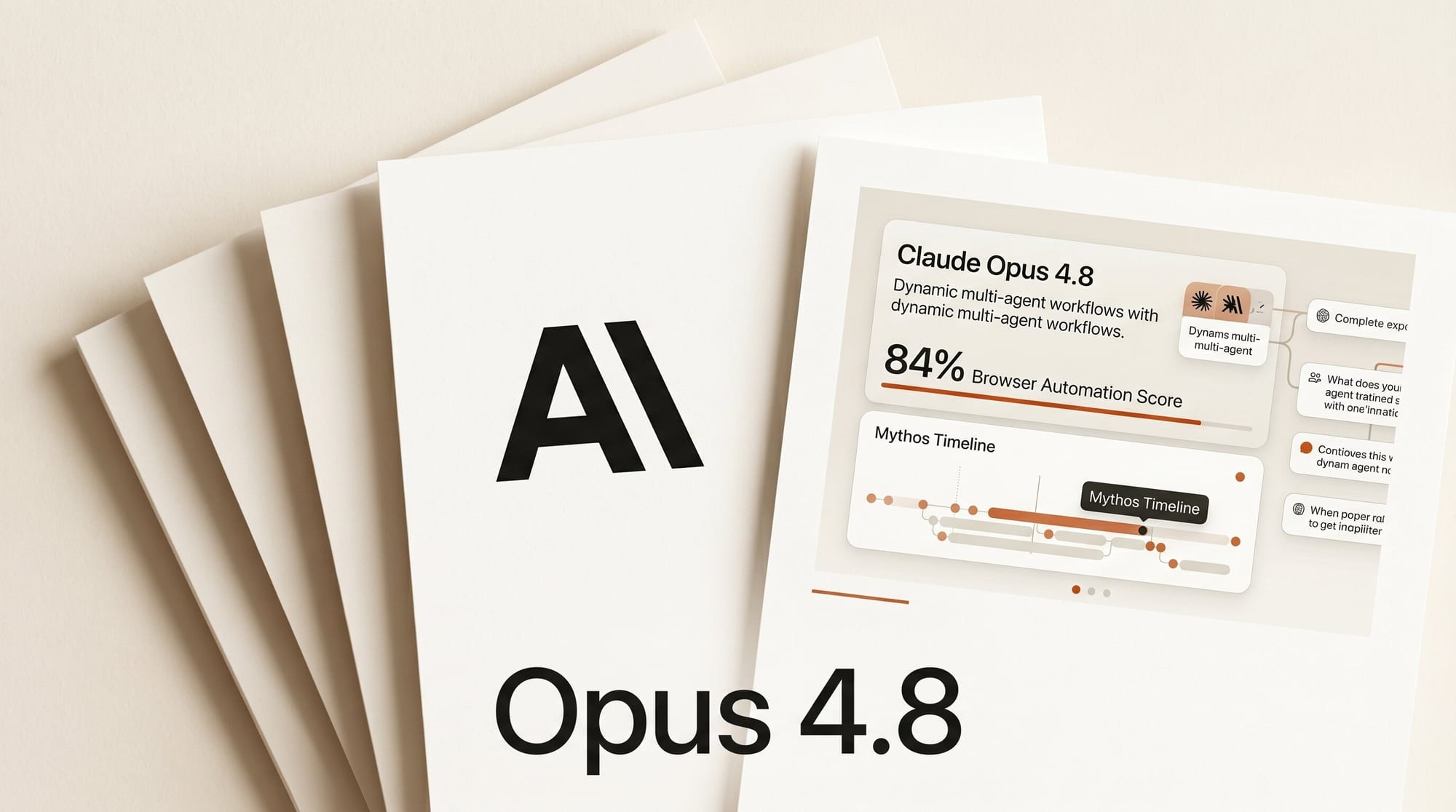
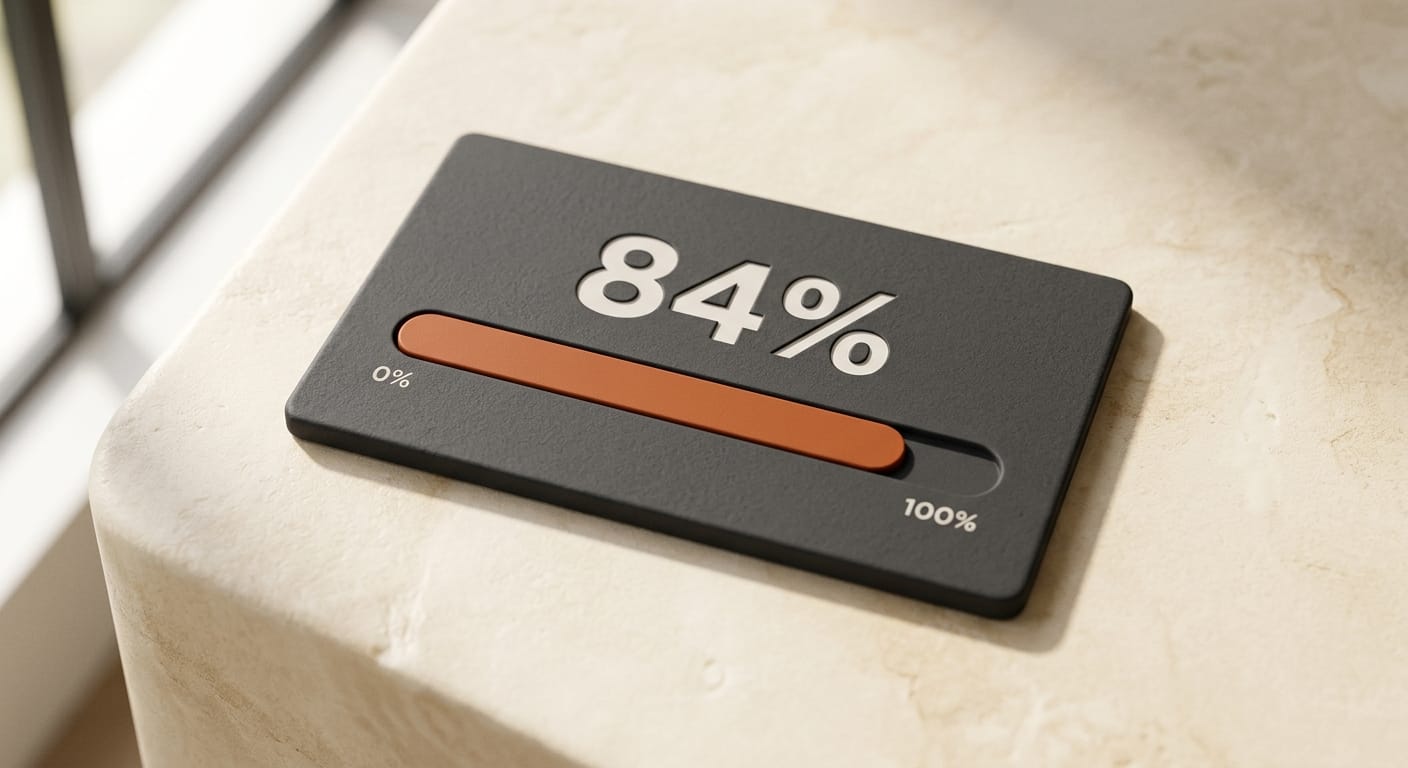
Anthropic launched Claude Opus 4.8 on May 28, 2026, alongside a research preview of dynamic workflows in Claude Code that can orchestrate hundreds of parallel subagents in a single session. The model scores 84% on Online-Mind2Web, beating both Opus 4.7 and GPT-5.5 on browser automation, and is the first model to complete every case end-to-end on the Super-Agent benchmark at comparable cost. It is available immediately via the claude-opus-4-8 API endpoint on all plans. Anthropic also confirmed that Claude Mythos, currently in preview for cybersecurity organizations, will be available broadly in the coming weeks.
What Launched on May 28
The Opus 4.8 release includes three simultaneous launches beyond the model itself:
- Dynamic Workflows (Claude Code, research preview): Orchestrates tens to hundreds of parallel subagents per session for codebase-scale tasks. Covered in detail in Anthropic's Dynamic Workflows launch post.
- Effort Control (claude.ai and Cowork): Users can select effort levels that affect response quality and rate limit consumption, giving teams more direct control over cost versus depth tradeoffs.
- Messages API update: System entries are now accepted mid-messages array without breaking the prompt cache, simplifying multi-turn agentic setups that mix system-level context with user turns.
Dynamic Workflows: How the System Works
Dynamic workflows address the main bottleneck in AI-assisted software work: large, interconnected tasks that exceed what a single context window can reason about coherently. The workflow engine follows this five-step process:

- Prompt analysis. Claude reads your request and identifies parallelizable subtasks, for example, auditing 400 files for a specific vulnerability class across a production codebase.
- Subagent dispatch. The orchestration layer spins up independent subagents, each working on a subset of files or a specific angle of the problem simultaneously.
- Cross-verification. Separate verification agents attempt to refute findings from the initial subagents. Results are not integrated until answers converge across independent runs.
- Progressive saves. Progress is saved continuously, so an interrupted session resumes rather than restarts from scratch.
- Synthesis. A coherent result is assembled from verified subagent outputs and delivered as a single response.
In a reported real-world example, Jarred Sumner used dynamic workflows to port the Bun runtime from Zig to Rust: 750,000 lines of code over 11 days, with a 99.8% pass rate on the existing test suite. Setup instructions are at code.claude.com/docs/en/workflows.
Dynamic workflows are available on Max, Team, and Enterprise plans in the Claude Code CLI, Desktop app, and VS Code extension. Enterprise admins must enable the feature before team members can use it. The feature also runs on Amazon Bedrock, Vertex AI, and Microsoft Foundry. Token consumption is substantially higher than a standard Claude Code session; the tool prompts for confirmation on first use.
Benchmarks: Opus 4.8 vs. GPT-5.5
Benchmarks below are from Anthropic's internal evaluations. The full model specification including context window and token limits is at the Claude model overview page.
| Benchmark | Claude Opus 4.8 | GPT-5.5 (comparable cost) |
|---|---|---|
| Online-Mind2Web (browser automation) | 84% | Below Opus 4.8 |
| Super-Agent (end-to-end task completion) | All cases completed | Did not complete all cases |
| Legal Agent Benchmark | Highest; first to exceed 10% all-pass | Below 10% all-pass |
| Terminal-Bench 2.1 (coding) | Exceeds all prior Opus models | Not reported |
On honesty, Opus 4.8 is approximately four times less likely than Opus 4.7 to pass flawed code without flagging it. In agentic pipelines where the model writes and reviews its own output, silent acceptance of bugs is the most expensive failure mode. For historical context on how Claude stacks up against GPT-5.5 on agentic benchmarks, see our DeepSWE benchmark analysis.
Claude Mythos: Broad Release Confirmed for Coming Weeks
Claude Mythos is Anthropic's highest-capability model tier, currently in restricted preview for cybersecurity research organizations. The May 28 announcement confirmed that Mythos-class models will reach general availability in the coming weeks, pending completion of additional cyber safeguard development. The Glasswing research update covers the safety evaluations in progress before Mythos exits closed preview.
For background on what Mythos demonstrated in security research contexts, see our earlier deep dive on Mythos identifying 10,000 critical software bugs. The coming-weeks timeline is the first concrete signal that Mythos is moving out of closed preview.
Pricing
Opus 4.8 standard mode pricing is unchanged from Opus 4.7. The fast mode price is approximately three times cheaper than equivalent fast-mode pricing on prior Opus generations.
| Mode | Input (per million tokens) | Output (per million tokens) |
|---|---|---|
| Standard | $5 | $25 |
| Fast | $10 | $50 |
Teams running high-frequency agentic loops who have been routing tasks to Sonnet-tier models purely for cost reasons should re-evaluate the gap, since the fast mode reduction narrows the unit economics difference meaningfully.
What This Means for Creators and Developers
Dynamic workflows change the practical ceiling for what AI-assisted development can accomplish in a single session. Tasks that previously required splitting work across multiple sessions, maintaining context manually between runs, or building custom orchestration scaffolding can now be issued as a single Claude Code request.
Three immediate applications for creative technologists:
- Codebase-wide refactors. Migrations spanning hundreds of files, such as adopting a new API client pattern across a large project or swapping a rendering pipeline, can run as a single dynamic workflow rather than a sequence of manual patches.
- Pre-launch security audits. Running an independent verification pass across all files before a release, with agents checking each other's findings, produces multi-perspective code review previously available only through dedicated tools or human reviewers.
- Asset pipeline automation. For developers building AI-powered creative tools, dynamic workflows can process entire media libraries in parallel, applying classification, metadata generation, or style analysis at scale in one session.
The Claude Code 2.1.147 /code-review command introduced effort levels for single-pass review; dynamic workflows extend that pattern to multi-agent, session-scale tasks where the problem is too large for a single pass.
What to Do Next
Update to the latest Claude Code version (CLI or Desktop), then either type "Create a workflow" as a prompt or enable the ultracode setting, which sets effort to xhigh and triggers dynamic workflows automatically for qualifying tasks. Full setup is at code.claude.com/docs/en/workflows.
API users can switch to claude-opus-4-8 immediately. The Messages API system-entry change is backward-compatible, so existing prompts continue to work without modification.
Frequently Asked Questions
Is Claude Opus 4.8 available on the free Claude plan?
Yes. Anthropic confirmed Opus 4.8 is offered on all plans, including free. Dynamic workflows require Max, Team, or Enterprise plans. Standard usage limits apply per plan tier.
What is the difference between standard mode and fast mode in Opus 4.8?
Standard mode prioritizes depth. Fast mode delivers responses faster at a higher per-token cost ($10 per million input vs. $5), designed for latency-sensitive agentic loops. Anthropic describes fast mode as approximately three times cheaper than equivalent fast-mode pricing on previous Opus generations.
Do dynamic workflows work with third-party cloud providers?
Yes. Dynamic workflows are available via Amazon Bedrock, Vertex AI, and Microsoft Foundry for Enterprise customers, in addition to the Claude Code CLI and Desktop app.
How is Claude Opus 4.8 different from Claude Mythos?
Opus 4.8 is generally available to all users today. Claude Mythos is a separate, higher-capability model tier currently in restricted cybersecurity preview. Anthropic expects to release Mythos broadly in the coming weeks pending additional safety evaluations.
What does the honesty improvement mean for agentic coding tasks?
Opus 4.8 is approximately four times less likely than Opus 4.7 to pass code flaws without flagging them. In agentic pipelines where the model writes, reviews, and submits code autonomously, this reduces the rate of silent bug acceptance, the most expensive failure mode in production agentic workflows.