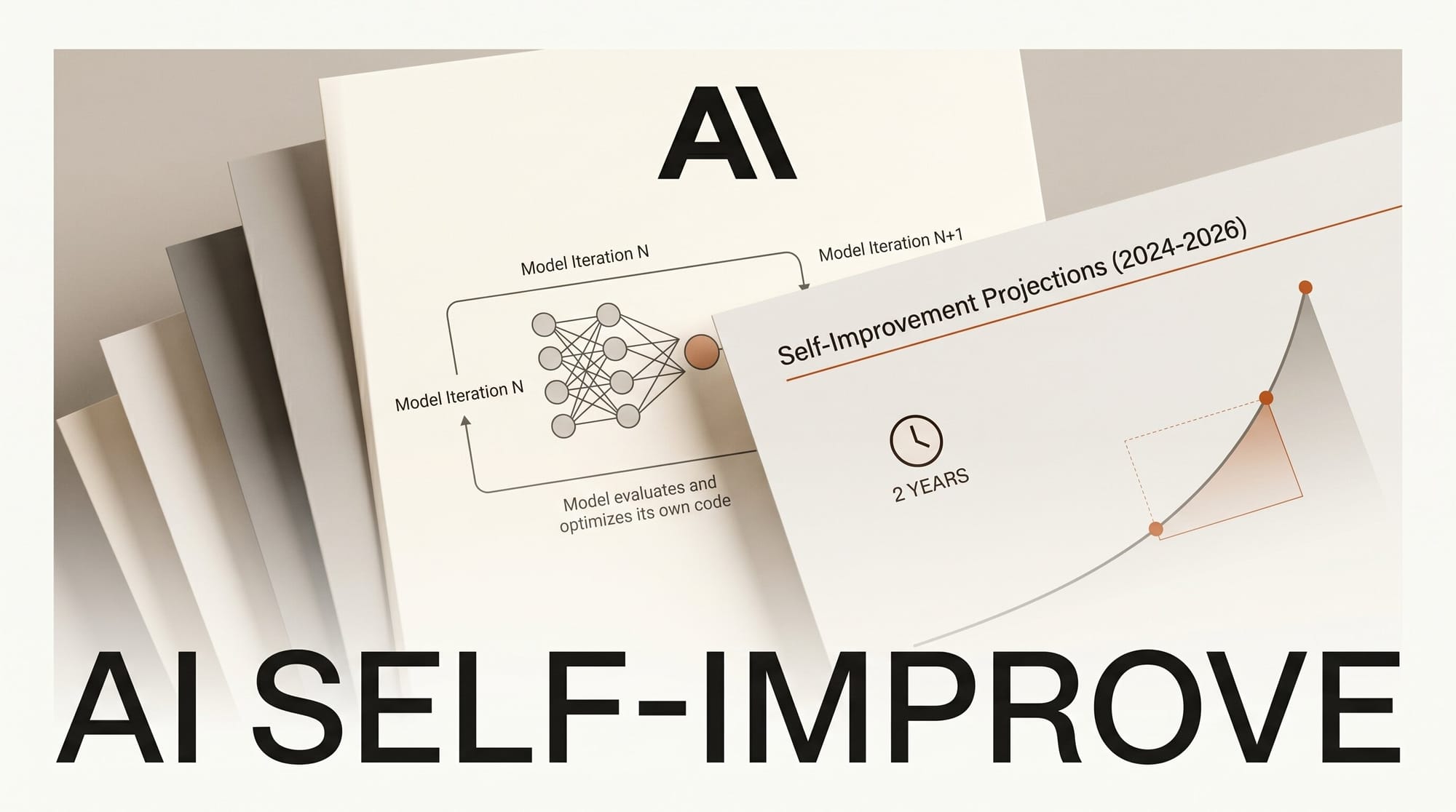
The Anthropic Institute has published a detailed analysis showing AI systems are already measurably accelerating their own development, with researchers calling for a globally coordinated mechanism to slow or pause frontier model development before AI reaches a point of self-directed improvement.
The report, authored by Marina Favaro and Jack Clark with editorial support from Santi Ruiz, documents a shift from AI as a tool that helps humans build AI to AI as an active participant in its own advancement. Anthropic engineers now merge eight times more code per day than they did in 2024, with over 80% of production code authored by Claude.
What Happened
The Anthropic Institute's recursive self-improvement report surfaced prominently this week, drawing broad coverage and discussion. SiliconAngle reports that Anthropic is calling for "a globally coordinated agreement to temporarily pause or at least slow down the pace at which new frontier models are being developed."
Co-author Jack Clark put a specific window on the concern: some models could reach self-improvement capacity "within just two years." The report connects rising task completion horizons, benchmark saturation rates, and Anthropic's own internal productivity metrics to make the case that development is accelerating faster than institutions are prepared to handle.
What Is Recursive Self-Improvement
Recursive self-improvement refers to an AI system that can design a better version of itself, which then designs an even better version, creating a self-reinforcing loop with no human oversight required at each step. Anthropic defines the threshold as "an AI system capable of fully autonomously designing and developing its own successor."
The company is careful to draw a clear line: "we are not there yet, and recursive self-improvement is not inevitable." Three possible futures are outlined in the report: capability growth stalls, AI substantially automates development while humans retain direction, or recursive self-improvement emerges. The authors consider the middle scenario most likely in the near term. Claude's forthcoming capability roadmap reflects that middle scenario.
The Evidence Anthropic Is Citing
Several concrete datapoints illustrate the acceleration the report describes:
- Task completion horizon: Claude Opus 3 handled 4-minute tasks in March 2024. Claude Sonnet 3.7 managed 1.5-hour tasks in March 2025. Claude Opus 4.6 handles 12-hour tasks as of March 2026. The horizon doubles roughly every four months.
- Benchmark saturation: SWE-bench (software engineering) progressed from single digits to saturation in two years. CORE-Bench (research reproduction) went from 20% to saturation in 15 months.
- Code quality: Models reached a 76% success rate on open-ended coding problems in May 2026, up 50 percentage points in six months.
- Research judgment: Models outperformed human choices on research direction decisions 64% of the time in April 2026, compared to 51% in November 2025.
- Productivity multiplier: Internal surveys show approximately 4x productivity gains on actual projects, corroborating the 8x lines-of-code metric, which the authors acknowledge may overstate true quality gains.
These metrics, taken together, show AI not just assisting development but compressing the development cycle itself. A task that required a full engineering sprint is now completed in a day. A research direction that would have taken months to evaluate can be assessed in hours.
What Anthropic Is Proposing
Rather than calling for an immediate halt, Anthropic is advocating for building the infrastructure that would make a coordinated pause possible if one became necessary. The proposal centers on international verification: creating systems that allow frontier labs to confirm others have actually reduced development pace, not just claimed to.
The authors draw an analogy to nuclear non-proliferation, while acknowledging a critical asymmetry: "training runs are far easier to conceal than missile silos." Making any coordination regime work would require "multiple well-resourced labs at or near the frontier, in multiple countries" and significant new institutional capacity. The authors acknowledge "those regimes took decades to build" while noting "we don't have that long."
The proposal lands as international AI governance discussions are taking shape. The Atlantic Council's 2026 geopolitics analysis identifies AI coordination as one of the defining strategic questions of the year, with first formal treaty negotiations potentially possible by early 2027. The UN Global Dialogue on AI Governance holds its first session in Geneva in July 2026.
Why Critics Are Skeptical
Community reaction has been mixed, with the central tension being that Anthropic is simultaneously one of the companies most aggressively pushing capability forward while calling for others to slow down.

Analyst Rob Enderle characterized the proposal as "strategic marketing" rather than a genuine safety initiative, arguing enforcement would be "practically impossible" given US-China competition. There is also a structural concern: a coordinated pause tends to benefit established players by freezing out competitors who might otherwise catch up, creating an incentive for incumbents to support it that is not purely safety-motivated.
A more sympathetic reading is that Anthropic is using its dual position as builder and safety researcher to shape norms before a crisis forces the issue. The report itself is unusually transparent about internal Anthropic data, which is not typical for strategic marketing.
What This Means for Creators
For anyone who relies on AI tools for image generation, video editing, audio production, or writing, the implications run in two directions.
In the near term, the acceleration Anthropic is documenting is the same mechanism making AI tools better. Faster capability growth, models that help build better models, task horizons that expand every few months: these are what produce meaningfully improved image generators, transcription tools, and creative assistants each release cycle. The tools available in late 2027 will likely be substantially more capable than those available today.
A coordinated pause, if one happened, would freeze that improvement cycle for frontier proprietary models. Existing tools would continue operating. New frontier model releases would halt. Open-weight models already released would remain available and improvable by the broader community, but cutting-edge capability from Anthropic, OpenAI, and Google DeepMind would stall.
The practical near-term concern is policy uncertainty rather than any immediate tool disruption. Anthropic's S-1 filing identified the regulatory environment as a key risk factor. Creators who have built deep workflow dependencies on specific proprietary models should be aware that the regulatory landscape for frontier AI is actively forming.
The most resilient workflow position is flexibility: using AI tools through APIs and interfaces that allow model switching, maintaining familiarity with open-weight alternatives, and not treating any single proprietary model as a permanent dependency.
What to Do Next
- Read the full Anthropic report at anthropic.com/institute/recursive-self-improvement. It is unusually direct about internal data and timeline evidence.
- Track the UN Global Dialogue on AI Governance. Its first formal session is in Geneva in July 2026. This is the venue where any binding international framework would be negotiated.
- Build workflow redundancy now. Identify open-weight model alternatives for your most critical AI-assisted tasks. Models already released will not be subject to any pause agreement.
- Follow this story through July. The combination of Anthropic's report, the Geneva session, and ongoing US-China AI competition makes mid-2026 a critical period for AI governance.
Frequently Asked Questions
What is recursive self-improvement in AI?
Recursive self-improvement is when an AI system can autonomously design a successor that is more capable than itself, which then designs an even more capable successor, creating a self-sustaining cycle. Anthropic defines it as "an AI system capable of fully autonomously designing and developing its own successor." This threshold has not been reached, but the company's data on accelerating task completion horizons and code quality suggests the trajectory points toward it within years rather than decades.

How long until AI can recursively self-improve, according to Anthropic?
Jack Clark, one of the report's co-authors, said some models could reach recursive self-improvement capacity within two years. The company acknowledges significant uncertainty in that estimate and is careful to note that this outcome is not inevitable. The same benchmarks they use to track progress, including task completion horizons doubling every four months, suggest the timeline is measured in years rather than decades, which is what makes the governance urgency credible.
Would an AI development pause affect the tools creators use today?
Tools already released and running would continue to operate. A pause would affect the development of new frontier models, slowing the rate of improvement in image generation, video synthesis, audio models, and large language models. Open-weight models already released would remain available and could continue to be fine-tuned and improved by the research community. The tools most affected by any pause would be cutting-edge proprietary models from Anthropic, OpenAI, and Google DeepMind.
What evidence does Anthropic cite for AI accelerating its own development?
Anthropic engineers merged eight times more code per day in Q2 2026 compared to 2024, with over 80% of production code authored by Claude. Task completion horizons doubled roughly every four months, from 4-minute tasks in March 2024 to 12-hour tasks in March 2026. Two key benchmarks, SWE-bench and CORE-Bench, both saturated within 24 months of baseline measurement. Research judgment scores went from 51% to 64% in six months. These metrics together show AI not just assisting development but compressing its timeline.
Why are some experts skeptical of Anthropic's pause proposal?
The main criticism is that Anthropic is proposing the solution to a problem it is actively contributing to, and the verification infrastructure it calls for does not exist and would take years to build. Analyst Rob Enderle called it "strategic marketing" because geopolitical competition between major AI-developing nations makes binding enforcement practically impossible. There is also a structural argument that a pause benefits established players like Anthropic by freezing out competitors who might otherwise catch up.
What can creators do to prepare for potential AI development slowdowns?
Build flexibility into your AI workflows now. Use tools through APIs that allow model switching rather than single-provider integrations. Maintain proficiency with open-weight models that would continue to be available under any pause scenario. Track the UN Global Dialogue on AI Governance, which holds its first formal session in July 2026. Reading the Anthropic report directly is worthwhile. It is more transparent about internal data than most similar publications.