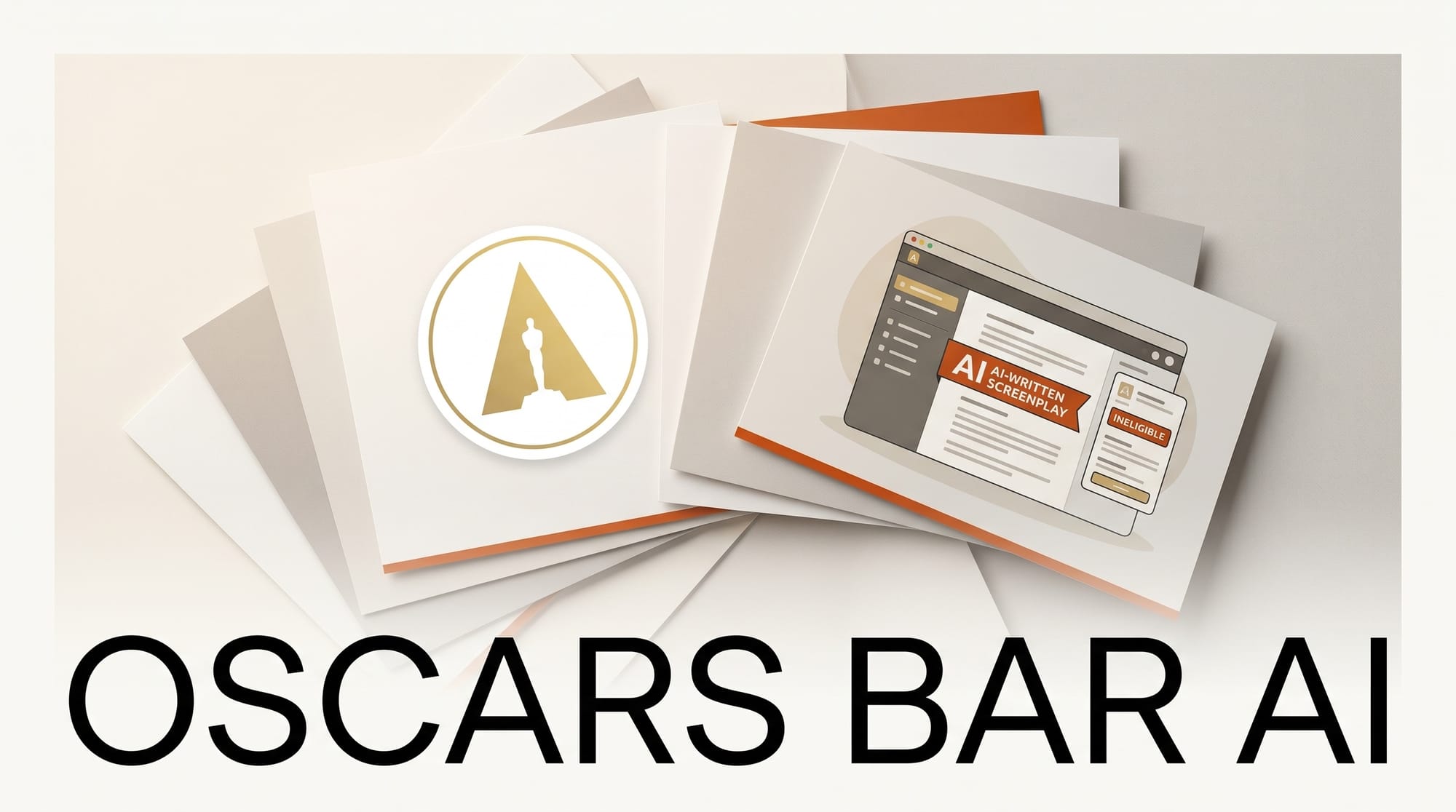
The Academy of Motion Picture Arts and Sciences approved sweeping rule changes for the 99th Oscars on May 1, 2026, ruling that AI-generated actors and AI-written screenplays are ineligible for Academy Awards. The new rules take effect for films competing for the March 14, 2027 ceremony, and the Academy reserves the right to investigate any submission for generative AI involvement.
What Happened
The rule change was approved in the Board of Governors' annual update cycle and was the headline item in a broader package that also expanded the International Feature Film qualification path and adjusted multiple-nominations math in the acting categories. Indiewire's report documents the full text. For acting, eligibility now requires that performances be "credited in the film's legal billing and demonstrably performed by humans with their consent." For writing, screenplays must be "human-authored." Both standards apply to films released within the 2026 eligibility window.
The change resolves an ambiguity that had been growing since the rise of synthetic performers like Tilly Norwood, the AI-generated actress whose 2025 representation announcement drew industry pushback from SAG-AFTRA and major talent agencies. Tilly Norwood is the canonical case study the new language is designed to exclude: a fully synthetic performer represented by an agency, marketed as cast for original feature films, and submitted to festival circuits. Under the May 1 rule, that kind of performance is ineligible regardless of the film's overall quality or critical reception.
Why It Matters
The Academy is the most-watched prestige body in entertainment, and its rule sets a public norm that other festivals, streamers, and guilds will measure themselves against. By drawing the line at performance and authorship while leaving VFX and post-production AI tooling alone, the Oscars validate the working creator economy and reject the wholesale-synthetic actor pitch from companies like Particle6 and Xicoia. Synthetic-actor startups now face a credibility ceiling: they can sell to ads, gaming, and direct-to-streaming, but the Academy door is closed for the 2026 to 2027 cycle.
For human actors and writers, this is a defensible workflow boundary. Studios that want awards prestige cannot quietly substitute a synthetic lead, and the Academy's right to investigate puts documentation burden on filmmakers. Expect parallel guidance from Cannes, Sundance, BAFTA, and Emmys within the next 12 months, with similar human-authorship language baked into eligibility rules.
Key Details
What the rule actually bans, and what it does not
The precision of the language matters. The new rule does not ban AI tools across film production. Filmmakers can still use generative AI for visual effects compositing, color grading, editing assistance, sound design, score generation, ADR and dubbing alignment, and any number of post-production workflows. The category-specific bans target outputs (the on-screen performance and the screenplay text) rather than the toolchain used to support them. TechCrunch confirms the Academy has not yet established rules for generative AI in visual effects, costume design, or music categories.

The practical line is between assistance and authorship. A screenwriter who uses Claude or ChatGPT to brainstorm scene structure or draft dialogue passes that gets revised and stamped by the human writer is still eligible. A screenwriter who outputs a finished script from a model and submits it without substantive human authorship is not. The Academy's reservation of investigative authority is the operational teeth: submissions can be challenged and required to demonstrate human authorship through drafts, revision history, or production correspondence.
Why the boundary lands on acting and writing first
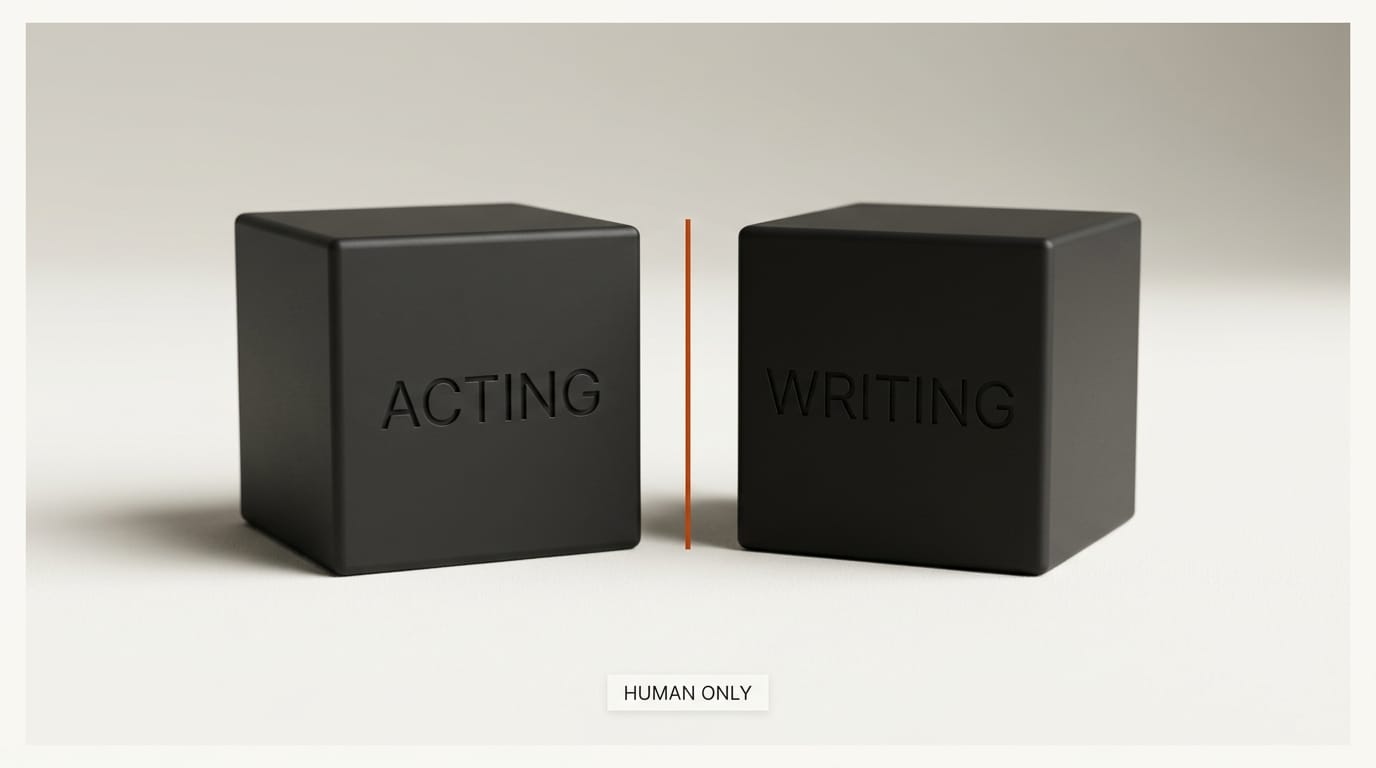
The Academy chose the two categories where labor displacement is most concrete and where the talent guilds have the strongest political position. Acting is governed by SAG-AFTRA, which struck for 118 days in 2023 and centered AI consent and likeness rights in the resulting MBA. Writing is governed by the WGA, whose 148-day strike the same year produced the first set of contractual guardrails on AI-generated material in studio writing rooms. The Academy's decision aligns with the contractual baselines its membership has already negotiated, which is why these two categories led rather than visual effects or music.
By contrast, the visual effects category sits in a more ambiguous spot. Generative AI is already deeply embedded in VFX pipelines for tasks like roto, paint-out, environment generation, and de-aging. Drawing a clean human-authorship line in that category would require a definition of what counts as a substantive human contribution to a fully rendered shot, and the Academy explicitly punted on that question. Variety reports the Academy intends to revisit VFX, costume, and music categories in next year's rules cycle.
What this means for synthetic performers and the talent agency model
For the synthetic performer category specifically, the May 1 rule creates a hard ceiling on the most prestigious recognition in cinema. A Tilly Norwood-style performer can still be cast in studio releases, can still appear in Cannes or Toronto, can still drive box office and streaming engagement, but cannot be credited toward an Academy Award nomination. That ceiling has direct implications for how talent agencies build representation around synthetic performers. The economics of AI-generated talent are predicated on lower production costs and longer asset shelf lives, but the prestige economy that drives top-tier feature financing is now closed off.

The cascade effect is that synthetic performers are likely to consolidate into specific commercial categories where awards prestige does not gate financing: streaming-native originals, advertising, music videos, gaming cinematics, and short-form social content. Major studios that had been quietly building synthetic-actor pipelines for franchise films now have to model the trade-off between cost savings and category exclusion when those films would otherwise be Oscar contenders.
The walling-off pattern across the platform tier
The Academy's move follows a broader 2026 pattern of culture industry institutions drawing explicit human-versus-AI boundaries in their authentication and recognition systems. Spotify's Verified Badge, launched in late April, bars AI-only artists from its top tier of authenticated creators. The Cannes Film Festival, Sundance, and the BAFTAs have signaled they will follow the Academy's lead in their next rules cycles. The pattern is consistent: institutional gatekeepers are erecting verification regimes around human authorship in the categories where audience trust depends on knowing a human made the work.
The implication for creators is structural. Distribution and discovery platforms are converging on a two-tier system: a "human-authored" tier with prestige access and a broader generative tier where AI-assisted and AI-generated work coexists with human work but does not compete for the same recognition. Most independent creators sit on both tiers depending on the project, and the practical task is to be deliberate about which tier each project targets and to keep the documentation that supports that classification.
What to Do Next
For independent filmmakers using generative AI inside their production pipelines, the rule's practical effect is documentation discipline. If your work targets festival or awards consideration, treat human authorship as a documentation problem from day one. Keep dated drafts, revision history, prompt logs that show editorial decisions, and signed consent agreements with on-screen performers. The Academy's investigative authority means a successful submission needs an audit trail, not just a final cut.
For creators whose work does not target awards consideration, the change is less directly binding but is worth tracking because streamers and distributors will begin asking the same questions. Netflix, A24, Searchlight, and the major studios are all watching how the Academy enforces its rule before deciding how much AI authorship to permit in their development pipelines. Within roughly 12 months, expect submission portals at festivals and streamers to add explicit AI authorship questions to their cover-sheet metadata.
Key Takeaways
- AI-generated actors and AI-written screenplays are ineligible for the 99th Oscars (March 14, 2027 ceremony) and any subsequent ceremonies until the Academy revises the rule.
- Acting performances must be "credited in the film's legal billing and demonstrably performed by humans with their consent." Screenplays must be "human-authored."
- The rule does not ban AI tools across the board. VFX, sound, color, editing assistance, and post-production AI use remains allowed in non-acting and non-writing categories.
- The Academy reserves the right to investigate generative AI involvement in any submission, putting the documentation burden on filmmakers.
- Visual effects, costume, and music categories will be addressed in the next rules cycle; expect parallel guidance from Cannes, Sundance, and the BAFTAs within 12 months.
What to Watch
The first practical test will arrive at festival submission deadlines for the 2026 awards window. Watch how Sundance, Toronto, and Venice handle borderline submissions, particularly films with extensive AI-assisted post-production but human-led acting and writing. The festival circuit is where the operational definitions of "human-authored" and "demonstrably performed" will be litigated in practice, well before the Academy itself has to rule on a contested submission.
The longer-tail signal to track is the studio side. Major-studio production agreements typically lag guild contracts by 12 to 18 months, but the May 1 ruling accelerates the timeline because awards-track films are already in development. Watch for studio AI riders in writers and actors contracts, agency representation policies on synthetic performers, and any test cases where a high-profile film deliberately submits with documented AI authorship to challenge the boundary. By the 100th Oscars, the rule's edges will be tested and either tightened or refined into clearer category-by-category guidance.