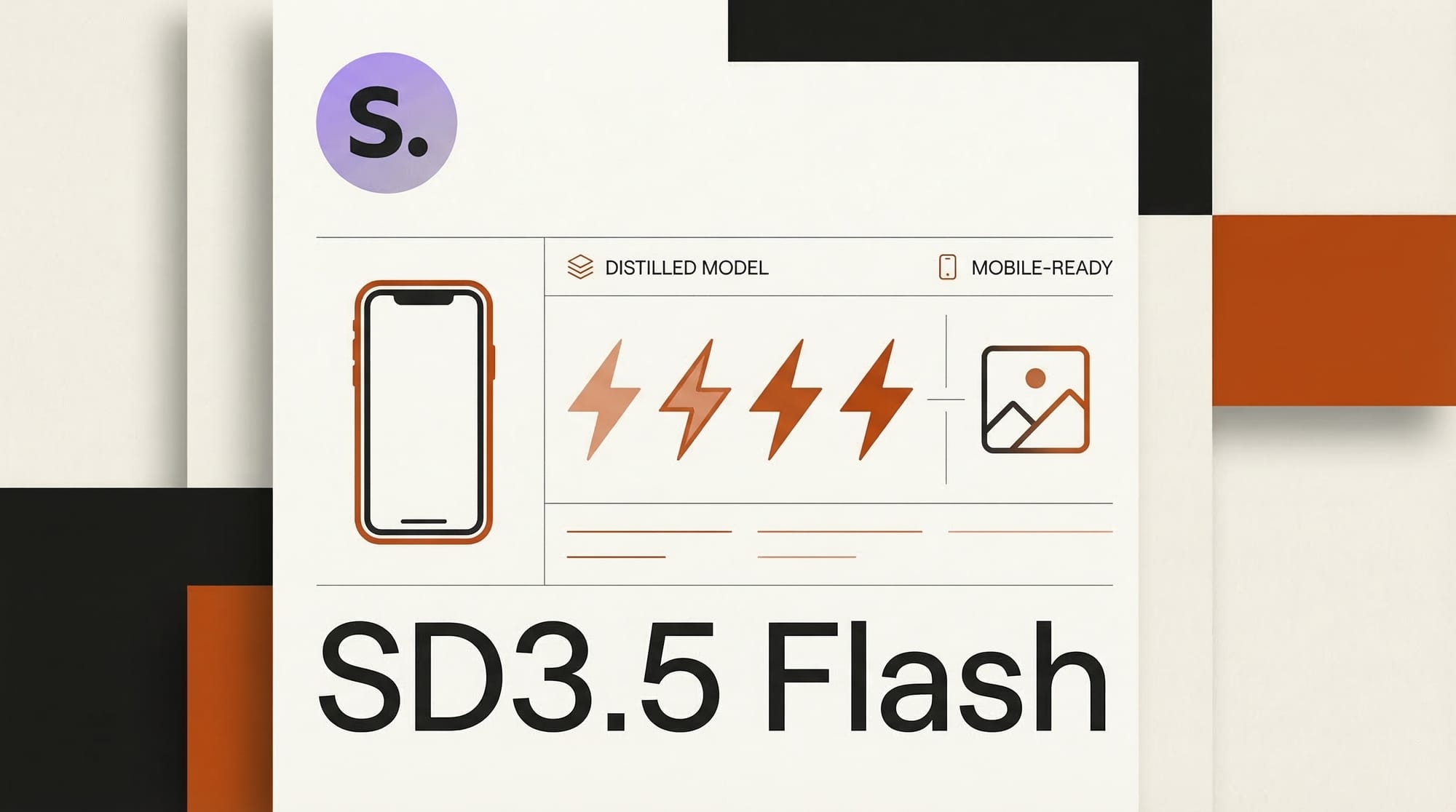
Stable Diffusion 3.5 Flash can generate images in just 4 steps instead of the 30 to 50 steps that current models typically require. That 10x reduction in compute makes on-device AI image generation practical on smartphones and laptops with under 8GB of RAM, no cloud connection needed.
What Happened
Developed in collaboration with the University of Surrey, SD3.5-Flash dramatically reduces the number of inference steps required to produce a quality image. Standard diffusion models work by gradually refining noise into a coherent picture over dozens of steps. Each step requires a full forward pass through the model, which is why image generation takes seconds even on powerful GPUs.
By cutting that process to just 4 steps, SD3.5-Flash makes the total compute requirement low enough to run on consumer hardware. A modern smartphone or a laptop with a modest GPU can generate images locally, without sending prompts to a cloud server and waiting for results.
According to Live Science's reporting, the model maintains competitive image quality despite the dramatic reduction in steps, making it a genuine alternative to cloud-based generation for many use cases.
Why It Matters
On-device image generation solves three problems at once: privacy, speed, and cost. Your prompts never leave your device. Generation is near-instant since there is no network roundtrip. And there are no per-image API fees.
For creators who use AI image generation in their daily workflow, this changes the economics significantly. Quick concept art, social media graphics, texture generation, and iterative design work can all happen locally. The push toward local AI generation that NVIDIA and ComfyUI have been driving now extends to devices that fit in your pocket.
This also matters for the broader ecosystem of AI image tools and playgrounds. As on-device models become viable, expect more apps to integrate local generation as a free tier or offline mode, reducing dependence on cloud infrastructure.
Key Details
- Steps: 4 (down from the typical 30 to 50)
- Memory: Runs on devices with under 8GB RAM
- Connectivity: Fully offline, no cloud required
- Research partner: University of Surrey
- Developer: Stability AI
What to Do Next
If you have been holding off on local AI image generation because of hardware requirements or slow generation times, SD3.5-Flash removes both barriers. Watch for integration into popular creative apps and open-source interfaces like ComfyUI, where community contributors typically add support for new Stable Diffusion variants within days of release.
For developers building AI-powered creative tools, 4-step generation opens up real-time use cases that were previously impractical. Live preview during prompt editing, interactive design tools, and batch generation workflows all become feasible on consumer hardware. The gap between cloud and local AI image generation just got much smaller.