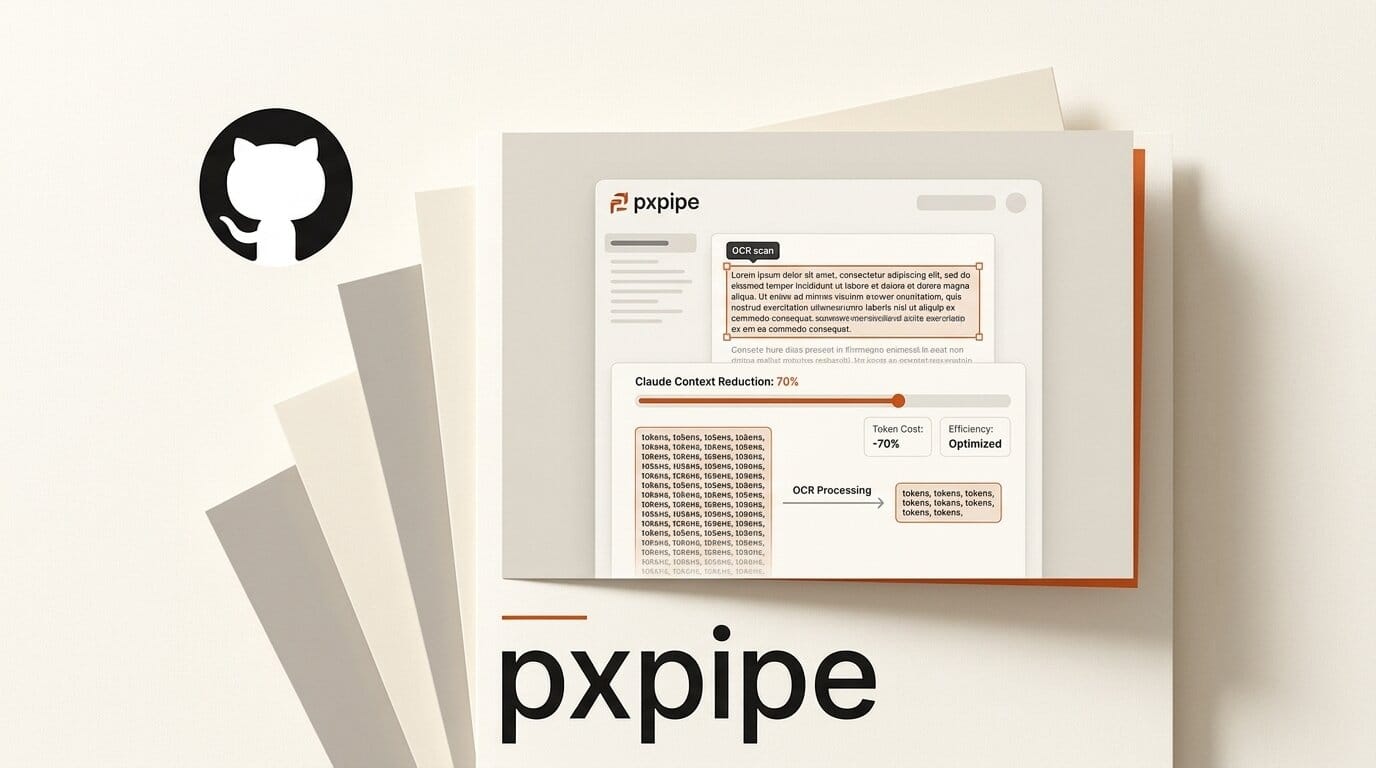
pxpipe is a free, open-source proxy that cuts Claude Code token bills by 59 to 70 percent using an unusual trick: it renders your bulky context as images and lets the model read them back with OCR. Version 0.7.1 shipped July 3, and it went straight to the front page of Hacker News. The tool targets the token-hungry Claude Fable 5 tier, where long system prompts and tool docs get expensive fast.
Try It: Cut Your Claude Token Bill in Two Commands
pxpipe sits between your terminal and Anthropic's API. Start the proxy, then point Claude Code at it:
1. Run npx pxpipe-proxy to launch the local proxy on port 47821.
2. Start Claude with ANTHROPIC_BASE_URL=http://localhost:47821 claude.
From there, pxpipe rewrites your static system prompt, tool documentation, and older conversation history into compact PNGs before each request leaves your machine. A live dashboard at the same address shows how many tokens each request saved. Nothing else in your workflow changes.
Why It Matters for Creators
Context is the hidden cost of agentic coding. Every request resends the same tool docs and history, and on a premium model those repeated tokens add up quickly across a long build session. pxpipe attacks that cost from a different angle than the tools we have covered before. Where the Condense proxy compresses context semantically and Weave Router reroutes cheap work to cheaper models, pxpipe exploits a pricing quirk: an image costs a fixed number of tokens based on its pixel size, not on how much text it contains. Dense code packed into a PNG lands roughly 3.1 characters per image-token versus 1 character per text-token.
Key Details
On SWE-bench runs, pxpipe reported 60 to 65 percent per-request compression and a 59 to 70 percent end-to-end bill reduction at current Fable 5 pricing. The wins are workload-dependent: it saves the most on dense code and JSON, and less on sparse prose.
The tradeoff is that OCR is lossy. In the maintainer's own tests, exact 12-character strings inside imaged content scored 0 of 15 on Opus and 13 of 15 on Fable 5, with silent confabulation as the failure mode. That makes pxpipe a strong fit for bulk context like docs and history, and a poor fit for anything where an exact literal string must survive intact. It is MIT-licensed and written in TypeScript.
What to Do Next
Spin up the proxy on a throwaway branch and watch the dashboard during a normal coding session to see your real savings before trusting it on production work. If you are weighing which model to pair it with, our Claude Fable 5 guide covers where the premium tier earns its keep and where a lighter model will do.