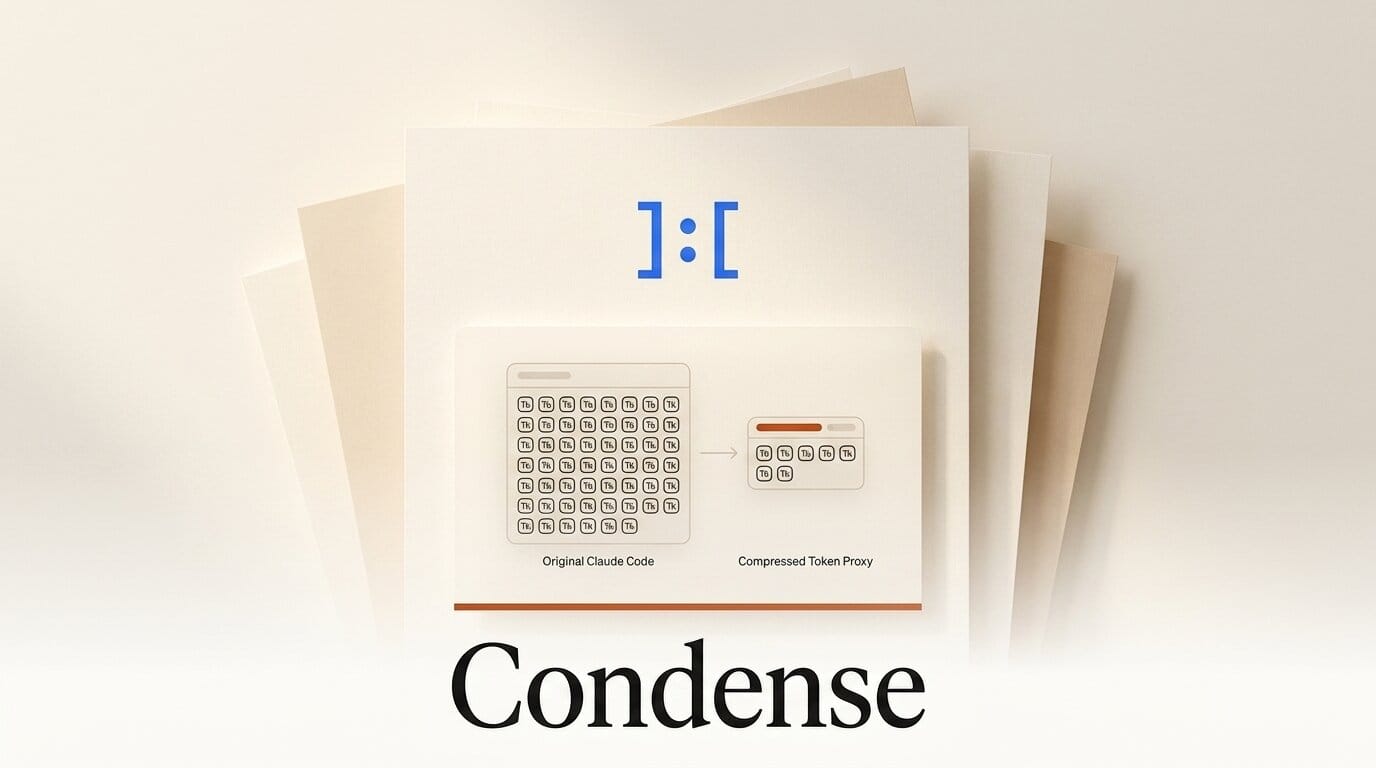
Condense, a new context-compression proxy for AI coding agents, launched on July 3, 2026 with a claim aimed squarely at heavy Claude Code users: up to 70% lower token bills with almost no quality loss. It sits between your coding agent and the model, rewriting bloated tool outputs, file reads, and test logs into compact digests before they ever reach Claude.
Try it: cut your Claude Code bill in one command
Install the CLI with curl -fsSL https://cli.condense.chat/unix | bash, then point your agent's base URL at the Condense route while keeping your existing Anthropic or OpenAI key unchanged. Every turn is routed through two compression models that squeeze tool outputs and file dumps before they hit the model. On a typical session Condense reports input dropping from roughly 100k to 30k tokens per request, which is where the savings come from. The setup docs walk through both the Anthropic and OpenAI SDK routes, so you can wire it into an existing project without changing agent code.
Why It Matters
Coding agents like Claude Code, Cursor, and Codex reread your files, tool results, and terminal logs on every turn, and that repeated context is what drives token spend up over a long session. The usual fix is Anthropic's own compaction, which collapses history once the context window fills but tends to lose detail in the process. Condense instead rewrites context continuously, keeping a running digest of tool calls rather than waiting for a compact-and-forget event. It claims 94.2% faithfulness, meaning the compressed context preserves nearly all of the information the agent actually needs. For a creator running agents against a large codebase, a 70% cut is the difference between a hobby budget and a production one.
Key Details
Condense is open source on GitHub and runs as a drop-in proxy, so no changes to your agent are required beyond swapping the base URL. It reports a 64% reduction in tokens and a 70% reduction in cost on typical sessions, and publishes a public compression leaderboard benchmarking itself against rival approaches, claiming roughly twice as many tokens removed as competing compressors. It enters a crowded field: Headroom, Edgee, and Token Limits all ship similar drop-in compression layers for coding agents. Condense's pitch is the two-model rewrite pipeline and the published faithfulness score, not raw truncation.
What to Do Next
If you run Claude Code or an OpenAI-compatible agent against a large repo and your token spend has crept up, test Condense on a single throwaway session first and compare the output quality against your normal runs before wiring it into production. Watch the faithfulness in your own workflow, since compression that drops a key file detail can cost more in re-prompts than it saves. Then check the pricing tier against your current model spend to confirm the proxy fee does not eat into the savings.