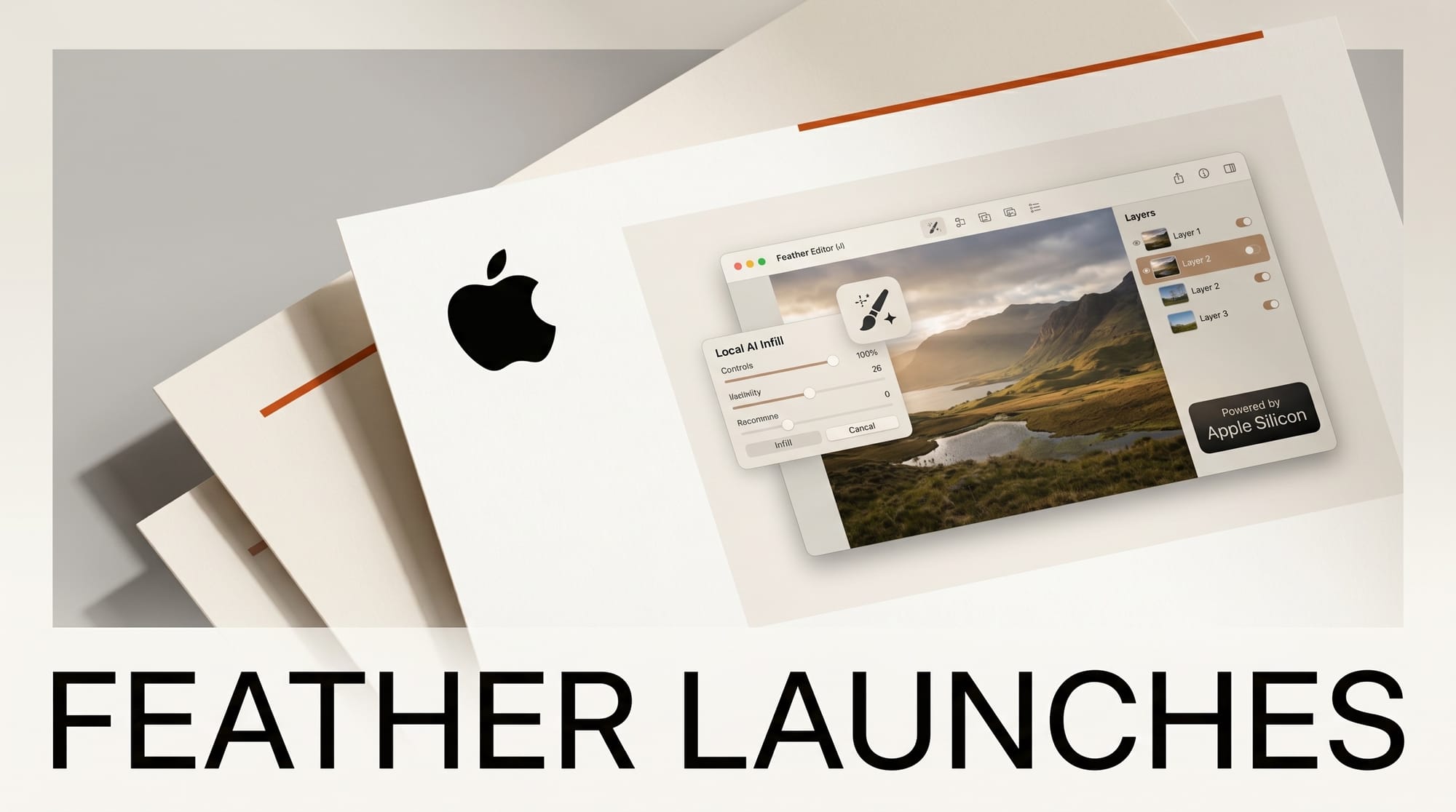
Indie developer Luca Miglioli launched Feather on May 2, 2026, a macOS photo editor that runs its AI features entirely on Apple Silicon, with no cloud uploads. The app shipped at Product Hunt the same day and entered the daily top three within hours of launch, signaling unusually strong reception for a one-developer tool in a category dominated by Adobe and Pixelmator.
Feather pitches three AI capabilities as the headline features: generative infill, magic selection with edge detection, and smart stacking that fuses multiple RAW frames into a cleaner composite. All three run on-device, which means photographers shooting NDA work, wedding clients, or pre-release product shots can use AI tools without ever sending image data to a vendor's servers.
What Happened
Miglioli described the build as a four-month solo project, telling commenters on the launch page that the original interface "was completely on PAPER" before any code went in. The pricing model is unusual for a 2026 photo editor: a single $20 charge for Pro AI Lifetime when using the launch code HUNT20, with no recurring subscription. By comparison, Adobe Photoshop Single App is $22.99 per month, and Pixelmator Pro charges $49.99 once but ships its heavier AI features through Apple's cloud Image Playground bridge.
The system requirement is firm. Feather only runs on Apple Silicon Macs (M1 and newer) because it leans on the Neural Engine for the local model inference. The team recommends at least 16GB of RAM for the smart stacking workflow, though 8GB machines reportedly handle generative infill and magic selection without trouble.
Why It Matters
Local AI in a creative app is rare in 2026. Most photo editors that advertise "AI" features ship the request to a remote server, even when the marketing copy implies otherwise. The privacy distinction matters for any photographer working under NDA, shooting for clients before product launch, or processing images of people who have not signed a model release. Feather's offline pipeline means the file never leaves the laptop.
The pricing model also lands at a moment when subscription fatigue is biting at the prosumer end of the creator market. A pay-once $20 lifetime tier is a direct dare to Adobe's monthly pricing, and it joins a small group of one-time-purchase tools like Pixelmator Pro that have held audience against the subscription default. The trade-off is that Feather has no team behind it for enterprise support or rapid feature shipping, so workflows that depend on tight tool turnaround should test before relying on it.
Key Details
- Launch date: May 2, 2026
- Developer: Luca Miglioli (independent)
- Platform: macOS, Apple Silicon only (M1 or newer)
- Pricing: $20 Pro AI Lifetime with code HUNT20, pay once
- AI features: Generative infill, magic selection, smart stacking
- Other features: RAW support, HSL color mixer inside masks, magic eraser, non-destructive edits
- Privacy posture: All AI inference runs on-device (no cloud upload)
- RAM: 8GB minimum, 16GB recommended for stacking
- Context: Apple itself has been building unified image models for the Apple Silicon Neural Engine, validating the on-device path
What to Do Next
Photographers and designers shooting under NDA or signed-release constraints should download Feather and run a single client edit through it before committing to a workflow change. The lifetime pricing means the cost-benefit of switching is tilted toward trying it. If your work depends on Photoshop-specific plugins or Lightroom-style cataloging, Feather is not a replacement yet, but it is a usable companion app for the AI-heavy edit steps where keeping data on-device matters most.