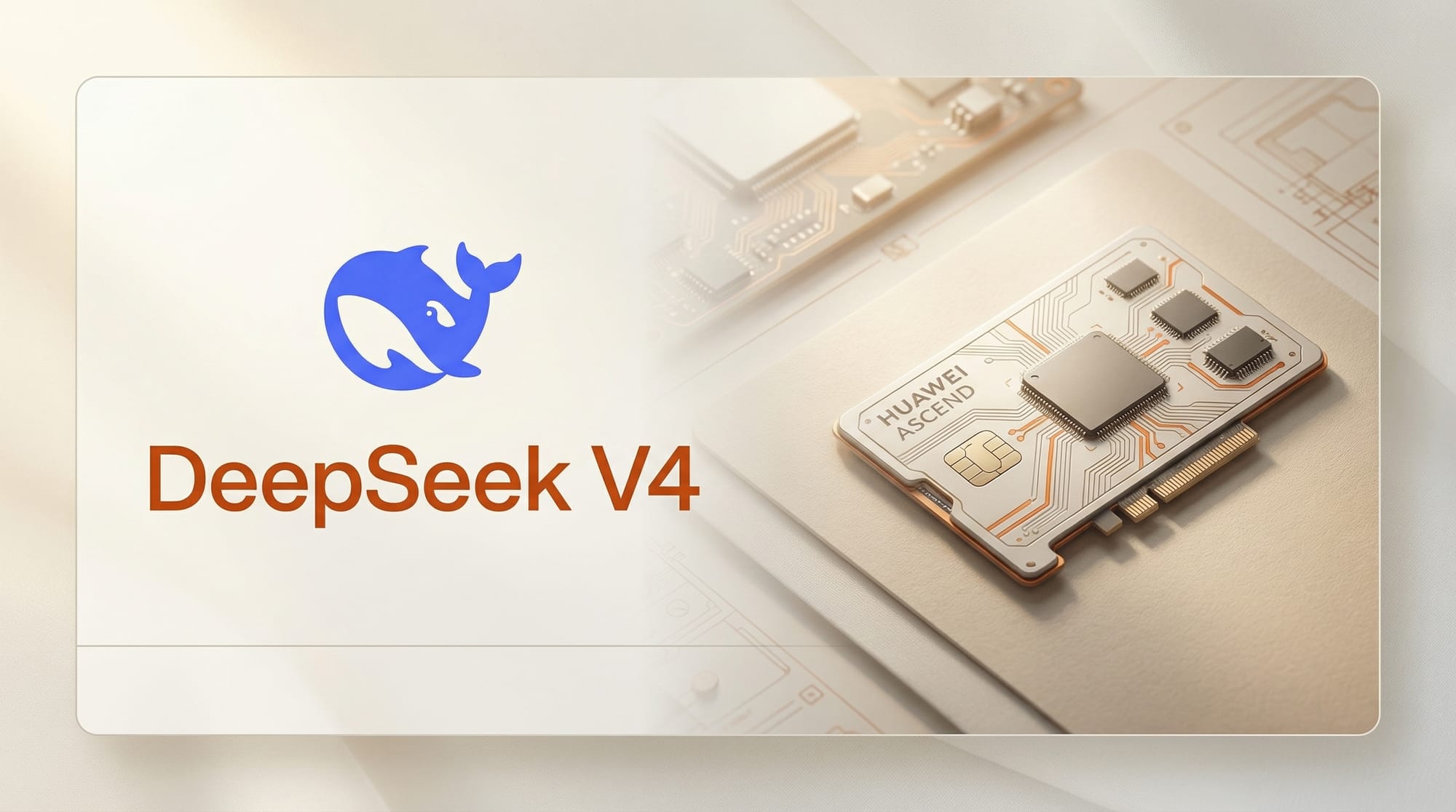
DeepSeek's next-generation V4 model will run exclusively on Huawei's Ascend 950PR processors, marking a significant milestone in China's push to build advanced AI systems without relying on American chip technology. The report, first published by The Information on April 3, comes as Chinese tech giants Alibaba, ByteDance, and Tencent place bulk orders for hundreds of thousands of Huawei's latest AI chips.
What Happened
DeepSeek has spent months collaborating with Huawei and chip designer Cambricon Technologies to port its V4 model to Chinese-made hardware. Engineers rewrote portions of the model's underlying code to achieve compatibility with domestic processors, according to Reuters. The company withheld early access to V4 from US chipmakers entirely, concentrating on local partners instead.
The model is expected to launch within weeks, with two additional variants currently in development.
Why It Matters
For creative AI users, DeepSeek V4 represents a potentially major new option in the multimodal space. The model is expected to be a 1-trillion parameter Mixture of Experts (MoE) architecture with native multimodal capabilities spanning text, image understanding, and code generation. If DeepSeek follows its established pattern, V4 will ship with open weights under a permissive license, giving creators and developers direct access to a frontier-class model -- a dynamic explored in our open source vs. closed AI guide.
The Huawei chip angle adds another layer. The Ascend 950PR delivers roughly 2.8 times the computing power of NVIDIA's H20 (the chip NVIDIA is allowed to sell to China), though it still falls short of the H200. The surge in demand has already pushed chip prices up 20 percent. This suggests China's AI ecosystem is building real momentum independent of Western supply chains, echoing the sovereign AI investment patterns seen in Europe.
Key Details
- Hardware: Huawei Ascend 950PR, co-developed with Cambricon Technologies for AI workloads
- Buyers: Alibaba, ByteDance, and Tencent have ordered hundreds of thousands of units for cloud AI services
- Architecture: Expected 1T-parameter MoE with approximately 32-40B active parameters per token
- Capabilities: Natively multimodal (text, image, code), extended context support
- Pricing: DeepSeek's V3 API costs less than one-tenth of GPT-5; V4 is expected to be even cheaper
- License: Expected open-weight release, consistent with DeepSeek's track record
- Timeline: Launch expected within weeks
What to Do Next
Creators and developers working with open-source AI models should watch for DeepSeek V4's release closely. If the multimodal capabilities match expectations, it could offer a powerful free alternative to proprietary models for image understanding, code generation, and text tasks. The model's availability on Chinese cloud infrastructure (via Alibaba, ByteDance, and Tencent) may also provide access options for users in regions where these services operate.
For those already using DeepSeek V3 in creative workflows, the upgrade path should be straightforward given the company's history of maintaining API compatibility. Keep an eye on the official DeepSeek website for the formal announcement.