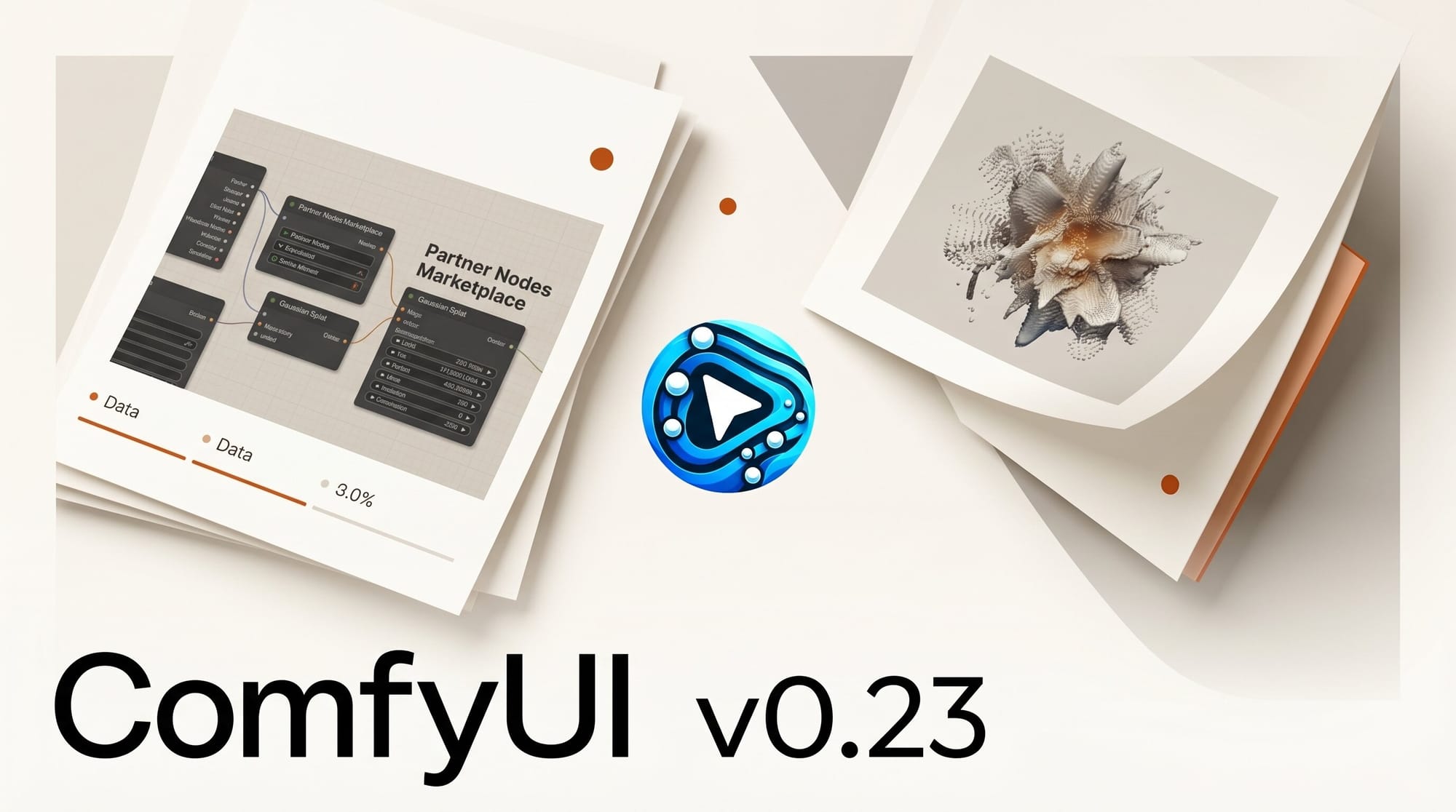
ComfyUI v0.23.0 shipped on June 1, 2026, bundling six new partner nodes, native 3D Gaussian Splat support, MediaPipe face detection, OAuth 2.1, and multi-GPU work units into a single release. The partner node drop is the headline for creators: Krea2 Image, Beeble SwitchX, Tripo3D P1, Rodin2.5, Flux Virtual Try-On, and SeeDance 2 improvements all land in the same template library.
How to Update and What to Try First
Pull the latest release through ComfyUI Manager or download the new portable build from the ComfyUI GitHub repo. The Template Library ships ready-made workflows for each partner node, so you can demo Krea2 Image generation, chain it into Flux Virtual Try-On for product mockups, then export through the new Save3D node as a PLY or SPLAT file for AR/VR delivery. Total setup time from clean install to first generation is under 15 minutes if you already have a working GPU driver stack.
Six Partner Nodes in One Drop
The new partner node lineup spans image, video, 3D, and routing layers in a way prior ComfyUI releases never combined. Krea2 Image adds style-control image generation. Flux Virtual Try-On lets you composite garments onto person shots at catalog scale. Tripo3D P1 and Rodin2.5 cover single-image and multi-view 3D asset generation. Beeble SwitchX is a lighting and relighting node aimed at virtual production workflows. SeeDance 2 improvements upgrade the existing video-generation node with better camera control. An OpenRouter LLM node also lands as a first-class integration, so any prompt-rewriting or autocaption step can route to OpenRouter's 400+ model catalog without a custom node install.
Why It Matters
ComfyUI is the de facto open workflow runtime for image and video generation, and partner nodes are the integration layer that determines which models reach working production pipelines. Six in one release is the biggest single drop the project has shipped this year. The Tripo3D and Rodin2.5 additions also formalize ComfyUI's role as the open frontend for 3D asset generation, on the same day NVIDIA announced its Cosmos Coalition for open world models. For creators, that convergence means fewer separate tools and one workflow editor that handles 2D, 3D, video, and now native Gaussian Splat output.
Key Details
The release also adds multi-threaded model loading for noticeable speedups on systems with NVMe storage, multi-GPU work units that distribute sampling across cards, a stochastic rounding CUDA kernel, MediaPipe face detection for portrait workflows, and OAuth 2.1 with RFC 7591 dynamic client registration for API integrations. Infrastructure updates include SOC 2 compliance detection in the security auditor, And/Or/Not logic nodes for branching workflows, an LTX AV timestep bug fix that improves audio-visual sync, workflow template updates, and a colored logging system that finally makes console errors readable.
What to Do Next
Update ComfyUI this week, run the Krea2 Image template, and test whether it replaces your current style-control model in a real client deliverable. If you use ComfyUI for 3D, the Tripo3D P1 and TripoSplat templates are the new defaults to evaluate, both natively producing the file formats game engines and AR platforms read.