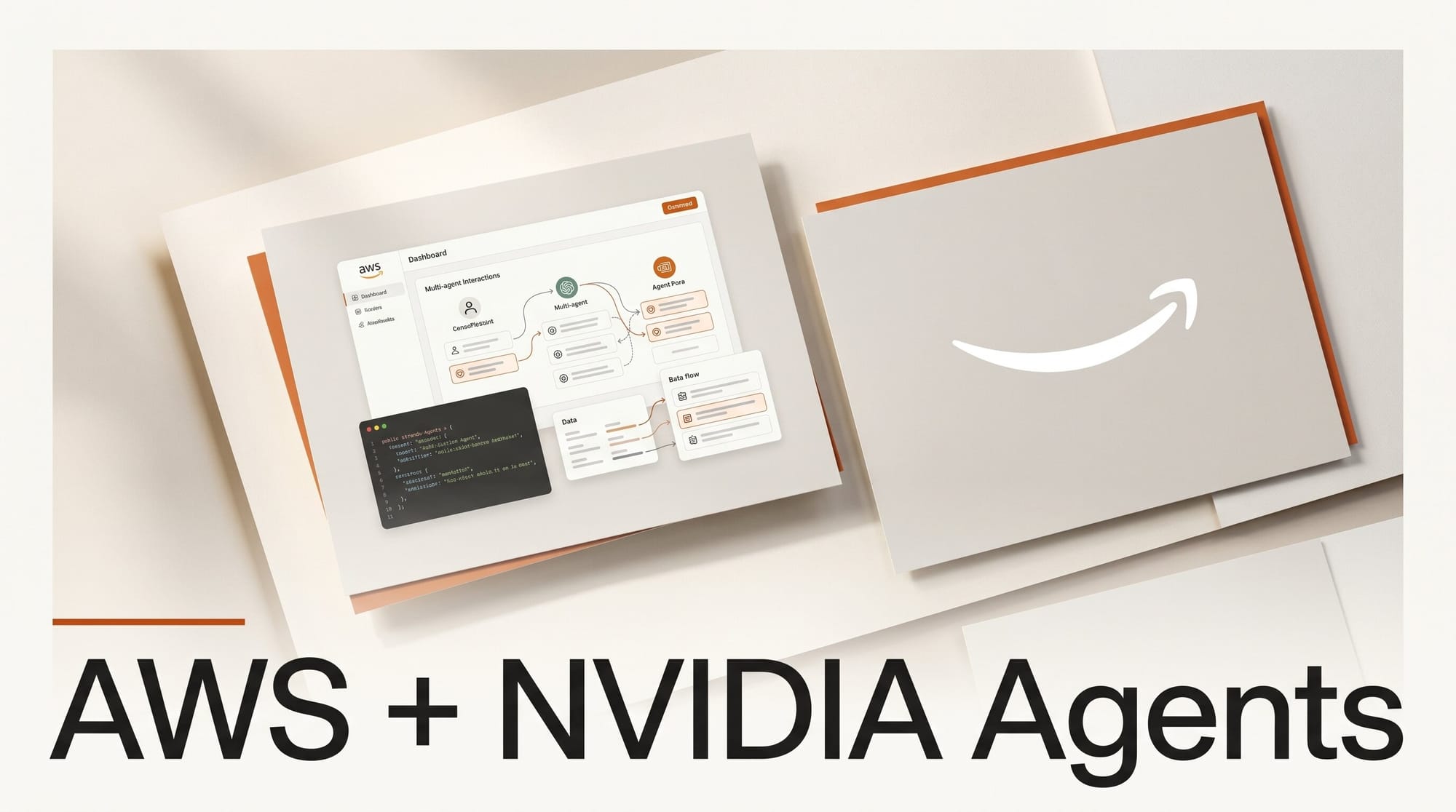
AWS published a reference architecture on May 26, 2026 combining three components into a production multi-agent system: Strands Agents for orchestration, NVIDIA NIM for GPU-accelerated inference, and Amazon Bedrock AgentCore for managed runtime and memory. The guide covers a three-agent campaign review system that evaluates content in parallel, checks brand guidelines, and aggregates recommendations.
What Happened
AWS engineers Kanishk Mahajan and Akshay Parkhi published a complete blueprint for building multi-agent systems that scale to thousands of concurrent invocations. The architecture solves three real problems in production agent deployments: inference latency under concurrent load, stateless execution losing context between calls, and limited visibility into agent execution paths.
Strands Agents is AWS's open-source Python and TypeScript SDK for multi-agent orchestration, built from Amazon's internal production systems. NVIDIA NIM provides GPU-accelerated large language model endpoints at build.nvidia.com, using TensorRT-LLM for low-latency inference with an OpenAI-compatible API so it plugs into existing tooling. Bedrock AgentCore wraps the deployed agent container with checkpointing, recovery, observability, and shared memory across invocations.
Why It Matters for Creators
If you are automating creative review pipelines, script feedback, design critiques, or content moderation, this reference architecture shows how to run multiple specialized reviewers in parallel rather than sequentially. The persona reviewer agent in the demo evaluates content from multiple audience perspectives simultaneously while a validator checks brand guidelines and a finalizer aggregates results. The same pattern applies to any workflow where parallel reasoning accelerates a multi-step review.
The observability layer is worth noting. Bedrock AgentCore surfaces per-step execution traces, token usage, and latency metrics through CloudWatch. For anyone running agents in production, being able to audit exactly what an agent reasoned about before making a decision is increasingly non-negotiable for client-facing workflows.
Key Details
- Strands Agents SDK: Open-source, Python and TypeScript. Available at github.com/strands-agents/sdk-python. Model-agnostic and cloud-agnostic.
- NVIDIA NIM: Hosted GPU inference at build.nvidia.com. OpenAI-compatible Chat Completion API, so no model-specific adapters needed. Requires NVIDIA AI Enterprise EULA acceptance.
- Bedrock AgentCore: Managed runtime with checkpointing (agents recover from interruptions), shared memory for multi-turn conversations, and built-in observability.
- Deployment: Packaged as a Docker container, deployed via AWS SAM template. Three agents run in parallel, React frontend polls asynchronously for results.
- Demo use case: Marketing campaign review with persona reviewer, brand validator, and aggregating finalizer operating in parallel.
What to Do Next
The AWS blog post includes a step-by-step deployment guide with SAM template, DynamoDB setup for persona data, and API Gateway configuration. If you have been prototyping multi-agent workflows and need a path to production infrastructure, this reference is a concrete starting point. For comparison with Google's approach to distributed agent execution, see our guide to migrating agents to Google AX. For AWS-specific AI API integration, see our earlier coverage of SageMaker's OpenAI-compatible endpoints.