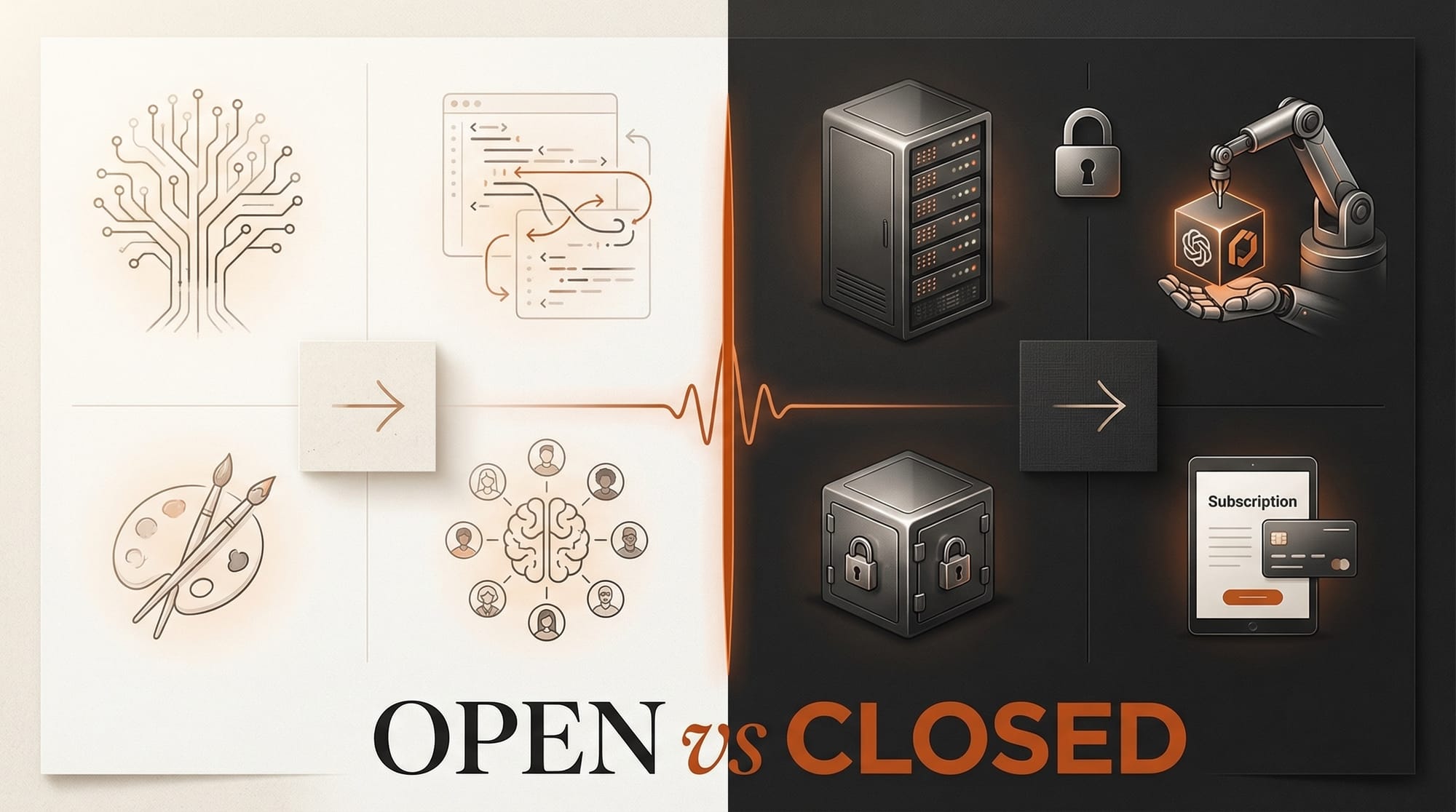
The performance gap between open-source and closed AI models has collapsed from 17.5 percentage points in late 2023 to effectively zero on knowledge benchmarks by early 2026. For creators, that shift changes everything about how you choose your tools.
This guide draws on download and engagement data from HuggingFace, trending repositories on GitHub, current API pricing from OpenAI, Anthropic, and Google, plus subscription costs from Midjourney, Runway, and Suno. The goal: a practical, modality-by-modality breakdown of where open-source models genuinely compete, where closed platforms still lead, and what it costs to use each.
Key Findings
1. Text-to-Image: Open Source Has Won on Volume
Open-source image generation models are pulling staggering download numbers. Stable Diffusion XL logged 2.27 million downloads in the past 30 days alone. FLUX.1-dev from Black Forest Labs hit 754,000 downloads with 12,474 likes, making it the most-loved text-to-image model on HuggingFace.
| Model | Monthly Downloads | Likes | License |
|---|---|---|---|
| SDXL 1.0 | 2,269,426 | 7,539 | CreativeML Open RAIL++-M |
| SD 1.5 | 1,595,405 | 1,049 | CreativeML Open RAIL-M |
| Z-Image-Turbo | 876,154 | 4,276 | Apache 2.0 |
| FLUX.1-dev | 754,240 | 12,474 | Non-Commercial (commercial license available) |
| FLUX.1-schnell | 709,839 | 4,694 | Apache 2.0 |
Compare this to the closed side: Midjourney starts at $10/month for roughly 200 images, while DALL-E 3 charges $0.04 to $0.08 per image via API. Running SDXL locally on a consumer GPU costs nothing per image after the initial hardware investment. FLUX.1-schnell, released under Apache 2.0, is fully free for commercial use and generates images in under 2 seconds.
Quality-wise, Midjourney still produces the most aesthetically consistent results out of the box. But FLUX.1-dev now matches or exceeds DALL-E 3 in prompt adherence, and the community ecosystem of LoRAs and fine-tunes on Civitai gives open-source users customization that no closed platform can offer.
2. Video Generation: Wan2.2 Is Closing the Gap Fast
Open-source video generation was a wasteland 12 months ago. Not anymore. Wan2.2-T2V-A14B pulled 130,303 downloads last month, with quantized GGUF versions adding another 113,254. The Wan family now dominates HuggingFace's text-to-video rankings, occupying 7 of the top 10 spots.
| Option | Type | Cost | Max Resolution |
|---|---|---|---|
| Runway Gen-4 | Closed | $12-76/month | 4K (Pro+) |
| Wan2.2 14B | Open Source | Free (self-hosted) | 720p |
| CogVideoX-5B | Open Source | Free (self-hosted) | 720p |
| Wan2.2 Lightning | Open Source | ~$0.05/video (cloud) | 720p |
Runway's Gen-4 still leads on resolution (up to 4K on Pro plans) and generation speed. But Wan2.2's 720p output is genuinely usable for social media content, storyboarding, and pre-visualization. A typical 5-second Gen-4 clip costs 25 to 60 Runway credits. With Wan2.2, the same clip on a cloud GPU runs about $0.05, or free on a local RTX 4090.
3. Text Generation: The Gap Is Effectively Zero
This is where open source has made its most dramatic gains. Qwen2.5-7B-Instruct leads all open-source models with 22 million monthly downloads. The Qwen family alone accounts for five of the top ten text-generation models on HuggingFace.
| Model | Monthly Downloads | License |
|---|---|---|
| Qwen2.5-7B-Instruct | 22,065,027 | Apache 2.0 |
| Qwen3-0.6B | 13,096,387 | Apache 2.0 |
| Qwen3-8B | 8,567,203 | Apache 2.0 |
| Llama-3.1-8B | 7,632,351 | Llama 3.1 Community (700M user cap) |
| GPT-OSS-20B | 7,468,776 | MIT |
On benchmarks, open models now match closed ones on MMLU, MATH-500, and GPQA Diamond. Qwen 3.5 scores 88.4 on GPQA Diamond, beating all but the most expensive frontier models. The remaining advantage for closed APIs like Claude Opus 4.5 ($5/$25 per million tokens) and GPT-5 ($1.25/$10) sits in complex coding tasks, agentic reasoning, and overall conversational polish.
For creators who need text generation for copywriting, brainstorming, or content editing, a 7B-parameter Qwen model running on a laptop delivers 90% of the quality at zero ongoing cost.
4. Audio and Music: Open Source Is Niche but Growing
Meta's MusicGen-Medium still commands the open-source audio space with 1.4 million monthly downloads. The newer ACE-Step 1.5 is gaining traction at 32,987 downloads and 649 likes since its January 2026 launch, with full-song generation and lyrics support.
| Option | Type | Cost | Commercial Rights |
|---|---|---|---|
| Suno Pro | Closed | $10/month (~500 songs) | Yes |
| Suno Premier | Closed | $30/month (~2,000 songs) | Yes |
| MusicGen-Medium | Open Source | Free (self-hosted) | CC-BY-NC (non-commercial) |
| ACE-Step 1.5 | Open Source | Free (self-hosted) | Apache 2.0 |
| Stable Audio Open | Open Source | Free (self-hosted) | Stability AI Community |
Suno still produces the most polished, radio-ready AI music. Its v4.5 model handles full song structure, vocals, and mixing in a way no open model can match yet. But for background music, sound effects, and quick prototypes, MusicGen and MOSS-SoundEffect get the job done without a subscription. ACE-Step 1.5 is the one to watch: it's Apache 2.0 licensed, meaning you can use it commercially without restrictions.
5. 3D Generation: Still Early, Open Source Leads
In 3D generation, open source actually leads the field. Microsoft's TRELLIS is the clear frontrunner with 26,659 monthly downloads and its own HuggingFace Space (4,776 likes). Tencent's HY-Motion and Hunyuan3D-2 round out the top tier.
Closed 3D generation tools remain scarce. OpenAI's Shap-E is technically open-source. The commercial 3D AI market is mostly dominated by plugins for existing software (Blender, Unity) rather than standalone generation tools. For creators working in 3D, open source is the default choice, not the alternative.
6. The Licensing Landscape Favors Creators
Not all "open" models are equally open. Here is what you actually need to know before building on top of them.
| License | Commercial Use | Notable Models |
|---|---|---|
| Apache 2.0 | Yes, unrestricted | Qwen 2.5/3, FLUX.1-schnell, ACE-Step 1.5, Z-Image-Turbo, DeepSeek R1 (MIT) |
| Llama Community | Yes, up to 700M monthly users | Llama 3.1 8B/70B/405B |
| FLUX Non-Commercial | No (commercial license purchasable) | FLUX.1-dev |
| CreativeML Open RAIL | Yes, with use restrictions | Stable Diffusion XL, SD 1.5 |
| CC-BY-NC | No | MusicGen (all sizes) |
| Stability Community | Non-commercial; commercial license available | Stable Audio Open |
The trend is clear: newer models are launching with more permissive licenses. Apache 2.0 is becoming the default for Chinese tech companies (Alibaba, Tencent, DeepSeek), while Western labs lean toward custom licenses with commercial tiers. If unrestricted commercial use matters to your workflow, filter for Apache 2.0 or MIT.
7. Cost Comparison: The Numbers Speak
Running the math on a small creative studio producing 100 images, 10 videos, 50,000 words of text, and 20 music tracks per month.
| Modality | Closed Platform | Closed Cost/Month | Open-Source Alternative | Open Cost/Month |
|---|---|---|---|---|
| Images (100) | Midjourney Standard | $30 | FLUX.1-schnell (local) | $0* |
| Video (10 clips) | Runway Standard | $12 | Wan2.2 (cloud GPU) | ~$0.50 |
| Text (50K words) | GPT-5 API | ~$7 | Qwen3-8B (local) | $0* |
| Music (20 tracks) | Suno Pro | $10 | ACE-Step 1.5 (local) | $0* |
| Total | $59 | ~$0.50 |
*Assumes existing GPU hardware (RTX 3060 or better). Cloud GPU alternative adds roughly $10-20/month for occasional use.
Even accounting for cloud GPU costs, the open-source stack runs at roughly 65-85% less than the closed equivalent. The trade-off is setup time, technical knowledge, and raw quality at the frontier. But that quality gap is narrowing every quarter.
8. What's Trending: HuggingFace Spaces Tell the Story
HuggingFace Spaces reveal what creators are actually using. The FLUX.1-dev Space sits at 9,405 likes. Wan2.2-Animate hit 4,986 likes within months of launch. TRELLIS leads in 3D at 4,776 likes. And Kokoro-TTS (3,232 likes) shows strong demand for open-source voice synthesis.
On GitHub, Microsoft's BitNet (35,886 stars, +4,792 this month) is pushing 1-bit LLM inference that could make running large models on consumer hardware even more accessible. Fish-Speech (28,338 stars) is becoming the go-to open-source TTS engine.
Trend Analysis
Rising
- Wan2.2 ecosystem is rapidly becoming the "Stable Diffusion of video." Seven variants in HuggingFace's top 10 text-to-video, plus Lightning and GGUF quantized versions for consumer hardware.
- Qwen3 model family from Alibaba is taking share from Llama at a rapid pace, with four models in the top 10 LLMs. All released under Apache 2.0.
- ACE-Step 1.5 is the first open-source music model with genuinely usable output and a permissive license.
- 1-bit and quantized models (BitNet, GGUF variants) are making large models runnable on laptops and phones.
Stable
- SDXL and SD 1.5 remain workhorses with massive download numbers, even as FLUX gains ground.
- MusicGen holds steady as the most-downloaded open audio model, though its non-commercial license limits adoption.
- Closed API pricing continues dropping. GPT-4-equivalent performance now costs $0.40 per million tokens, down from $20 in late 2022.
Emerging
- OpenAI's GPT-OSS-20B (7.5M downloads, MIT license) signals that even closed-first companies see value in open releases.
- TRELLIS and Hunyuan3D-2 are creating a real open-source 3D generation ecosystem for the first time.
- MOSS-SoundEffect from Fudan University represents the first wave of specialized open audio tools beyond music.
Predictions
- Wan2.2 (or its successor) will reach 1080p native generation by Q3 2026. The Lightning variant already demonstrates the optimization trajectory. When it hits 1080p, Runway's core value proposition shrinks to speed and UX.
- Apache 2.0 will become the dominant creative AI license by end of 2026. Alibaba, Tencent, and DeepSeek are forcing the issue. Companies using restrictive licenses will face adoption pressure.
- At least one major image generation company will go open-source or shut down by Q4 2026. The economics of competing with free, high-quality open models while charging subscriptions are brutal. Stability AI's trajectory is a cautionary tale.
- Open-source music generation will cross the "good enough" threshold for commercial production by summer 2026. ACE-Step 1.5 is close. The next version, if it follows the image/text trajectory, will be competitive with Suno for many use cases.
- Local inference on consumer GPUs will become the default for image and text generation. GGUF quantization, BitNet-style 1-bit models, and Apple Silicon optimization are converging to make cloud APIs optional for most creative workflows.
What This Means for Creators
If you are just starting out: Use closed platforms. Midjourney, ChatGPT, and Suno have the lowest learning curve and the most consistent output. The subscription costs are modest and the time you save is worth it.
If you are producing content at scale: Start migrating to open-source models now. The cost savings compound quickly. A studio producing 1,000 images per month saves roughly $270/month switching from Midjourney to self-hosted FLUX.1-schnell. Over a year, that is $3,240.
If you need maximum control: Open source is already your best option. Fine-tuning, LoRA training, custom pipelines, running models offline, keeping data private. None of that is possible with closed APIs.
If licensing matters for your business: Stick to Apache 2.0 and MIT models. Qwen, FLUX.1-schnell, ACE-Step 1.5, and DeepSeek R1 all allow unrestricted commercial use. Avoid CC-BY-NC models (MusicGen) and custom non-commercial licenses (FLUX.1-dev) unless you purchase a commercial tier.
Practical steps to take this week:
- Install ComfyUI or Automatic1111 and try FLUX.1-schnell locally. If your GPU can handle it, you may never pay for image generation again.
- Test Qwen3-8B via Ollama for your text generation needs. It runs on 8GB of VRAM.
- Bookmark Wan2.2-Animate on HuggingFace Spaces to try open-source video generation without any setup.
- Watch the ACE-Step project for updates. It is the most promising open-source music model for commercial use.
Full Data: Open Source vs. Closed by Modality
| Modality | Open-Source Leader | OS Downloads/Month | Closed Leader | Closed Price | Quality Gap | Verdict |
|---|---|---|---|---|---|---|
| Text-to-Image | SDXL / FLUX.1 | 2.3M / 754K | Midjourney | $10-120/mo | Small | Open source wins on cost; closed wins on polish |
| Video | Wan2.2 14B | 130K | Runway Gen-4 | $12-76/mo | Moderate | Closed still leads; open source closing fast |
| Text (LLM) | Qwen2.5-7B | 22M | GPT-5 / Claude Opus | $1.25-25/M tokens | Minimal | Open source matches on benchmarks; closed wins on UX |
| Music | MusicGen-Medium | 1.4M | Suno v4.5 | $10-30/mo | Large | Closed leads significantly; ACE-Step gaining |
| 3D | TRELLIS XL | 27K | (No clear leader) | N/A | Open source leads | Open source is the default |
| TTS/Voice | Fish-Speech / Kokoro | 28K stars (GH) | ElevenLabs | $5-99/mo | Moderate | Closed leads on quality; open source viable |
The era of closed AI models having an unchallenged quality advantage is ending. In image generation and text, open-source models already deliver professional-grade results. Video and audio are 6 to 12 months behind but closing the gap at an accelerating rate. For creators, the question is no longer "is open source good enough?" but "does the convenience of closed platforms justify the ongoing cost?"
For most creators in 2026, the answer is increasingly: no.
This research was produced by Creative AI News.
Subscribe for free to get the weekly digest every Tuesday.