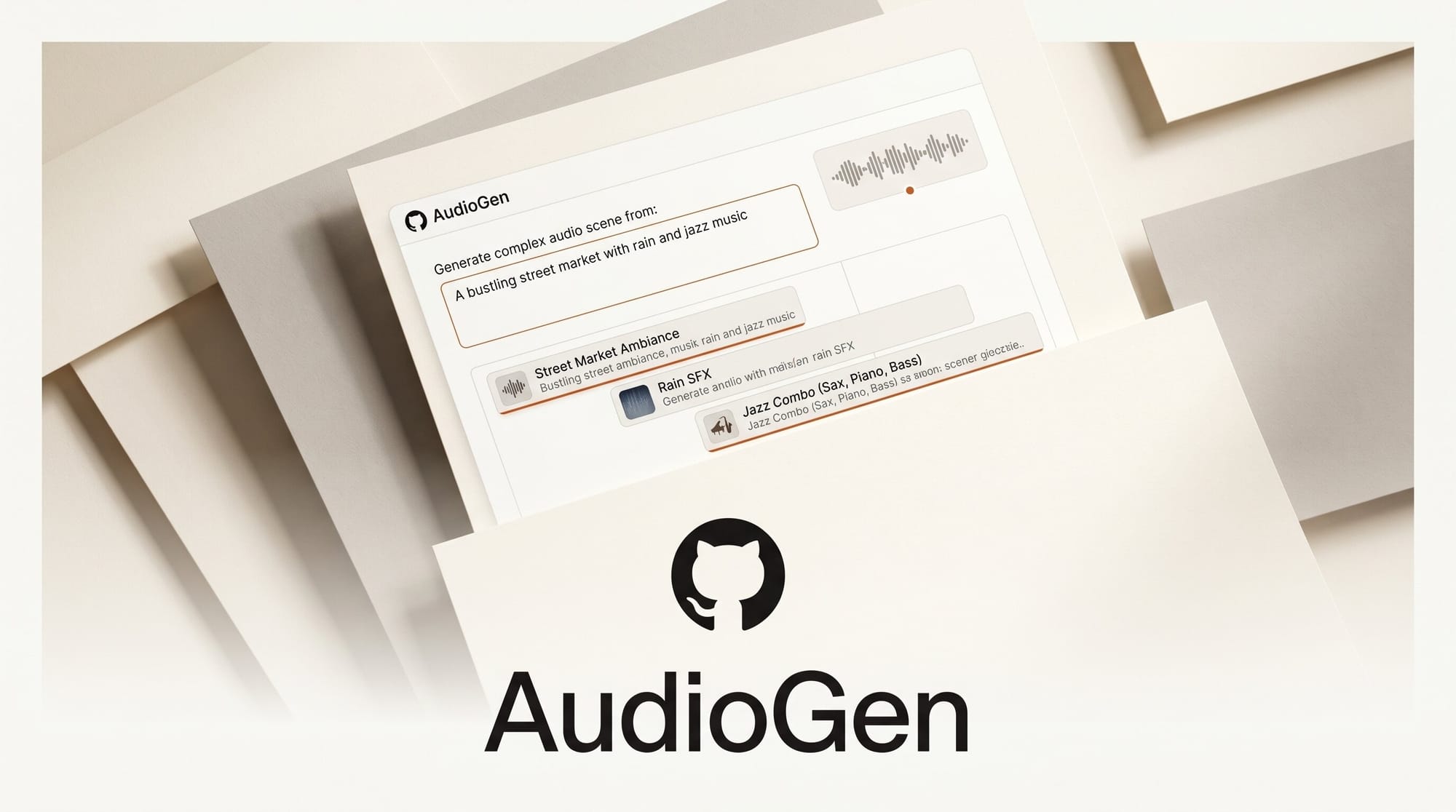
A team of 10 researchers published Dasheng AudioGen on May 27, 2026, a unified model that generates complete audio scenes from text descriptions. Unlike existing tools that handle speech, music, or sound effects as separate tasks, Dasheng AudioGen produces all three simultaneously as one coherent output from a single prompt.
What Happened
The paper, titled "Dasheng AudioGen: A Unified Model for Generating Coherent Audio Scenes from Text," introduces a framework built by Jiahao Mei, Heinrich Dinkel, Yadong Niu, and seven colleagues at multiple institutions. The model addresses what the researchers describe as "fragmentation" in audio generation, where no single tool today generates speech, music, and sound effects as a blended, coherent scene.
The model is available as a research demo with audio samples demonstrating mixed-scene generation across four categories: Mix Audio (coherent scenes), Clean Speech, Music, and Sound Effects. Code and model weights have not been released publicly as of the paper submission date.
Why It Matters for Creators
Current audio production for video content requires assembling layers from multiple sources. A short film creator might use a voice synthesis tool for narration, a music generator for the score, and download licensed ambient sounds from a library like Freesound, then manually balance all three in a DAW. Each layer carries different acoustic fingerprints: reverb, dynamic range, and frequency profiles that rarely match out of the box.
The mixing step that follows, aligning tonality, spatial placement, and timing, is where non-audio specialists lose hours or produce results that sound assembled rather than natural. Dasheng AudioGen generates all three components as a single scene, with the model internal representations keeping them acoustically consistent from generation time.
This matters across several creator use cases:
- Short films and video essays: A single prompt like "A scientist narrates calmly in a sterile laboratory, sparse ambient electronics in the background, occasional equipment beeps" could yield a ready-to-use scene audio track.
- Game development: Environmental audio for scenes combining ambient dialogue, music, and environmental sound generated dynamically from scene descriptions.
- Podcast production: Intro and outro soundscapes blended with voice segments from a single style description.
- Social video: Background scenes for talking-head videos where the audio environment needs to match the visual setting.
How Dasheng AudioGen Works
The system uses three technical components working together:
Structured multi-view captions. When you provide a text description of a scene, the model parses it into distinct views, separating speech, music, and sound effects using special tokens like <|music|> and <|speech|>. This decomposition allows the model to maintain fine-grained control over each audio layer while generating them together as a unified output.
Unified semantic-acoustic latent space. All three audio types share a high-dimensional representation (1280 dimensions). This shared space is what allows speech, music, and SFX to blend without the seams you get from stitching separately generated tracks, because each component is spatially aware of the others during generation.
Flow-matching Diffusion Transformer architecture. The model generates audio through a modern diffusion process, iteratively refining the output from noise to a coherent scene. Flow-matching is increasingly common in high-quality audio and image generation because it produces smoother, more natural outputs than earlier diffusion approaches.
The research team claims results "approaching real-world recordings in mixed-audio categories, while remaining competitive with specialized models in single-type generation tasks." Specific numerical benchmark comparisons were not included in the abstract, but the demo page includes side-by-side audio comparisons between unified and acoustic-only embeddings.
Creator Workflow: Using Dasheng AudioGen Today
Since Dasheng AudioGen is currently a research demo, here is a practical workflow that bridges what exists today and prepares you for when unified audio generation reaches production tools:
- Explore the demo first. Visit the Dasheng AudioGen project page and listen to the mixed-audio examples. Pay close attention to how speech, music, and SFX interact in the same scene. These samples give you a concrete reference for what coherent unified generation sounds like compared to manually mixed tracks.
- Practice scene-based prompting. Write out audio scene descriptions as if you were describing a room: who is speaking, what the background music energy and instrumentation is, and what environmental sounds would naturally be present. This structured thinking translates directly to better results in any audio AI tool, not just Dasheng AudioGen.
- Use production tools for current projects. For commercial work, ElevenLabs Sound Effects handles ambient and environmental audio generation, while Suno generates music from text descriptions. The gap Dasheng AudioGen fills, coherent mixing of all three without a DAW step, still requires manual assembly in production workflows today.
- Set up a Hugging Face account. When the team releases model weights, they will almost certainly appear on Hugging Face. Having an account and familiarity with running inference notebooks will let you test Dasheng AudioGen as soon as it becomes available.
- Watch for commercial implementations. The pattern in AI research is that a strong academic paper precedes a commercial API by six to eighteen months. ElevenLabs, Adobe, and similar companies actively adopt published research. A Dasheng-style unified scene generation feature is a natural roadmap item for any serious audio AI platform.
How It Compares to Current Tools
| Tool | Speech | Music | Sound Effects | Unified Scene | Availability |
|---|---|---|---|---|---|
| Dasheng AudioGen | Yes | Yes | Yes | Yes, single prompt | Research demo only |
| ElevenLabs | Yes, voice cloning and dubbing | Yes, Music v2 | Yes | No, separate tools | Commercial API |
| Suno | Limited, vocals in music only | Yes | No | No | Commercial |
| Traditional DAW workflow | Manual recording or import | Manual or imported | Manual or imported | Manual mix | Always available |
The key differentiator is coherence at generation time. ElevenLabs generates professional-quality speech, music, and SFX, but each is produced separately and requires a mixing step. Dasheng AudioGen value is that the components are acoustically aware of each other from the moment they are generated.
Limitations to Know Before Getting Excited
- No commercial API or workflow integration. You cannot plug this into Premiere Pro, DaVinci Resolve, or any production tool today.
- No code or model weights released. The demo shows the research, but you cannot run the model locally or fine-tune it on your own audio style.
- Duration control not highlighted. Outputs appear to be fixed-length samples. Generating exactly 47 seconds of audio for a specific video segment is not a documented feature.
- Benchmarks are relative, not standardized. The paper describes performance as "approaching real-world recordings" without mapping to standard metrics like Frechet Audio Distance against specific competitor models.
What to Do Next
Listen to the research demos and calibrate your expectations for what unified audio generation actually sounds like today. The trajectory of audio AI in 2026 is clear: ElevenLabs Music v2 cut prices 50% in May and added genre transitions, while new ICML research on compression-resistant audio watermarks signals the field is maturing fast. Dasheng AudioGen is the research foundation that commercial unified audio tools will build from.
Subscribe to the Creative AI News newsletter to get coverage of audio AI tools as they move from research to production.
Frequently Asked Questions
Is Dasheng AudioGen available as a product I can use today?
No. As of May 27, 2026, Dasheng AudioGen is a research demo. You can listen to generated audio samples on the project page, but there is no public API, no downloadable model weights, and no commercial service built on this research yet.
What makes this different from using ElevenLabs and Suno separately?

When you use ElevenLabs and Suno separately, each audio component is generated independently with its own acoustic profile. The reverb, dynamic range, and spatial positioning of the two outputs rarely match without manual mixing work. Dasheng AudioGen generates all components in a shared latent space, so they are acoustically consistent without a separate mixing step.
Does it require a text prompt, or can it take audio input?
The model is text-to-audio: you provide a text description of the scene, and it generates the audio. The paper does not describe audio-conditioned or style-transfer modes where you provide a reference clip.
Will this replace tools like ElevenLabs or Suno?
Not immediately, and possibly not entirely. ElevenLabs and Suno are commercial tools with fine control, voice cloning, style presets, and API integrations that Dasheng AudioGen does not currently offer. The more likely outcome is that commercial tools adopt this unified-scene research approach as a feature alongside their existing capabilities.
What industries would benefit most from unified audio scene generation?
Film and video production, game development, podcast production, interactive audio experiences, and virtual reality content. Any workflow where creators currently assemble audio from multiple separate sources would benefit from a single-prompt unified scene generator that produces coherent output.
Is there any code available to experiment with or extend?
No code, model weights, or training data were released alongside the paper. If model weights are released, they would typically appear on Hugging Face or the project GitHub repository.