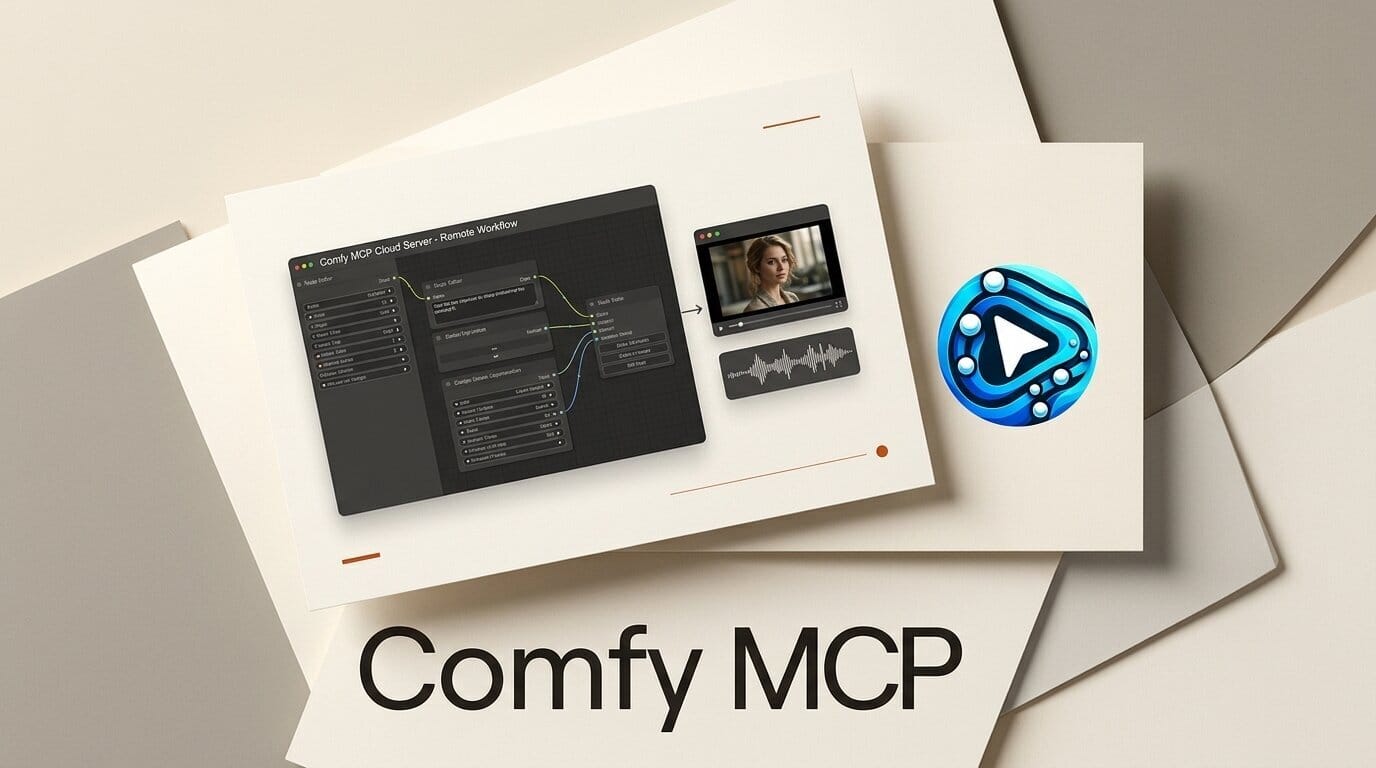
ComfyUI built its name on the node graph, the dense web of boxes and noodles that gave creators total control over image, video, and audio pipelines and scared off almost everyone else. On June 29, 2026, Comfy Org released Comfy MCP, a public-beta server that hands that entire pipeline to an AI agent in plain language. The pitch is blunt: "No nodes, no download, no GPU, no node graphs if you don't want them." For the first time, you can tell Claude or Cursor to generate a video, and ComfyUI does the work in the cloud.
Background
The Model Context Protocol (MCP) is the open standard, introduced by Anthropic, that lets AI agents call external tools through a single connector. Over the past months it has become the default way creative software exposes itself to agents. We have covered Runway's MCP server for video, Figma's MCP for design-to-code, and Picsart's agent-callable CLI for editing. Comfy MCP is the most ambitious entry yet, because ComfyUI is not a single model or a single product. It is the orchestration layer that runs nearly every open and partner model in the creative AI ecosystem.
Comfy Org positions this as "the first MCP built for production pipelines," and the framing matters. Most generation MCPs are tuned for one-off requests: ask, receive an image, move on. Comfy MCP is built around reproducibility and reuse, the things a real project needs when the same look has to hold across fifty shots. It connects Claude, Codex, Hermes, Cursor, and other agents to hundreds of popular ComfyUI workflows and, in Comfy Org's words, "all the latest image, video, 3D, and audio models."
Deep Analysis
What the server actually exposes
Comfy MCP is not a vague "talk to ComfyUI" wrapper. It ships a defined set of tools the agent can call, which keeps behavior predictable. The generation tools cover the four creative modalities plus the utility operations that real edits require, and three search tools let the agent discover what is available before it commits to a run.

The full set: generate-image, generate-video, generate-audio, and generate-3d for creation; remove-background and upscale-image for post-processing; and search-models, search-nodes, and search-templates for discovery. Because the agent can search the model and template catalog first, it does not have to guess which checkpoint or workflow to use. It can look, choose, and then run, the same loop a human takes in the ComfyUI interface.
Cloud-first is the whole point
The headline differentiator is that Comfy MCP runs on Comfy Cloud, not on your machine. There is no model download, no VRAM ceiling, and no local install to maintain. An agent on a laptop with no GPU can generate a video that would otherwise need a 24GB card and a multi-gigabyte checkpoint. That removes the single biggest barrier to agent-driven creative work, which is that the agent and the GPU usually do not live in the same place.
This is also where Comfy MCP separates itself from the community MCP servers that came before it. Projects like joenorton/comfyui-mcp-server and artokun/comfyui-mcp are genuinely useful and feature-rich, with the latter exposing dozens of tools and skills for Flux, WAN, LTX video, and Qwen. But both point an agent at a local ComfyUI install you have to run, patch, and power yourself.

| Dimension | Comfy MCP (official) | Community MCP servers |
|---|---|---|
| Hosting | Comfy Cloud, no local setup | Your own local ComfyUI instance |
| GPU required | None on the client | Yes, local GPU and VRAM |
| Models | Latest image, video, 3D, audio, auto-updated | Whatever you install and maintain |
| Workflows | Hundreds of best-practice templates, kept current | Hand-built or imported by you |
| Auth | OAuth sign-in or API key for CI | Local, usually no auth |
| Maintenance | Handled by Comfy Org | Yours to patch and update |
Reproducibility for long projects
Comfy Org draws a sharp line between "one-off generations" and "long-term projects," and builds Comfy MCP for the latter. The server lets an agent build, edit, run, save, and re-run workflows, execute a shared workflow URL, and retrieve every generation it has produced. Critically, the best-practice workflows are auto-updated, so the agent always calls the current recommended pipeline rather than a stale one a developer pasted in months ago.
That combination, saved workflows plus shared URLs plus a generation history, is what makes results repeatable. A team can lock a workflow, hand its URL to an agent, and get the same output structure every time. For commercial work where a campaign needs visual consistency across dozens of assets, that reproducibility is worth more than any single model upgrade.
Getting it running
Setup is deliberately short. In Claude Code, you add the marketplace with /plugin marketplace add Comfy-Org/comfy-skills, install with /plugin install comfy-cloud@comfy-skills, then run /mcp and authenticate through the browser. In Claude Desktop you add a custom connector pointing at https://cloud.comfy.org/mcp and sign in once. For headless or CI use, you attach an API key directly: claude mcp add --transport http comfy-cloud https://cloud.comfy.org/mcp -H "X-API-Key: comfyui-...".

Interactive clients use OAuth with auto-refreshing tokens, so you sign in once and the agent stays connected. The original comfy-cloud-mcp installer repo was archived on June 22, 2026, with the slash commands moved to the comfy-skills repository, a sign the install path is now stable enough to consolidate.
Impact on Creators
The practical shift is that ComfyUI's power is no longer gated behind learning the node graph. A creator who could never wire a video workflow can now describe the result and let an agent assemble it from current best-practice templates. The skill that mattered, knowing which model and which node order produces a clean result, is increasingly encoded in the templates the search tools surface.
For builders, the bigger unlock is composition. Because Comfy MCP speaks the same protocol as every other MCP tool, an agent can pull a script from one server, generate the matching b-roll through Comfy MCP, remove backgrounds, upscale, and assemble a 3D asset, all in one session without a single node graph or local GPU. That is the production pipeline Comfy Org is describing, and it now lives inside the agent rather than inside the ComfyUI canvas.
Key Takeaways
1. Comfy MCP, launched June 29, 2026, lets agents like Claude, Cursor, Codex, and Hermes drive ComfyUI's full image, video, audio, and 3D pipeline in natural language, with no nodes and no local GPU.
2. The cloud-hosted, first-party model is the key separator from community MCP servers, which are powerful but require you to run and maintain a local ComfyUI install.
3. Reproducibility is the design goal: saved workflows, shareable URLs, generation history, and auto-updated templates make it suitable for long-term projects, not just one-off images.
What to Watch
Comfy MCP is in public beta, and Comfy Org warns that "APIs, tools, and behavior may change." The open questions are pricing and credits, which the beta does not yet detail, and how cloud generation costs scale for heavy production use against running your own hardware. Watch whether the auto-updated template library stays genuinely current, and whether Comfy MCP becomes the default creative tool agents reach for the way Claude Code became the default coding agent.
Frequently Asked Questions
What is Comfy MCP?
Comfy MCP is an official Model Context Protocol server from Comfy Org, released June 29, 2026, that connects AI agents to ComfyUI's cloud. It lets agents generate images, video, audio, and 3D, run and reuse workflows, and search models and templates in natural language.
Do I need a GPU to use Comfy MCP?
No. Comfy MCP runs on Comfy Cloud, so generation happens on Comfy Org's hardware. Your client machine does not need a GPU or any local ComfyUI install, which is the main difference from community ComfyUI MCP servers.
Which AI agents work with Comfy MCP?
Comfy Org lists Claude, Codex, Hermes, and Cursor, plus other agents that support MCP. You install it as a plugin in Claude Code, a custom connector in Claude Desktop, or via an API key for headless and CI environments.
How is Comfy MCP different from community ComfyUI MCP servers?
Community servers such as joenorton/comfyui-mcp-server and artokun/comfyui-mcp point an agent at a local ComfyUI instance you host and maintain. Comfy MCP is first-party and cloud-hosted, with auto-updated best-practice workflows and access to the latest models, in exchange for running on Comfy Cloud rather than your own machine.
Is Comfy MCP free?
It is in public beta and requires a Comfy account at cloud.comfy.org. Comfy Org has not published pricing or credit details for cloud generation yet, and notes that behavior may change during the beta.
What can an agent actually do with it?
Through nine tools, an agent can generate images, video, audio, and 3D, remove backgrounds, upscale images, search models, nodes, and templates, and save, re-run, or share workflows. It can also retrieve every generation it has produced, which supports reproducible, multi-step production work.
Deep dive by Creative AI News.
Subscribe for free to get the weekly digest every Tuesday.