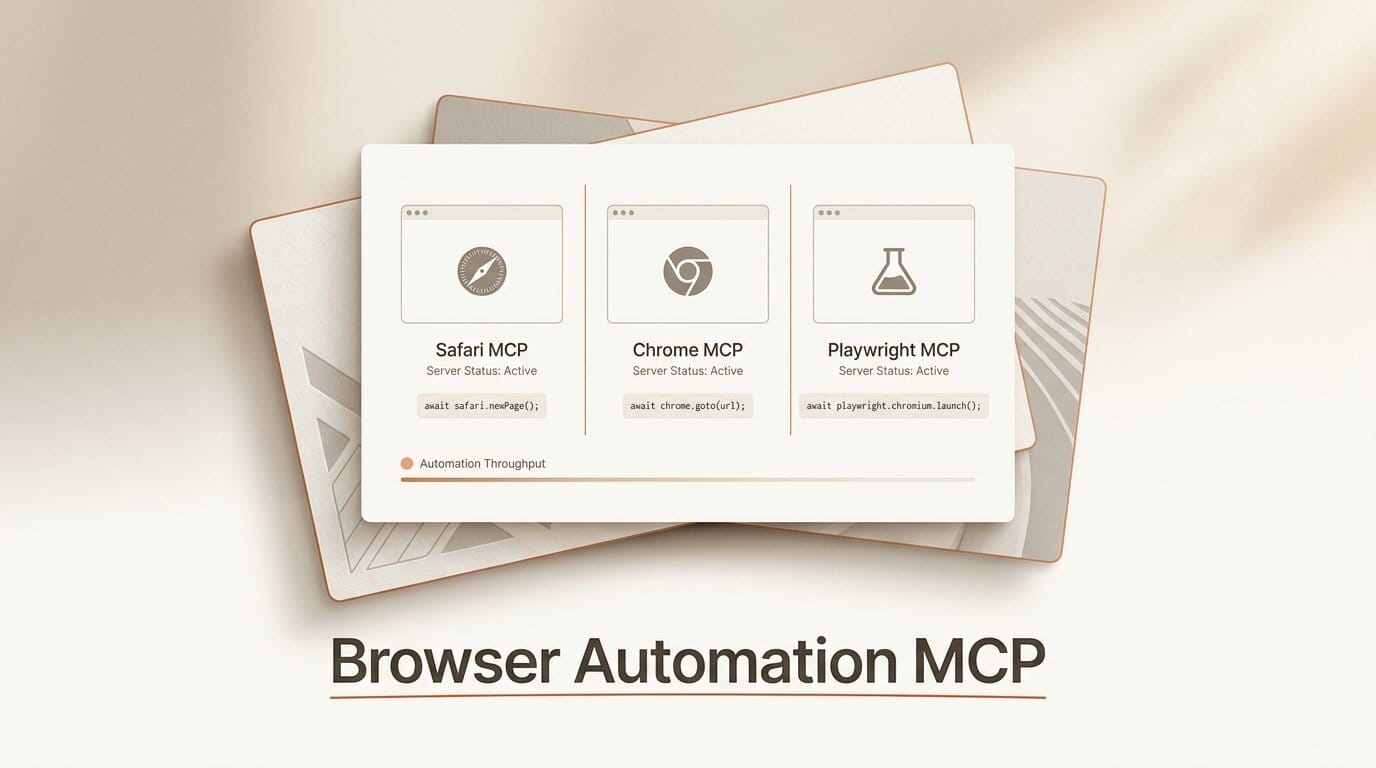
If your AI coding agent needs to drive a real browser, there are now three first-party Model Context Protocol servers to choose from, and the right pick depends almost entirely on which browser you are targeting and how many tools you need. Playwright MCP wins for cross-browser automation and CI, Chrome DevTools MCP wins for deep Chrome performance work, and the Safari MCP server wins when you specifically need to debug on real WebKit. This comparison is based on each project's official documentation, comparing browser coverage, tool count, transport, and setup.
Quick Picks
Pick Playwright MCP if you need one server that automates Chromium, Firefox, and WebKit, runs headless in CI, and gives your agent the widest toolset.
Pick Chrome DevTools MCP if you are building for Chrome and want your agent to read live performance traces, network waterfalls, and the DOM the way a human uses DevTools.
Pick the Safari MCP server if you need to reproduce and debug bugs on real Safari and WebKit, which no Chromium-based tool can do faithfully.

The Three Browser-Automation MCP Servers Compared
All three speak the Model Context Protocol, so any MCP-capable agent, such as Claude Code or a Codex-style tool, can connect to any of them. The differences are in coverage, depth, and how they represent a page to the model.
| Dimension | Playwright MCP | Chrome DevTools MCP | Safari MCP |
|---|---|---|---|
| Maintainer | Microsoft | Google / Chrome | Apple / WebKit |
| Browsers driven | Chromium, Firefox, WebKit | Chrome / Chromium | Safari / WebKit |
| Tool count | 67+ | Growing (incremental) | 15 |
| Page representation | Accessibility tree | DevTools protocol | DOM + console + network |
| Headless / CI | Yes | Node-based | Local macOS only |
| Install | npx @playwright/mcp | npx chrome-devtools-mcp | safaridriver + config |
Browser Coverage
This is the single biggest differentiator. Playwright MCP drives Chromium, Firefox, and WebKit from one server, selected with a browser flag, which makes it the only option for genuine cross-browser work. Chrome DevTools MCP is Chrome and Chromium only. The Safari MCP server drives Safari and WebKit only. If you need to confirm a bug reproduces on Apple's engine, Playwright's WebKit build helps, but the Safari server debugs the actual shipping browser rather than a WebKit build.
How Each Represents a Page to the Model
Playwright MCP uses Playwright's accessibility tree rather than pixel input, so the agent reasons over structured data and does not need a vision model, with coordinate-based clicking available only as an opt-in capability. Chrome DevTools MCP leans on the DevTools protocol, exposing performance tracing through a named tool, network inspection for issues like CORS, console analysis, and DOM and CSS inspection. The Safari server exposes DOM interactions such as click, type and scroll, console message retrieval, network request inspection, JavaScript evaluation, and screenshots. The practical effect is that Playwright is optimized for reliable automation, Chrome DevTools for diagnosis, and Safari for faithful reproduction.
Tool Count and Depth
Playwright MCP ships 67 or more tools across core automation, tab management, network mocking, storage, tracing, and opt-in PDF and vision capabilities. The Safari server exposes a focused set of 15 tools aimed at debugging workflows. Chrome DevTools MCP is building incrementally and points to its own tool reference rather than a fixed count, with performance tracing as its standout capability. More tools are not automatically better, but for complex multi-step automation Playwright's breadth reduces how often the agent has to improvise.

When Each One Wins
Playwright MCP wins for automation at scale. Cross-browser support, headless operation, and the largest toolset make it the default for end-to-end testing, CI pipelines, and any agent that needs to click through real flows across engines. Its documentation frames the MCP server as better than the Playwright CLI for coding agents specifically because it offers persistent state, rich introspection, and iterative reasoning over page structure.
Chrome DevTools MCP wins for diagnosis on Chrome. When the question is why a page is slow, why a request failed, or what the rendered DOM actually looks like, giving the agent live access to performance traces and the network panel is exactly what a human developer would reach for. It is the strongest choice for performance debugging on the world's most-used engine.
The Safari MCP server wins for WebKit fidelity. Safari-specific rendering and behavior bugs are a recurring tax on web developers, and until now an AI agent had no faithful way to inspect them. Because it runs entirely on the local machine and makes no network calls of its own, it is also the most contained option, though it cannot access personal browser data like AutoFill or history.

Setup and Requirements
All three are free and open, so the real cost is setup and platform lock-in rather than money. Playwright MCP and Chrome DevTools MCP both install through a single npx command and need only a Node.js environment, which makes them trivial to add to most agent configs and to run in CI. The Safari MCP server is the most demanding: it requires Safari Technology Preview 247 or newer on macOS, developer features enabled in Safari settings, and registration of the safaridriver executable via a command such as an MCP add step or a config file. That macOS requirement means the Safari path is only available to developers on Apple hardware, while the other two run anywhere Node runs.
Verdict
For most agent workflows, start with Playwright MCP: it covers the most browsers, ships the most tools, and runs in CI. Add Chrome DevTools MCP when you need to profile or diagnose a Chrome-specific problem in depth, and add the Safari MCP server when a bug only shows up on real Safari. They are not mutually exclusive: because they all speak MCP, an agent can hold connections to more than one at once and route each task to the server that fits. The same multi-tool pattern shows up across the broader agent-in-the-browser space, from Codex's own Chrome extension browser agent to purpose-built bridges.
Frequently Asked Questions
Can I use more than one browser MCP server at the same time?
Yes. All three implement the Model Context Protocol, so an MCP-capable agent can connect to several at once and choose the right one per task, for example Playwright for automation and Chrome DevTools for a performance trace.
Which browser MCP server has the most tools?
Playwright MCP, with 67 or more tools spanning automation, tab and network control, storage, and tracing. The Safari server exposes 15 focused debugging tools, and Chrome DevTools MCP is expanding its set incrementally.
Does the Safari MCP server work on Windows or Linux?
No. It requires Safari Technology Preview 247 or newer on macOS and drives Safari through safaridriver, so it is macOS-only. For WebKit coverage off macOS, Playwright MCP's WebKit build is the closest alternative.
Do these servers need a vision model to work?
Not by default. Playwright MCP uses the accessibility tree rather than screenshots, so the agent reasons over structured data. Coordinate and vision-based interaction is available in Playwright only as an opt-in capability.
Are they free to use?
Yes. All three are free, open first-party tools. The meaningful cost is setup and platform requirements, most notably the Safari server's macOS and Safari Technology Preview dependency.