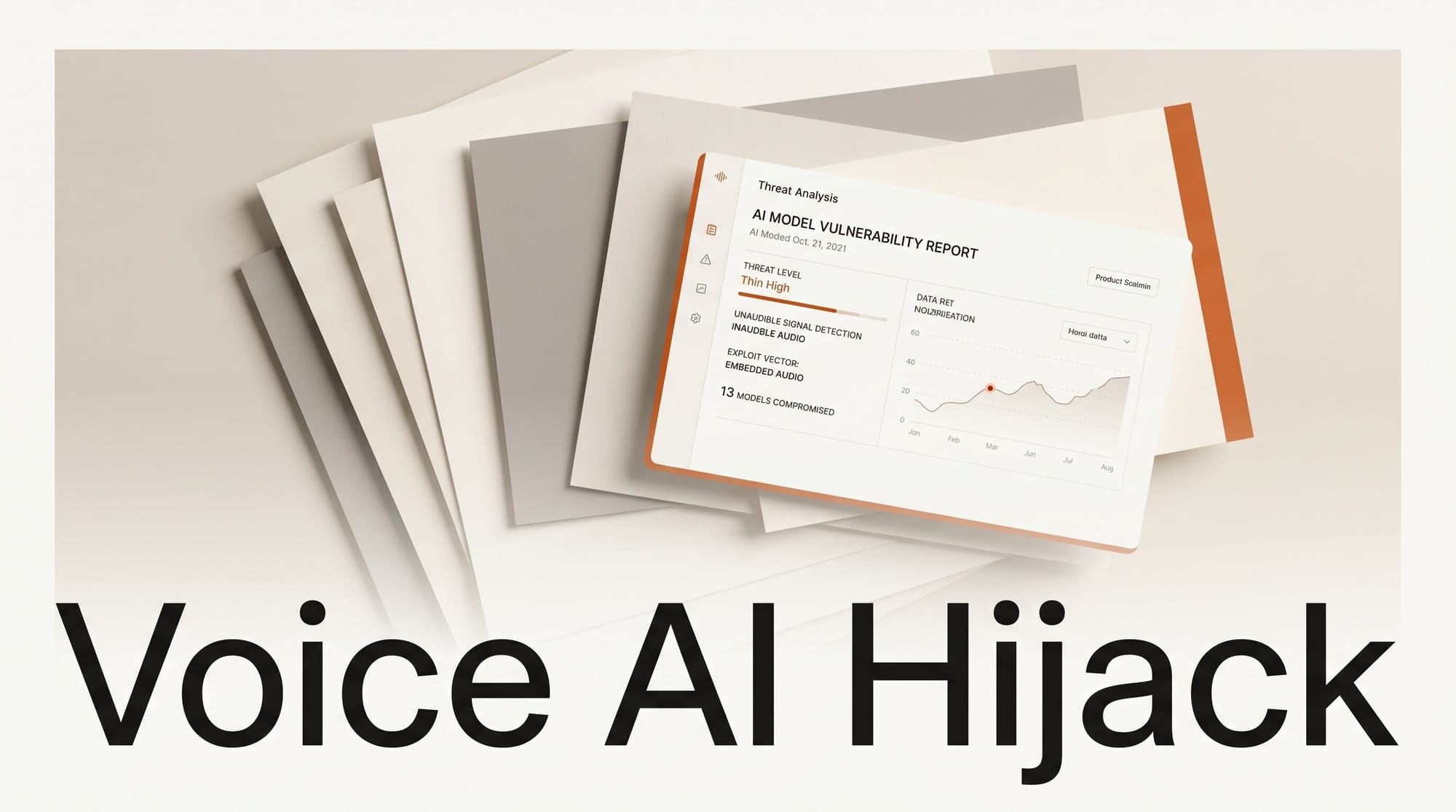
Security researchers have found a way to hijack voice AI models using inaudible sounds embedded in ordinary audio clips. The attack, called AudioHijack, achieved 79 to 96 percent success rates across 13 large audio language models, including commercial systems from Mistral AI and Microsoft Azure. IEEE Spectrum covered the research on May 17, 2026, ahead of its presentation at the IEEE Symposium on Security and Privacy 2026, one of the top academic security conferences in the world.
The finding is relevant to any creator building or using voice AI systems that accept audio input: voice agents for customer support, AI-powered podcast analysis with response generation, or multimodal audio APIs in production workflows. The attack surface is already live in tested production models.
What Happened
Researchers Meng Chen, Kun Wang, Li Lu, Jiaheng Zhang, and Tianwei Zhang developed a general attack framework that generates adversarial audio clips capable of hijacking large audio language models (LALMs). Their paper, submitted April 16, 2026, demonstrates six categories of malicious behavior that an attacker can trigger by sending a manipulated audio clip to an AI voice system:
- Making the model falsely claim it cannot process audio
- Refusing legitimate user requests
- Responding with fabricated information
- Inserting malicious links into model responses
- Altering the model or system identity
- Triggering unauthorized tool actions on behalf of the user
The injected instructions are inaudible to humans. An audio clip sounds like a normal recording, possibly with slight reverberation, but contains hidden commands that override the intended behavior. No specialized playback equipment is needed. The clip can be sent through any channel the voice AI accepts: an uploaded file, a phone call, or a web form.
How AudioHijack Works

Earlier adversarial audio attacks added noise to recordings. Noise is detectable, especially in high-quality audio. AudioHijack solves this with a convolutional perturbation blending technique that redistributes the injected signal across the time and frequency domain using learnable reverberation-like kernels. The result sounds like natural room echo, not artificial interference.
The framework also addresses a deeper technical obstacle. Most audio language models use non-differentiable audio tokenizers, meaning standard gradient-based optimization cannot run through them end-to-end. AudioHijack uses sampling-based gradient estimation to work around this, enabling optimization even when the audio frontend is a black box. An attention-steering mechanism ensures the model focuses on adversarial instructions rather than the legitimate audio content.
The attack is context-agnostic. The same manipulated clip hijacks the model regardless of what the user asks, making it scalable and practical in real-world deployments. A single crafted audio file could be embedded in shared content and affect every downstream user who plays it through a vulnerable voice AI system. The full technical breakdown is in the HTML version of the paper.
Which Voice AI Systems Are Affected

The researchers tested 13 state-of-the-art LALMs across diverse architectures and scales. Specific models named in coverage include Kimi-Audio, Qwen2-Audio, and GLM-4-Voice. Mistral AI and Microsoft Azure had commercial systems confirmed vulnerable through responsible disclosure before the paper published.
| System Type | Examples | Exposure |
|---|---|---|
| Large audio language models (LALMs) | Kimi-Audio, Qwen2-Audio, GLM-4-Voice | Directly tested, confirmed vulnerable (13 models) |
| Commercial voice AI APIs | Mistral Voxtral, Microsoft Azure voice services | Confirmed via responsible disclosure |
| Voice agents built on affected LALMs | Any application using the above as backend | Inherits vulnerability from underlying model |
| Text-to-speech output tools | ElevenLabs TTS, Suno, Udio | Not directly exposed (generate audio, do not process audio instructions) |
| Voice assistants with ASR pipeline | ChatGPT Voice, Gemini Live (text-routed) | Reduced exposure if audio is transcribed to text before LLM processing |
The distinction between output-only TTS tools and input-processing LALMs is critical. Tools like ElevenLabs generate audio but do not process audio instructions from untrusted sources. Creators who have deployed ElevenLabs voice agents using GPT-5.4 backends should verify whether the conversation layer passes raw audio to a LALM or first transcribes to text.
What Creators Need to Know
The practical threat model for creative AI builders is narrow but concrete. If you use a LALM to process user-submitted audio, that audio can be pre-manipulated to change the model behavior before it reaches your application layer. Standard audio analysis cannot detect this. The manipulated clip sounds normal.
The attack is most dangerous for voice agent builders because the sixth attack category enables unauthorized tool use. A voice AI agent connected to file storage, calendars, email, or payment systems could be manipulated into taking actions the user never requested, simply by receiving a crafted audio clip. The researchers describe this as executing unauthorized actions on behalf of users. This threat model is similar to concerns about AI models with elevated system access: audio-based prompt injection adds a new delivery vector.
Creators using multimodal audio APIs like Qwen2-Audio for content analysis, podcast processing, or interactive audio applications should treat audio from external sources as potentially adversarial until mitigations are available from model providers. The broader security landscape for voice AI, covering deepfakes, voice cloning, and prompt injection, is mapped in Nurix AI voice security guide for 2026.
What to Do Next
If you build with voice AI, take these steps now:
- Audit your audio input pipeline. Any system that passes user-submitted or externally sourced audio directly to a LALM is at risk. Document every point where audio from outside your system enters an AI model.
- Request vendor disclosure. If you use Mistral Voxtral or Microsoft Azure voice AI services, contact your vendor about the AudioHijack disclosure and ask about available patches or mitigations.
- Restrict tool access on voice agents. If your voice AI agent has tool use enabled, apply least-privilege permissions. An agent that can only read data is far less dangerous under this attack than one that can write, send, or execute actions.
- Verify audio source authenticity. Only process audio from authenticated users through verified channels where possible. Avoid passing publicly submitted or anonymous audio directly to LALM endpoints without additional verification.
- Log and monitor for anomalous behavior. Set up alerts for unexpected tool invocations, persona shifts, or out-of-character responses from voice agents. AudioHijack attacks produce detectable anomalies in model outputs even if they cannot be caught in real time at the audio level.
Track ongoing research and vendor patches through IEEE Spectrum adversarial attacks coverage.
Frequently Asked Questions
Does AudioHijack affect ElevenLabs or Suno?
No. ElevenLabs and Suno are text-to-speech and AI music generation tools that produce audio output. They do not process audio instructions from users. AudioHijack targets large audio language models that accept audio as input and act on its content. TTS output tools are not in scope for this attack.
How inaudible are the injected commands?
AudioHijack uses convolutional perturbation blending to make adversarial signals sound like natural room reverberation. The paper reports preserved audio quality at levels that pass casual human review. Detecting the manipulation requires specialized signal analysis, not the human ear.
Can I patch my voice AI application without waiting for the model provider?
Partially. Application-level defenses like tool permission restrictions, audio source authentication, and response monitoring reduce risk but cannot eliminate the underlying vulnerability. The flaw exists in the model architecture itself. A complete fix requires model provider patches or architectural changes to the LALM.
Which model providers have acknowledged the vulnerability?
Mistral AI and Microsoft Azure were named in the researchers responsible disclosure process. The paper was accepted at IEEE S&P 2026, which follows rigorous peer review. Other providers among the 13 tested have not been publicly named, but the disclosure scope was broad given the paper scale.
Is this related to earlier audio adversarial attacks?
Earlier work focused on speech recognition systems: manipulating them into transcribing incorrect text. AudioHijack targets generative models with tool access and response capabilities. The attack surface is structurally similar in that it involves manipulated audio input, but the blast radius is far larger when the model can take actions rather than only produce text.
What is the difference between a LALM and a standard voice AI tool?
A large audio language model processes audio as direct input and generates responses or takes actions based on audio content. Models like Qwen2-Audio and Kimi-Audio are examples. A standard voice AI pipeline transcribes audio to text first using ASR (automatic speech recognition), then passes that text to a text-based LLM. Systems using a separate ASR step before the LLM may have reduced exposure, since the adversarial audio would need to survive transcription intact to reach the language model.