xAI has turned voice agents into a two-minute build. On July 1, 2026, the company launched the Voice Agent Builder, a no-code platform that takes a plain-English description of a phone call and turns it into a live agent running on Grok Voice. The headline that matters for builders is not the speed of setup, though. It is the price: $0.05 per minute of audio, all-inclusive, with voices and the model bundled in and no separate platform fee. That number lands exactly on the floor of the voice-agent market, and it is structured to stay there.
For anyone who has wired together speech-to-text, a language model, text-to-speech, and telephony to ship a support line or a booking bot, this is a direct shortcut. Below is what shipped, how the economics actually compare once you account for the pieces most platforms bill separately, and how to stand up a working agent yourself.
What xAI Shipped
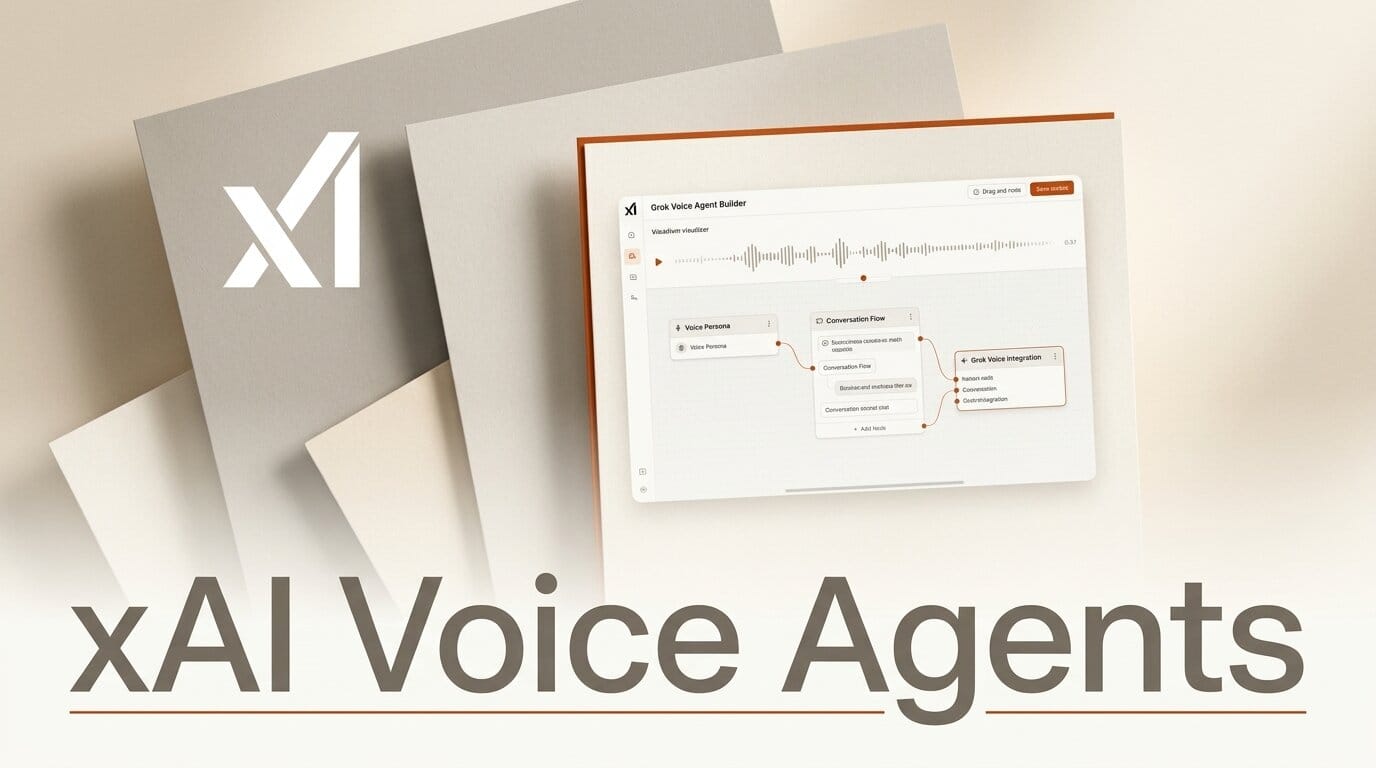
The Voice Agent Builder is a configuration surface, not a framework. You write how a call should flow in ordinary language, attach the documents the agent should know, connect the tools it can call, and set guardrails for what it must not do. xAI says a working agent goes from zero to live in about two minutes. Out of the box you get telephony, knowledge retrieval, tool use, guardrails, Model Context Protocol connectors, and observability in one place, so there is no surrounding stack to assemble.
The voice layer is generous. Agents can use any of 80-plus built-in voices, or a clone of a brand voice generated from roughly two minutes of reference audio. The platform supports more than 25 languages and runs on Grok's voice model, which xAI positions around sub-second response times and natural back-and-forth. Every account ships with a free provisioned phone number for test and production traffic, and direct SIP connect lets you bring an existing number from any major telephony provider. The full parameter set is documented in the xAI Voice Agent docs.

How the Pricing Actually Compares
Voice-agent pricing is a minefield because a "$0.05 per minute" headline rarely includes the things that actually cost money. Bring-your-own-key platforms quote an orchestration fee and leave you to pay for the model, the transcription, and the synthesis on top. Bundled platforms fold everything into one rate but usually set that rate higher. xAI's contribution is a bundled rate at the bring-your-own-key floor.
| Platform | Headline rate | What it includes | Realistic all-in |
|---|---|---|---|
| xAI Voice Agent Builder | $0.05/min | Model, voices, guardrails, tools (telephony +$0.01/min) | $0.05-0.06/min |
| Vapi | $0.05/min | Orchestration only, bring your own STT/LLM/TTS | $0.14-0.33/min |
| Retell | ~$0.055/min | Voice infra, components billed separately | $0.07-0.15/min |
| Bland | $0.11-0.14/min | Bundled STT, LLM, TTS, telephony | $0.11-0.14/min |
| ElevenLabs Agents | $0.08-0.24/min | Bundled voice pipeline | $0.08-0.24/min |
The gap is real once you model a full pipeline. A basic Vapi setup on Deepgram, a small GPT model, and PlayHT runs roughly $0.14 to $0.15 per minute, and swapping in premium providers pushes it to $0.25 to $0.33. Independent calculators such as the Softcery per-minute calculator exist precisely because the headline numbers mislead. xAI's rate is notable not because $0.05 is unprecedented as a number, but because it is $0.05 with the model and voices already inside it.
Build a Voice Agent in Under Two Minutes
The fastest way to judge the platform is to ship a throwaway agent and call it. Here is the minimal path:
1. Describe the call flow in plain language. Write two or three sentences: who the agent is, what it should accomplish, and how it should escalate. Example: "You are the booking line for a dental clinic. Collect the caller's name, preferred day, and reason for the visit, then confirm and offer to transfer to a human if they ask."
2. Attach a knowledge base. Upload the documents the agent should answer from, such as a services list, hours, and an FAQ. Retrieval is built in, so there is no separate vector database to provision.
3. Add tools and guardrails. Connect any MCP tools the agent may call (a calendar, a CRM lookup) and set guardrails for topics it must refuse or always escalate.
4. Pick a voice. Choose one of the 80-plus built-in voices, or clone your brand voice from about two minutes of audio.
5. Provision a number and call it. Use the free phone number attached to the account, or SIP-connect an existing line, then dial in and stress-test the flow. Call replay lets you review what the agent heard and said.

Why One Speech-to-Speech Model Matters
The technical decision underneath the pricing is that xAI runs a single speech-to-speech model rather than the usual three stitched-together APIs. Most voice agents transcribe audio to text, send that text to a language model, then synthesize the reply back to speech. Every hop adds latency and a failure point, and every hop is a separate line item on the bill. Collapsing that into one model is where the sub-second response time and the all-inclusive rate both come from.
This is the same architectural shift that made real-time assistants feel conversational rather than walkie-talkie-like. It echoes what happened when OpenAI moved ChatGPT to bidirectional voice: once the model hears and speaks natively, interruptions, overlaps, and tone stop being bolt-on features. For builders, the practical upshot is that latency budgets and cost budgets move together. You are not paying a tax for the plumbing because there is less plumbing.

What Builders Should Do Next
If you already run a voice agent on a bring-your-own-key platform, price your current monthly minutes against an all-inclusive $0.06 per minute including telephony and see whether the migration pays for itself. If you have never shipped one, the two-minute build makes this the cheapest experiment in the category right now: stand up a support or booking agent, call it, and decide from a real conversation rather than a demo video. Keep the guardrails tight on any agent that touches customer data, and log every call through the built-in observability before you point real traffic at it.
Frequently asked questions
How much does the xAI Voice Agent Builder cost?
Agents are billed at $0.05 per minute of audio, with voices and the model included and no separate platform fee. Telephony on the free provisioned number adds $0.01 per minute. Bringing your own number over SIP avoids that telephony surcharge.
Is the Voice Agent Builder generally available or in beta?
It launched on July 1, 2026 as a beta and is live for operators and developers now. The core capabilities, including voices, telephony, and SIP connect, are available at launch.
Do I need to write code to build an agent?
No. The builder is no-code. You describe the call flow in plain language and attach documents, tools, and guardrails through the interface. Developers who want deeper control can use the Voice Agent API documented by xAI.
How many voices and languages does it support?
There are more than 80 built-in voices, plus voice cloning from roughly two minutes of reference audio. The platform supports over 25 languages on Grok's voice model.
How does it get sub-second response times?
It runs on a single speech-to-speech model instead of chaining separate transcription, language, and synthesis APIs. Removing those hops cuts latency and is also why the per-minute rate can stay all-inclusive.
Can I connect an existing phone number?
Yes. Direct SIP connect brings a number from any major telephony provider, or you can use the free number provisioned with each account for testing and production traffic.