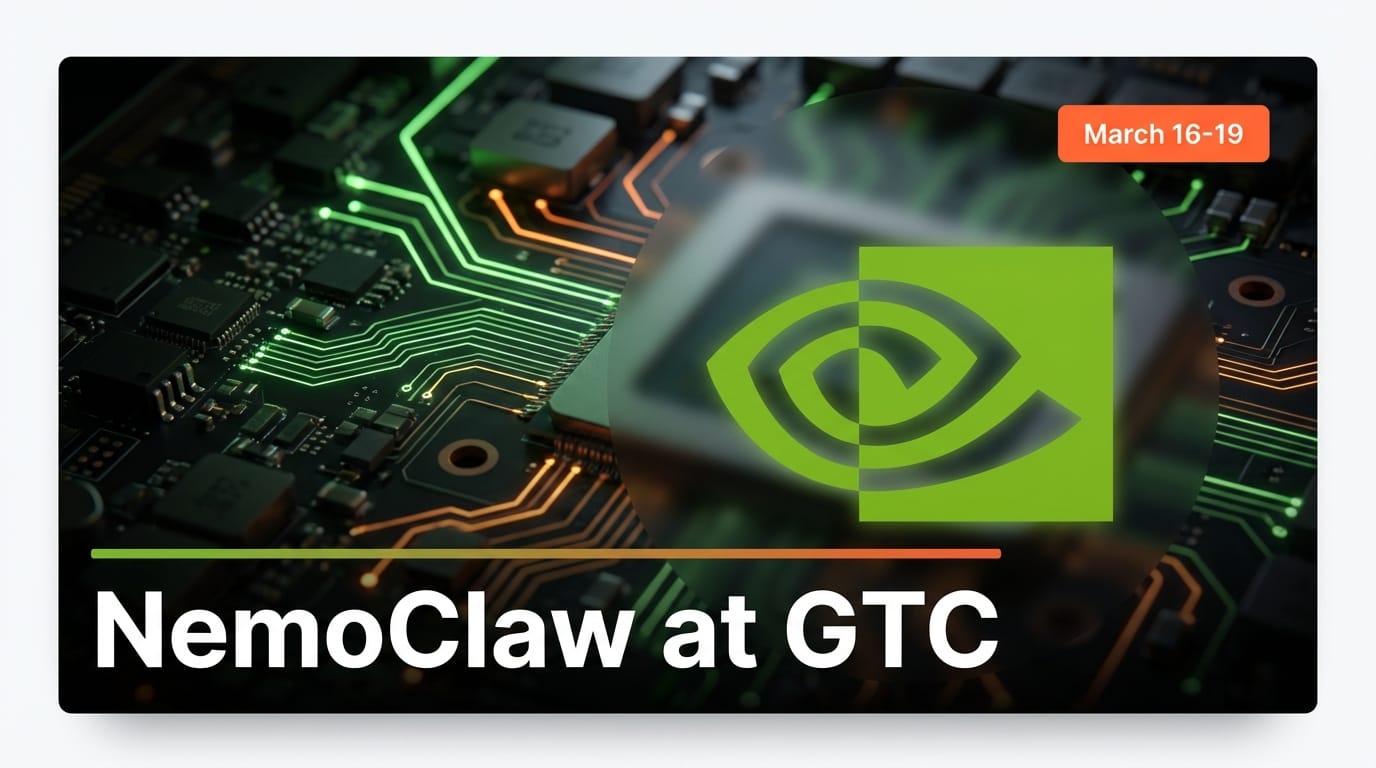
NVIDIA is launching NemoClaw, an open-source enterprise AI agent platform, ahead of GTC 2026 (March 16-19). The platform integrates with the NeMo framework and Nemotron models, backed by partnerships with Salesforce, Google, Adobe, Cisco, and CrowdStrike. GTC will also showcase the Vera Rubin GPU with 5x Blackwell performance, the Feynman architecture built on silicon photonics and TSMC's 1.6nm A16 process, and a new partnership with Mira Murati's Thinking Machines Lab for gigawatt-scale training systems.
What Happened
NemoClaw is NVIDIA's answer to the growing demand for enterprise-grade AI agents. The open-source platform allows businesses to build, deploy, and manage autonomous AI agents that can take actions across software systems. It plugs directly into NVIDIA's existing NeMo training framework and Nemotron family of models, giving enterprises a full stack from model training to agent deployment.
The launch partner list signals serious enterprise ambitions. Salesforce brings CRM automation, Google adds cloud infrastructure, Adobe contributes creative workflow integration, Cisco covers networking and security, and CrowdStrike handles cybersecurity agent applications. Each partner is building NemoClaw-powered agents tailored to their platforms.
Beyond NemoClaw, GTC 2026 is shaping up to be NVIDIA's biggest hardware event in years. The Vera Rubin GPU promises 5x the performance of Blackwell, which itself is already powering the current generation of AI training clusters. The Feynman architecture takes a different leap entirely, using silicon photonics on TSMC's cutting-edge 1.6nm A16 process node. Jensen Huang has publicly stated the announcement will "surprise the world."
NVIDIA also revealed a partnership with Thinking Machines Lab, the AI company founded by former OpenAI CTO Mira Murati. The collaboration targets gigawatt-scale AI training infrastructure starting in 2027, suggesting training runs that dwarf anything currently in operation.
Why It Matters for Creative Professionals
NemoClaw is open source, which means creators and studios can build custom AI agents without licensing fees. A production studio could deploy an agent that automates asset management across Adobe Creative Cloud. A game developer could build agents that handle QA testing, bug triage, and localization workflows autonomously.
The Vera Rubin GPU and Feynman architecture will directly impact how fast AI models can generate images, video, and 3D content. A 5x performance increase over Blackwell translates to faster inference for tools like Stable Diffusion, Runway, and any model running on NVIDIA hardware. For creators using local GPU setups, the next generation of consumer GPUs based on these architectures will dramatically reduce render and generation times.
The Thinking Machines Lab partnership points toward a future where training runs produce significantly more capable creative AI models. Gigawatt-scale infrastructure means models with better understanding of visual composition, audio nuance, and creative intent.
Key Details
Platform: NemoClaw (open-source enterprise AI agent platform)
Event: GTC 2026, March 16-19
Partners: Salesforce, Google, Adobe, Cisco, CrowdStrike
Integration: NeMo framework + Nemotron models
Hardware: Vera Rubin GPU (5x Blackwell), Feynman architecture (silicon photonics, TSMC 1.6nm A16)
Partnership: Thinking Machines Lab (Mira Murati) for gigawatt-scale training (2027+)
License: Open source
What to Do Next
Watch the GTC 2026 keynote on March 17. Jensen Huang's keynotes consistently reveal products that reshape the AI landscape within months. If you build AI-powered creative tools or workflows, the NemoClaw platform documentation will be worth reviewing as soon as it goes live.
Track the Vera Rubin GPU specs when they drop. If you run local AI generation, plan your next hardware upgrade around this architecture. The 5x performance claim, if it holds, will make real-time high-resolution generation practical on a single card.
Explore the NemoClaw GitHub repository once it launches. Building a custom AI agent for your creative pipeline is now a viable option without vendor lock-in or licensing costs. For a preview of how multi-model agent orchestration works in practice, see how Luma's Creative AI Agents coordinate across image, video, and audio models.
This story was featured in Creative AI News, Week of March 10-14, 2026. Subscribe for free to get the weekly digest.