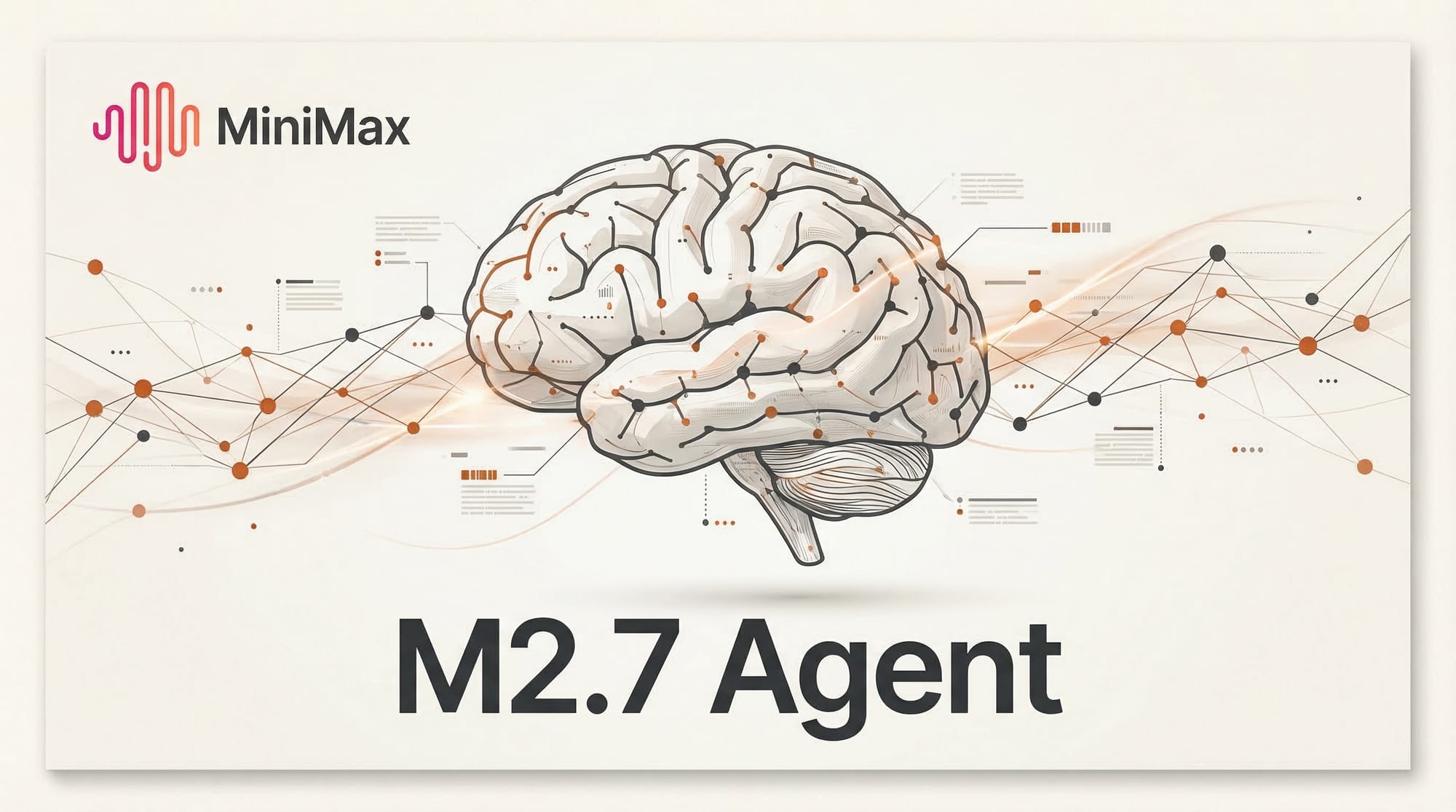
MiniMax, the company behind the Hailuo video generation platform, released M2.7 with 10 billion activated parameters and built-in self-improvement capabilities that let the model refine its own performance over time. Priced at $0.30 per million input tokens, it positions itself as what MiniMax calls "the smallest Tier-1 Model."
What Happened
M2.7 is not just another language model competing on benchmarks. Its defining feature is an integrated self-improvement system that combines data pipelines, training environments, evaluation tools, and persistent memory into a single architecture. Rather than remaining static after deployment, the model can learn from its interactions and refine its capabilities continuously.
The model's technical specifications show competitive results against much larger models. On SWE-Pro, a software engineering benchmark, M2.7 scores 56.22%. It hits 55.6% on VIBE-Pro and 57.0% on TerminalBench 2. These scores place it in the range of models with significantly more parameters.
MiniMax reports 97% skill adherence on complex multi-step tasks, which measures how reliably the model follows detailed instructions across extended workflows. For agent-based applications where a model must execute a series of steps without losing track of context or requirements, this metric matters more than raw reasoning benchmarks.
Why It Matters
The self-improvement angle addresses one of the most persistent frustrations with current AI models: they freeze at their training cutoff. Once deployed, a standard model cannot learn from its mistakes or adapt to a user's specific needs. M2.7's integrated training pipeline suggests a different approach where the model gets better the more you use it.
The economics are also notable. At $0.30 per million input tokens and a blended rate of $0.06 per million with caching, M2.7 is priced to compete with models a fraction of its capability. Combined with inference speeds exceeding 100 tokens per second, roughly 3x faster than larger frontier models, this makes it practical for high-volume agent workloads where cost and latency compound quickly.
For creative AI professionals running automated workflows, the combination of low cost, fast inference, and strong instruction-following creates a compelling option for production agent systems that need to handle repetitive but complex tasks reliably.
Key Details
- Parameters: 10 billion activated (mixture-of-experts architecture)
- Pricing: $0.30 per million input tokens, $0.06/M blended with cache
- Speed: 100+ tokens per second
- SWE-Pro: 56.22%, VIBE-Pro: 55.6%, TerminalBench 2: 57.0%
- Skill adherence: 97% on complex multi-step tasks
- Self-improvement: Integrated data pipelines, training, evaluation, and persistent memory
What to Do Next
If you are building AI agents or automated workflows, test M2.7 against your current model on a real task sequence. The self-improvement claims are the most interesting part of this release, but they need to be validated in practice. Start with a well-defined multi-step workflow where you can measure whether the model actually improves over repeated runs, and compare the total cost against what you currently spend on inference.