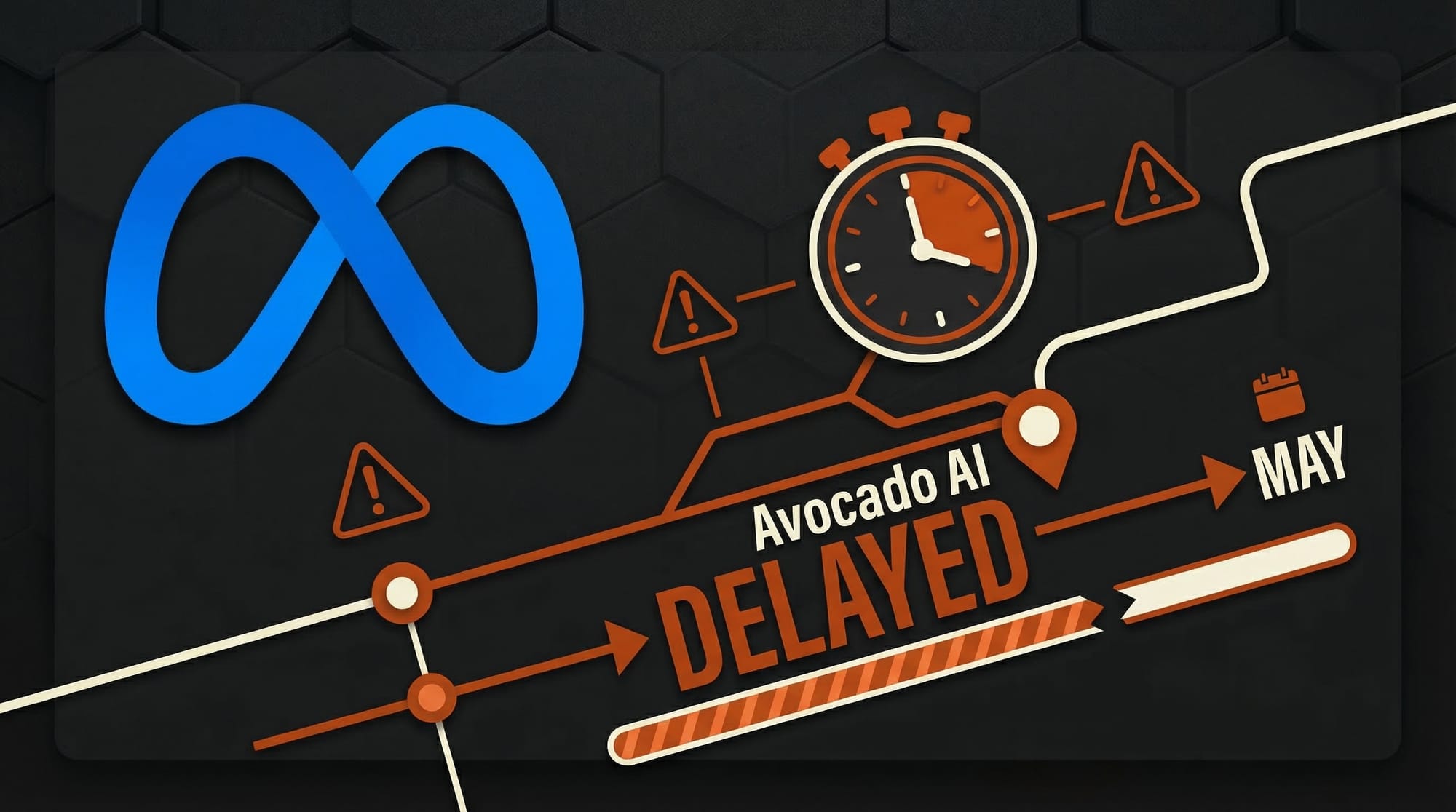
Meta has delayed the launch of its next-generation AI model, codenamed "Avocado," from March to at least May 2026. Internal testing revealed the model falls short of competitors from Google and OpenAI, landing somewhere between Google's Gemini 2.5 and Gemini 3 in performance. The delay comes despite Meta's plans to spend $115 to $135 billion on AI infrastructure this year.
What Happened
According to a report from The New York Times, Meta's leadership decided to push back the Avocado release after benchmarks showed it trailing both Google's Gemini and OpenAI's latest models. The model was originally set to ship this month but will now arrive in May at the earliest.
The setback follows last year's disappointing reception of Llama 4, which failed to close the gap with leading closed-source models. Meta is also developing two other AI projects: "Watermelon," a next-generation foundation model, and "Mango," focused on image and video generation. None of these have firm release dates.
Perhaps the most striking detail from the report is that Meta's leadership discussed temporarily licensing Google's Gemini to power some Meta products while Avocado development continues. No final agreement has been reached, but the fact that Meta considered using a competitor's model highlights how far behind the company feels in the current AI race.
Why It Matters for Creators
Meta's AI tools are embedded across Facebook, Instagram, WhatsApp, and Messenger, reaching billions of users. When Meta's models improve, creators get better AI-powered editing, content suggestions, and audience tools on those platforms. A delay means those improvements take longer to arrive.
The broader signal here is that the AI landscape is not a straight line upward. Even companies spending over $100 billion can hit walls. For creators who rely on AI tools in their workflows, this is a reminder to build on capabilities that exist today rather than banking on announcements. Google and OpenAI continue to set the pace, and tools built on their models remain the safest bet for production work right now.
The potential Gemini licensing deal is also worth watching. If Meta ends up running Google's models inside its apps, the creative tools available on Meta's platforms could improve faster than Meta's own research would allow.
What to Do Next
Keep an eye on Meta's AI announcements through May. If you currently use Meta AI features for content creation or audience engagement, do not expect major upgrades in the near term. Evaluate whether tools from Google or OpenAI better serve your current needs while Meta regroups.
For those tracking the open-source AI space, the Llama model family remains available and actively maintained. But the Avocado delay suggests Meta's next open-source release may also slip. Follow the full New York Times report for additional details on Meta's internal AI strategy and the competitive dynamics shaping the industry.
This story was covered by Creative AI News.
Subscribe for free to get the weekly digest every Tuesday.