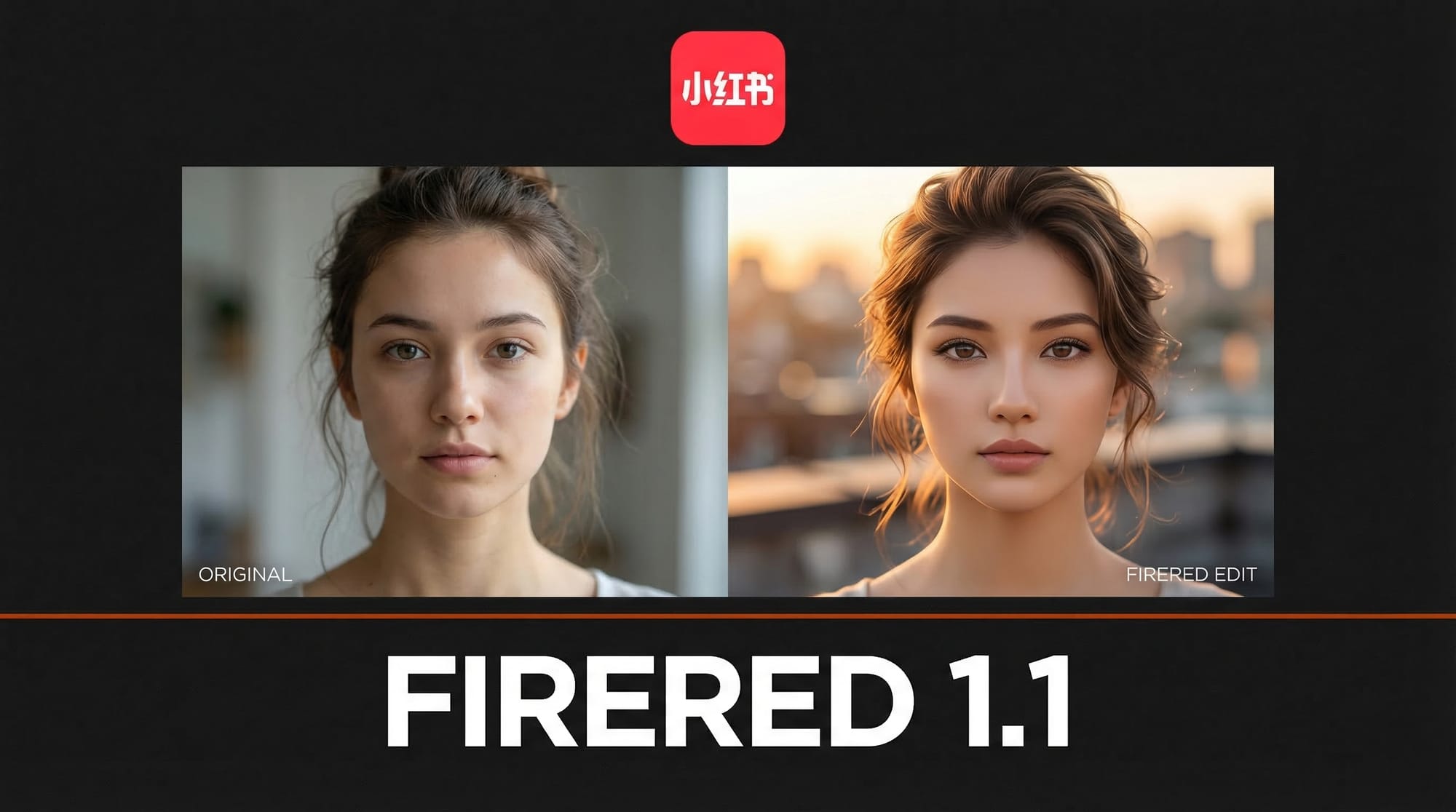
Xiaohongshu's Intelligent Creation team released FireRed-Image-Edit 1.1 on March 3, 2026, achieving a composite score of 7.94 across five authoritative benchmarks and claiming the top spot among open-source image editing models. The model surpasses Alibaba's Qwen-Image-Edit-2511 and delivers major improvements in identity consistency, multi-element fusion, and portrait editing under an Apache 2.0 license.
What Happened
Xiaohongshu, the Chinese social platform often described as China's Instagram, released version 1.1 of its FireRed-Image-Edit foundation model. The upgrade builds on the original FireRed architecture with targeted improvements in four areas: portrait consistency, multi-element fusion, stylized text reference, and portrait makeup effects. The model is fully open-source on GitHub with both code and weights released under the Apache 2.0 license.
Why It Matters
Open-source image editing has struggled to match proprietary solutions in two critical areas: keeping a person's identity consistent across edits, and combining multiple visual elements without artifacts. FireRed-Image-Edit 1.1 addresses both gaps. The model scores 4.33 (Chinese) and 4.26 (English) on REDEdit-Bench, ranking first among open-source models, while achieving a near-perfect text preservation score of 4.97. For creators and developers working with AI-powered image editing, this release removes the need for expensive API subscriptions to achieve professional-grade results.
Key Details
- Benchmark performance: 7.94 composite score across ImgEdit, GEdit, and REDEdit benchmarks, establishing state-of-the-art for open-source image editing
- Identity consistency: Subjects remain recognizable across complex edits, a critical feature for portrait and character-based workflows
- Multi-element fusion: Freely combines 10+ visual elements with Agent-powered automatic cropping and stitching
- Portrait makeup: Supports dozens of styles from professional beauty retouching to creative artistic looks
- Hardware requirements: Produces results in 4.5 seconds with 30GB VRAM, making it accessible on consumer-grade GPUs with sufficient memory
- Diffusion transformer architecture: Accepts natural language instructions in both English and Chinese
- License: Apache 2.0 for both code and model weights
What to Do Next
Developers can download the model weights from HuggingFace and clone the GitHub repository to start experimenting. A ComfyUI integration is also available for node-based workflow users. The Apache 2.0 license allows commercial use, making it viable for production pipelines. If you are evaluating image editing models, Pandaily's coverage includes additional benchmark comparisons against competing models. For teams already using the original FireRed, the upgrade path is straightforward since the API and inference pipeline remain compatible.