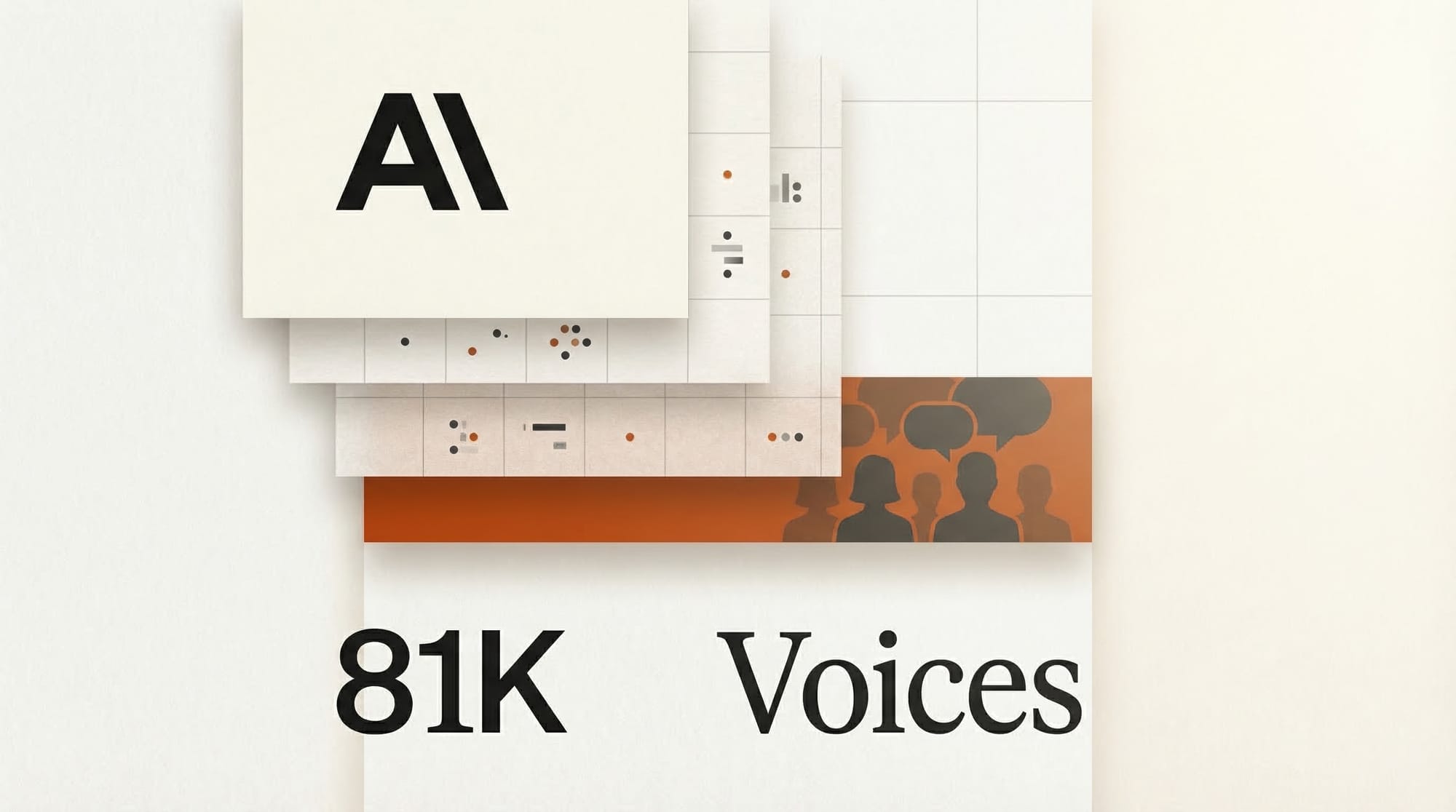
Anthropic has published the largest multilingual qualitative AI study ever conducted, interviewing 81,000 people across 159 countries in 70 languages about what they want from artificial intelligence. The results reveal that most people are simultaneously excited and concerned about AI, with professional excellence topping the list of aspirations.
What Happened
The study, titled "What 81,000 People Want from AI," used Claude to conduct structured interviews that went beyond typical survey checkboxes. Instead of asking people to pick from predefined options, the AI conducted open-ended conversations in each participant's native language, then analyzed the responses at scale.
The top aspiration across all respondents was professional excellence at 18.8%, meaning people primarily want AI to help them do their jobs better. The top concern was hallucinations and unreliability at 26.7%, confirming that trust remains the biggest barrier to adoption. Notably, 81% of participants said AI had already advanced their stated vision in some way.
Why It Matters
For creative AI users specifically, the study offers critical context. People do not fall into neat "pro-AI" or "anti-AI" camps. The same individuals who are excited about AI capabilities express genuine concerns about reliability and misuse. This tension exists within individual users, not between separate groups. Understanding this helps tool builders and creators alike navigate the landscape with more nuance.
The study also demonstrates a new methodology: using AI itself to conduct and analyze qualitative research at a scale that would be impossible with human interviewers alone. Running 81,000 interviews across 70 languages represents a research approach that could reshape how companies gather user feedback.
Key Details
- Scale: 81,000 interviews across 159 countries in 70 languages
- Top aspiration: Professional excellence (18.8%)
- Top concern: Hallucinations and unreliability (26.7%)
- Methodology: AI-conducted open-ended interviews, not checkbox surveys
- Key finding: Tensions about AI exist within individuals, not between opposing camps
What to Do Next
Read the full study on Anthropic's site for detailed breakdowns by region, language, and demographic. The findings are particularly useful for anyone building AI tools or creating content about AI adoption, as they provide data-backed insights into what real users actually care about rather than what the loudest voices on social media suggest.