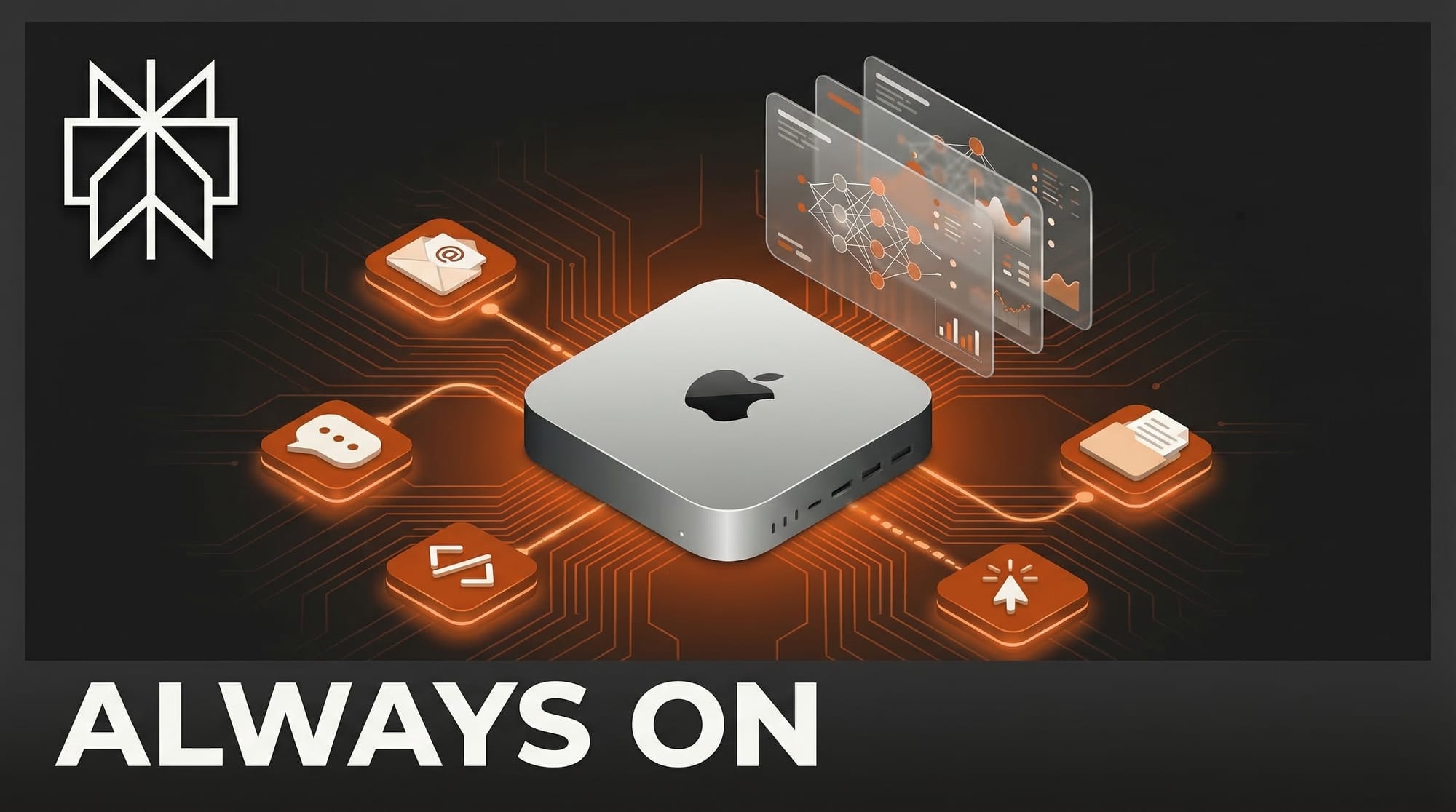
Every AI assistant you have used so far has one fundamental limitation: it forgets you exist the moment you close the tab. Perplexity wants to change that. Its new Personal Computer, announced March 11 at the Ask 2026 conference in San Francisco, is an always-on AI agent that runs continuously on a Mac mini, working across your files, apps, and projects around the clock. For creative professionals juggling tools like Notion, Slack, and GitHub, this is not an incremental upgrade. It is a shift in how AI fits into daily work.
Background
Perplexity launched its broader Computer platform in late February 2026, introducing a multi-model agent that could execute complex workflows in the background. Computer bundles 19 different AI models into a single orchestration layer, routing each task to the best-suited model automatically. Within weeks of launch, the enterprise version reportedly completed 3.25 years of internal work in four weeks at Perplexity itself.
Personal Computer extends this foundation from the cloud to your desk. Instead of running entirely on Perplexity's servers, the system installs on a Mac mini that stays powered on at home or in your office. It maintains persistent access to local files, applications, and browser sessions while routing AI processing through Perplexity's cloud. CEO Aravind Srinivas described it on X as "a digital proxy that never sleeps."
The product arrives in a market that is rapidly defining what "always-on AI" means. OpenClaw, the open-source AI agent framework, pioneered the concept of persistent computer-controlling agents but faced criticism over security vulnerabilities and a steep setup curve. Claude's Computer Use and OpenAI's Codex have explored similar territory. Perplexity is betting that the sweet spot lies between full open-source control and fully cloud-hosted agents.
Deep Analysis
The 19-Model Orchestra
The core technical differentiator is multi-model orchestration. Rather than relying on a single AI model for everything, Personal Computer routes each subtask to the model best equipped to handle it. Claude Opus 4.6 serves as the central reasoning engine and orchestrator. Gemini handles deep research. Nano Banana generates images. Veo 3.1 creates video. Grok takes on fast, lightweight tasks. ChatGPT 5.2 manages long-context recall and comprehensive web search.
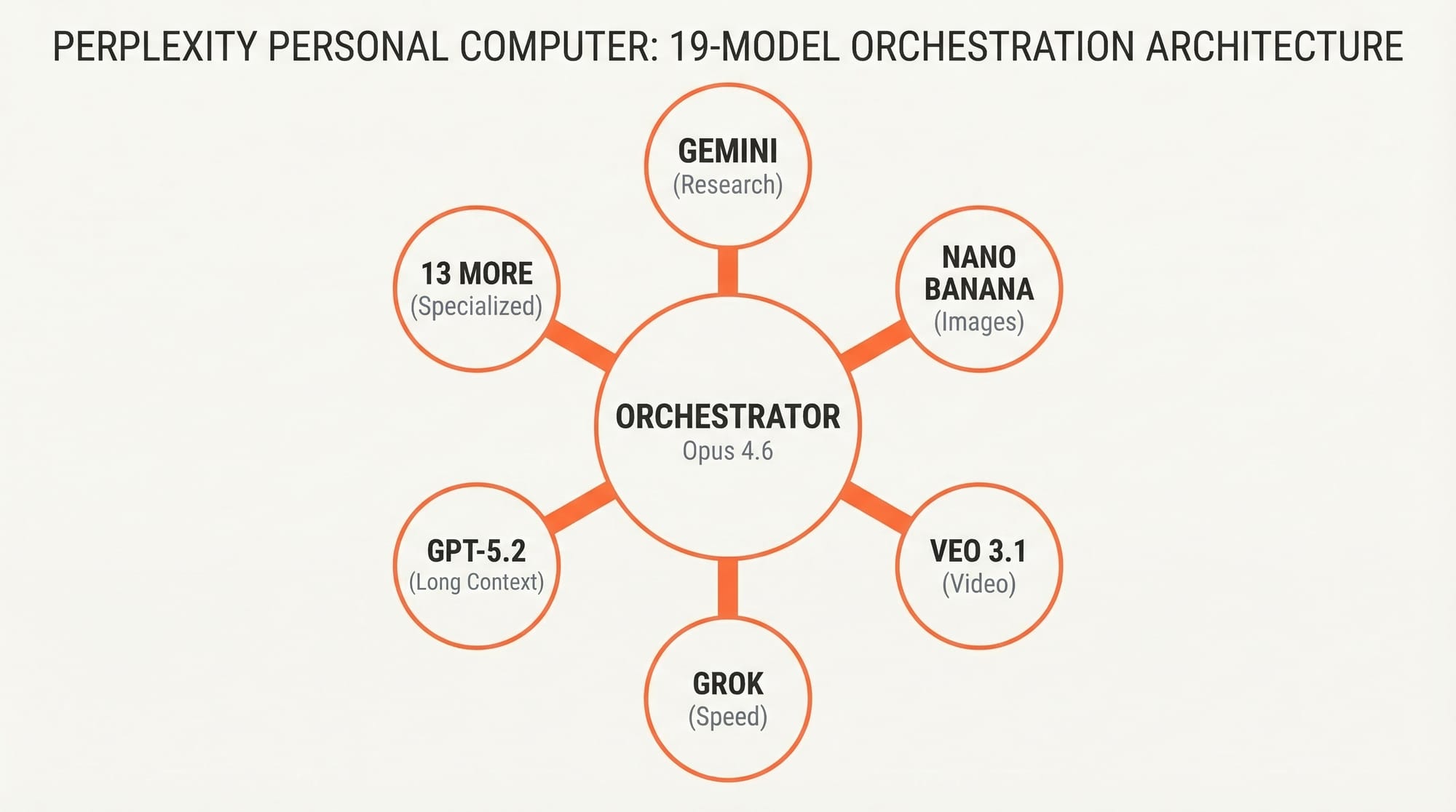
This matters for creative work because no single model excels at every creative task. A designer who needs to research a client brief, generate reference images, draft copy, and organize project files is touching at least four different capability categories. Personal Computer handles that routing automatically, spawning specialized subagents for each piece and running them in parallel.
The multi-model approach also builds on Perplexity's earlier Model Council feature, which cross-checks AI answers across multiple models to reduce hallucinations. In Personal Computer, this same principle extends to execution: the system can verify its own work by routing quality checks through a different model than the one that produced the initial output.
Convenience vs. Control: Personal Computer vs. OpenClaw
The competitive framing is unavoidable. OpenClaw is free, open-source (MIT license), and gives users complete control over their agent setup. You bring your own API keys, choose your models, and manage the entire stack. Personal Computer costs $200 per month and makes most of those decisions for you.
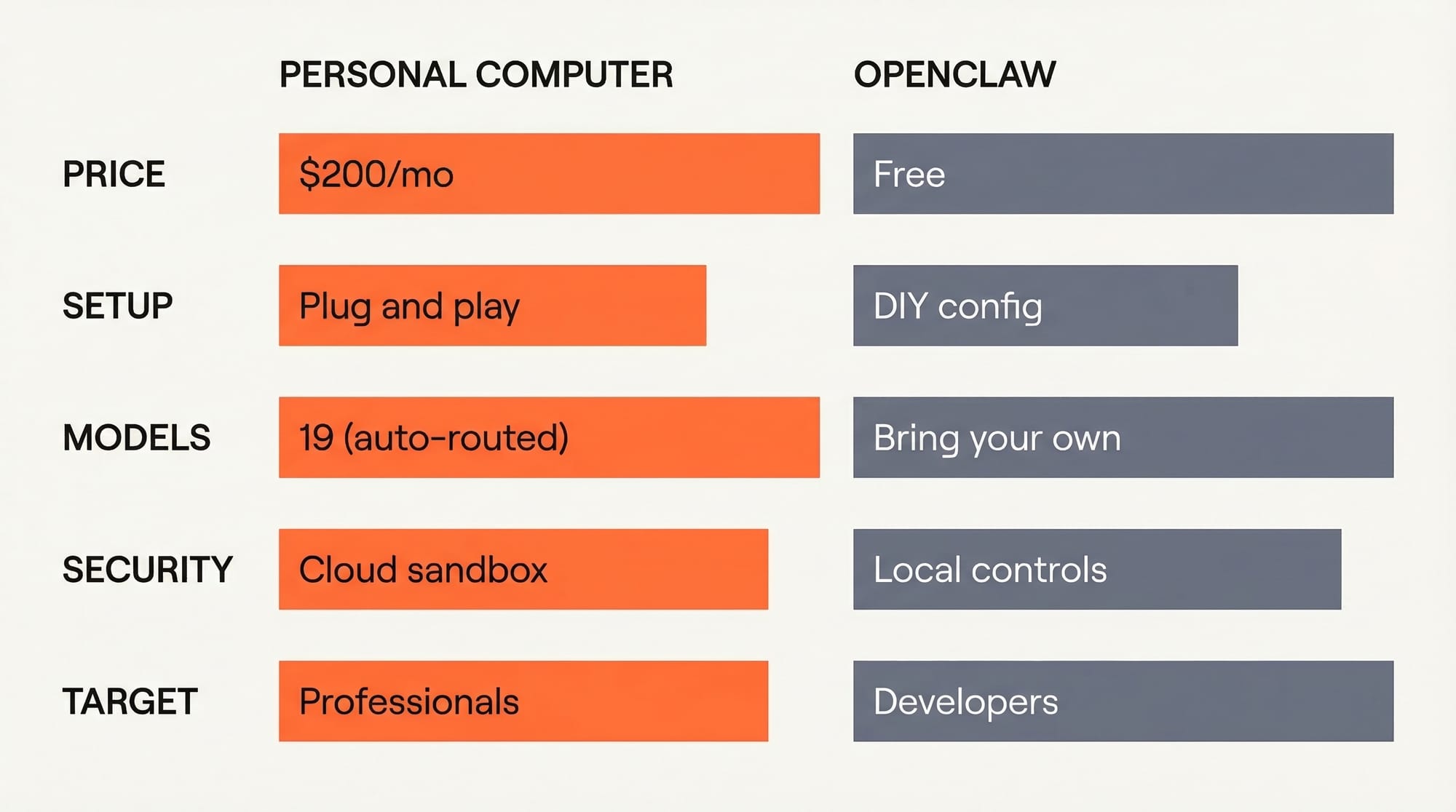
The trade-off is accessibility. Srinivas has noted that "even your mom can text on the app and delegate tasks" with Personal Computer, while OpenClaw "took our own engineers a long time to set up." For creative professionals who are not developers, this gap is decisive. A freelance video editor or graphic designer is unlikely to configure API keys, manage model routing, and debug agent failures. They want a tool that works when they plug it in.
Security tells a similar story. OpenClaw relies on application-level controls like allowlists and permission checks. Security researchers have documented real vulnerabilities, including CVE-2026-25253, which demonstrated that those controls can be bypassed. Perplexity's approach runs AI processing in a controlled cloud environment, keeping the agent from directly manipulating the local operating system. The local Mac mini provides file access, but the execution sandbox lives on Perplexity's servers.
The Trust Architecture
The biggest barrier to always-on AI agents is not capability. It is trust. Handing an AI continuous access to your files, email, and communication tools requires confidence that the system will not take destructive actions, leak sensitive data, or simply make expensive mistakes while you sleep.
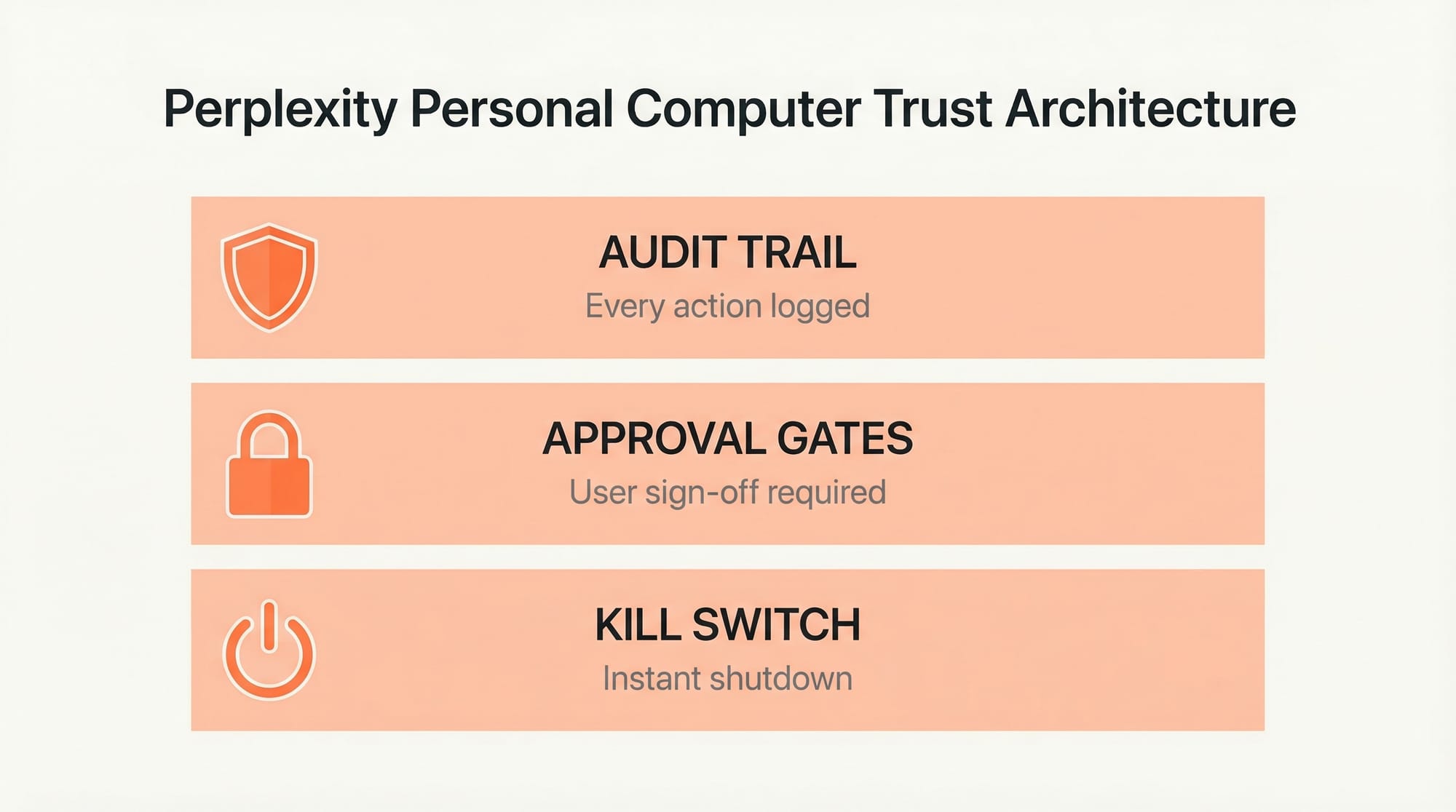
Perplexity addresses this with three mechanisms. First, every action the agent takes is logged in a detailed audit trail. You can review exactly what it did, when, and why. Second, sensitive operations require explicit user approval before execution. The system will not send an email, make a purchase, or delete a file without asking first. Third, a kill switch allows immediate shutdown of all agent activity. These are table-stakes features for enterprise adoption, and Perplexity clearly designed them with IT departments in mind.
The enterprise version adds single sign-on (SSO), compliance controls, and integration with over 400 business tools including Salesforce and Snowflake. For creative agencies and production studios, this means Personal Computer can potentially be deployed across teams with centralized management and security oversight.
Impact on Creators
The practical implications for creative professionals break down into three areas. First, workflow continuity. A content creator can set up a research brief before bed and wake up to a completed report with source links, key data points, and draft summaries. A video producer can queue overnight render checks, asset organization, and client update drafts. The agent maintains context across sessions, so you do not lose project state between interactions.
Second, tool integration. Creators typically work across five to ten applications daily. Personal Computer's connections to Gmail, Slack, GitHub, Notion, and Salesforce mean the agent can pull context from one tool and act on it in another. If a client emails a revision request, the agent can update the project board in Notion, notify the team in Slack, and flag the relevant files for review without manual intervention.
Third, the cost equation. At $200 per month, Personal Computer is priced as a professional tool. That is roughly two hours of freelance creative work. If the agent saves more than two hours of administrative overhead per month, which is a low bar for anyone managing multiple projects and clients, it pays for itself. The 10,000 monthly compute credits should be sufficient for most individual creative workflows, though heavy users running continuous background tasks may find limits.
Key Takeaways
1. Perplexity Personal Computer is the first polished, consumer-ready always-on AI agent, running on a Mac mini with 19-model orchestration and integrations with 400+ tools.
2. The $200/month price point positions it as a professional tool. It competes with OpenClaw on convenience and security, not on cost or flexibility.
3. Multi-model routing is a genuine advantage for creative workflows where tasks span research, writing, image generation, and project management.
4. The trust architecture (audit trails, approval gates, kill switch) is designed to overcome the adoption barrier that has limited enterprise use of autonomous AI agents.
What to Watch
The waitlist approach means real-world feedback is limited. Watch for early creator reports on reliability, credit consumption rates, and how well the agent handles complex multi-tool workflows over days and weeks, not just hours. The Mac-only limitation also narrows the initial market significantly. If Perplexity can deliver a Windows or Linux version, the addressable audience expands dramatically.
The bigger question is whether "always-on" becomes a standard expectation for AI tools. If Personal Computer proves that persistent agents deliver measurably better results than session-based assistants, every major AI company will follow. Perplexity is not just launching a product. It is defining a category.
Deep dive by Creative AI News.
Subscribe for free to get the weekly digest every Tuesday.