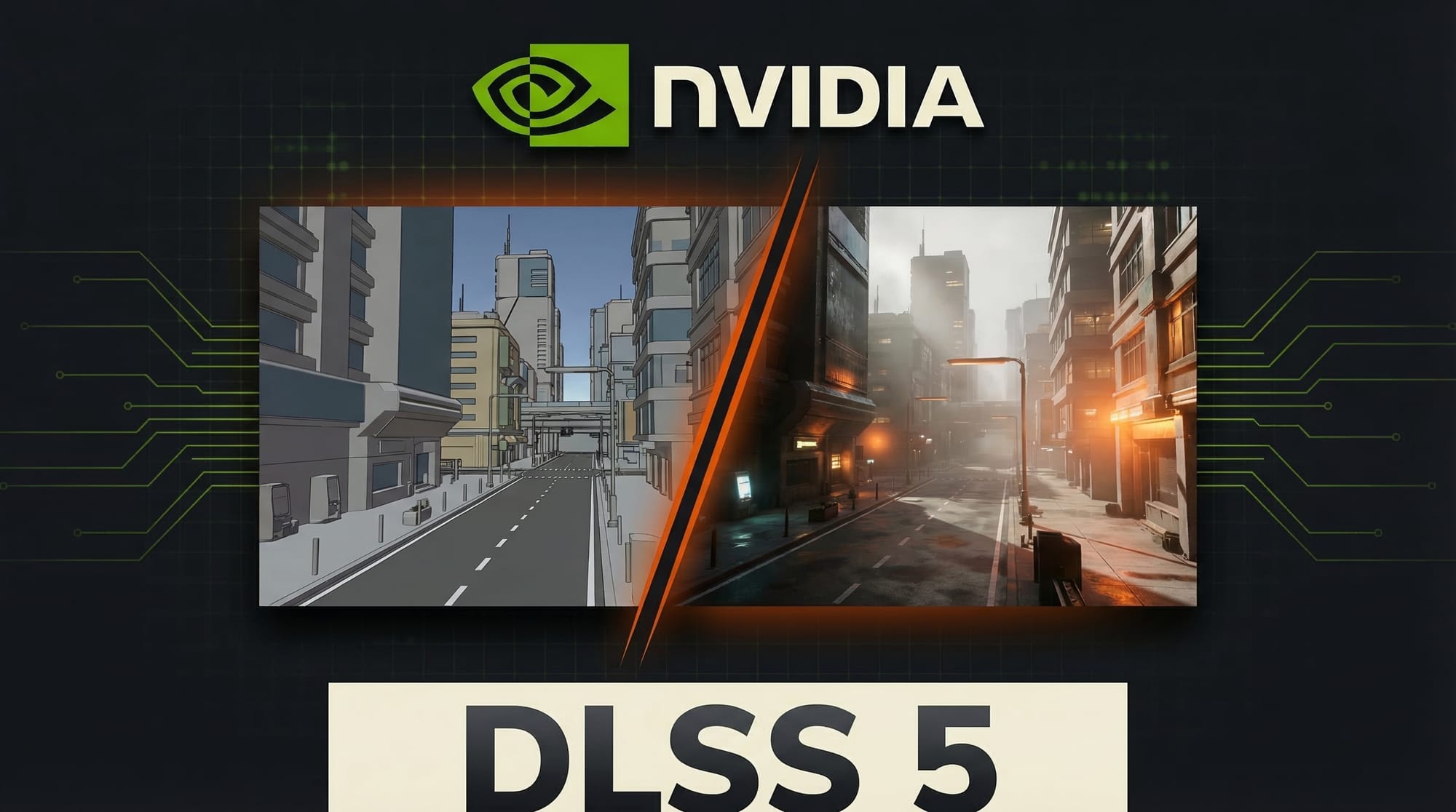
NVIDIA just made the boldest bet in real-time graphics since ray tracing. DLSS 5, unveiled at GTC 2026 on March 16, replaces the reconstruction approach that defined previous DLSS versions with a generative AI model that creates photoreal lighting and materials from scratch. Jensen Huang called it "the GPT moment for graphics." The gaming community called it something else entirely.
The reaction split was immediate and extreme. Within hours, the DLSS 5 reveal video had near-universal negative YouTube comments, developer backlash on social media, and memes comparing the results to AI dating profile photos. But underneath the controversy sits a genuine technical inflection point that will reshape how every real-time 3D application handles visual fidelity.
Background
DLSS has evolved through four distinct phases since 2018. Version 1.0 introduced AI-based upscaling using deep learning, but the results were blurry and inconsistent. DLSS 2.0 in 2020 fixed the quality problems and became genuinely useful. DLSS 3.0 in 2022 added Frame Generation, using AI to create entirely new frames between rendered ones for massive FPS boosts. DLSS 4.0 at CES 2025 brought transformer-based Super Resolution and 4X Multi Frame Generation. And DLSS 4.5 at CES 2026 upgraded to a second-generation transformer model with five times more computational power.
Every version until now shared a core philosophy: take what the game engine already rendered and make it better. Upscale lower-resolution frames, reconstruct missing detail, generate intermediate frames. The engine stayed in control.
DLSS 5 breaks that contract. Instead of enhancing the engine's output, it reinterprets it.
Deep Analysis
From Reconstruction to Generation
The fundamental shift is in what the AI does with each frame. DLSS 4.x takes a lower-resolution rendered frame and reconstructs it at higher resolution, filling in subpixel detail that the engine could not afford to compute. The engine renders the scene; DLSS cleans it up.
DLSS 5 works differently. It takes the game's color output and motion vectors as input, then runs them through a neural rendering model that generates new lighting, material responses, and surface detail. The AI model is trained end-to-end on synthetic scenes, captured imagery, and path-traced ground truth data. It learns to understand scene semantics: the difference between skin and fabric, between backlit hair and front-lit metal, between overcast outdoor lighting and harsh interior spotlights.
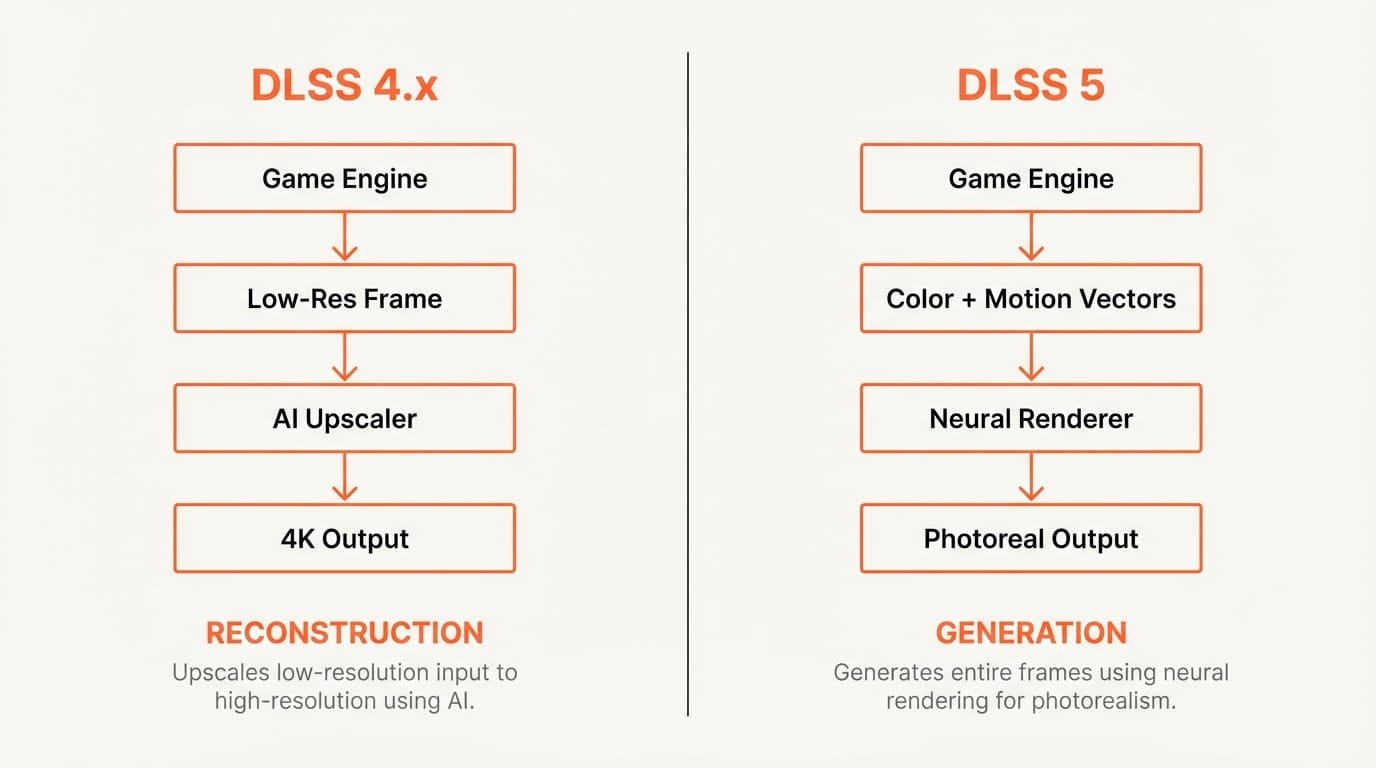
The result is what NVIDIA calls "intra-frame generation." While DLSS 3 generated entire new frames between existing ones, DLSS 5 generates visual information within a single frame. It predicts subsurface scattering on skin, the sheen of fabric, light-material interactions on hair, all constrained by the 3D data the engine provides.
NVIDIA emphasizes that the output is deterministic and anchored to source geometry. The AI does not hallucinate new objects or alter scene structure. But it does change how surfaces look, how light behaves, and how materials respond, and that is exactly where the controversy begins.
The Community Backlash
The GTC demos showed DLSS 5 applied to Resident Evil Requiem, Starfield, Hogwarts Legacy, and Oblivion Remastered. The before-and-after comparisons were dramatic: characters gained smoother skin, deeper eye detail, fuller lips, and more realistic hair. Environments received richer lighting with more natural shadows and reflections.
The gaming community's response was overwhelmingly negative. A reply to NVIDIA's announcement post gained over 60,000 likes, more than the original post's 40,000, calling the technology "AI slop." Gamers Nexus described the character transformations as resembling "an AI-generated dating profile picture." On Bluesky, artist Karla Ortiz, who has worked at Ubisoft, Blizzard, and Marvel, called it "so disrespectful to the intentional art direction of devs."
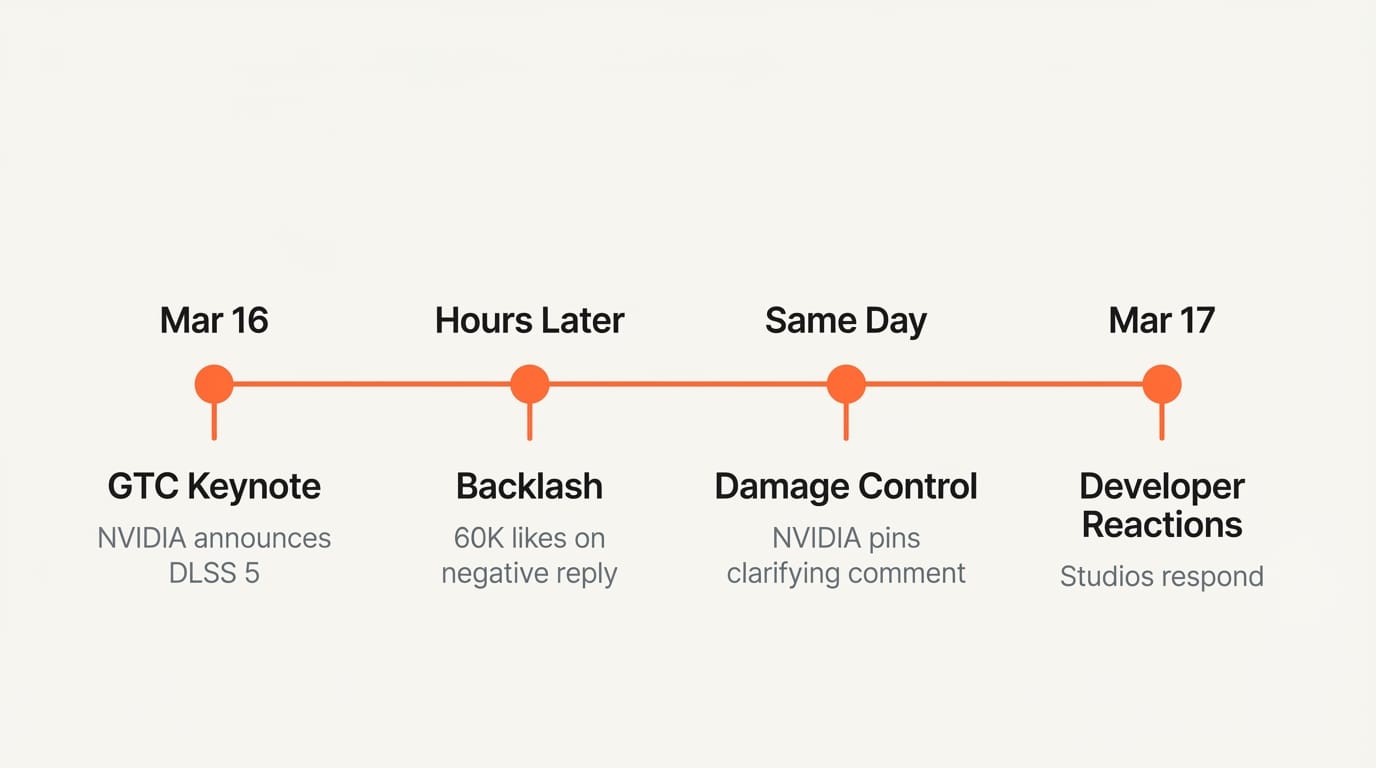
The criticism centered on two points. First, DLSS 5 visibly changed the artistic intent of games. Characters looked different, not just better. The effect resembled a beauty filter more than a rendering enhancement. Second, the demo ran on two RTX 5090 GPUs (roughly $4,000 in hardware) with one card dedicated entirely to the neural rendering model.
NVIDIA and its partners moved quickly to contain the damage. NVIDIA posted a pinned YouTube comment clarifying that developers have "full, detailed artistic control" over intensity, color grading, and masking. Bethesda responded on X, calling it "a very early look" and confirming the effect would be "totally optional for players."
The pushback is legitimate, but it may also be premature. The demos compared DLSS 5 against games without any DLSS enabled, not against DLSS 4.5 with path tracing. The technology is months from release. And the developer controls NVIDIA described, if implemented well, could address most of the artistic concerns.
The Competitive Race Ahead
DLSS 5 lands in a market where NVIDIA already leads but competitors are closing the gap in traditional upscaling. DLSS is supported in over 650 game titles. AMD's FidelityFX Super Resolution (FSR) has reached 400+ titles with broader hardware compatibility, running on AMD, NVIDIA, and Intel GPUs alike. Intel's XeSS has matured through version 3 but remains limited by Intel's GPU lineup.
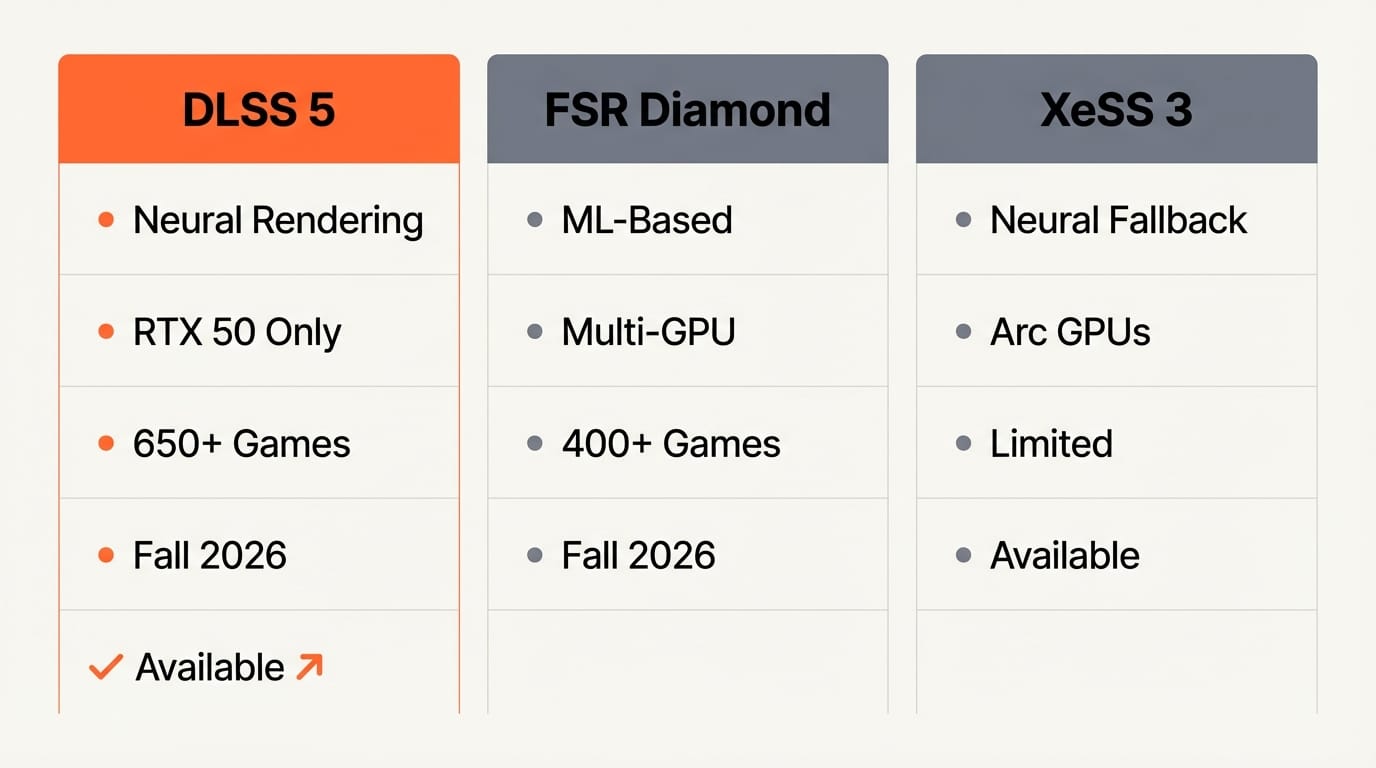
Neural rendering changes the competitive dynamics entirely. AMD has responded with FSR Diamond, a machine-learning-based algorithm that directly answers DLSS 5's neural approach. Details are scarce, but AMD targets a fall 2026 release alongside DLSS 5. Intel has released the XeSS 3 SDK but has not announced anything comparable to neural rendering.
The hardware exclusivity concern is significant. DLSS 5 requires RTX 50-series GPUs at launch. AMD's FSR Diamond, if it follows FSR tradition, will likely support a wider range of hardware. For game developers choosing which technology to implement, the audience reach of FSR versus the visual quality of DLSS creates a familiar tension that neural rendering will intensify.
Impact on Creators
For game developers, DLSS 5 introduces a new variable in the art pipeline. The developer controls for intensity, color grading, and masking mean studios can dial the effect from subtle enhancement to dramatic transformation. The challenge is testing: every art style will interact differently with the neural model, and QA teams will need to verify that DLSS 5 does not override intentional design choices in edge cases.
For real-time 3D artists working in Omniverse, architectural visualization, or virtual production, the implications are more straightforwardly positive. DLSS 5's ability to generate photoreal lighting in real time could replace hours of offline rendering for previsualization work. NVIDIA has confirmed the same neural rendering approach extends to Omniverse for digital twins and Drive Sim for autonomous vehicle training environments.
For content creators and streamers, the hardware barrier is the immediate concern. If DLSS 5 ships requiring an RTX 5090, it will be a premium feature for high-end builds only. NVIDIA's track record suggests optimization will eventually bring it to the broader RTX 50-series lineup, but the timeline is uncertain.
Key Takeaways
1. DLSS 5 shifts from reconstruction to generation, using AI to create lighting and material detail rather than upscale existing renders.
2. The gaming community backlash is real and centers on artistic integrity, not just visual quality. NVIDIA needs to prove that developer controls can preserve creative intent.
3. AMD's FSR Diamond will bring competition by fall 2026, but details remain scarce. The upscaling wars are becoming a neural rendering arms race.
4. Hardware exclusivity (RTX 50-series only at launch) limits near-term adoption, though the technology's Omniverse and simulation applications extend its value beyond gaming.
What to Watch
Three milestones will determine whether DLSS 5 lives up to NVIDIA's ambitions or becomes a cautionary tale about AI overreach in creative tools. First, the single-GPU optimization: NVIDIA must deliver playable performance on a single RTX 5090 by fall 2026, not the dual-GPU setup shown at GTC. Second, developer adoption: how studios like Bethesda, Capcom, and Ubisoft implement the artistic controls will define whether DLSS 5 feels like an enhancement or an override. Third, AMD's FSR Diamond reveal will show whether neural rendering becomes an industry standard or an NVIDIA-only feature.
The next six months will determine if this is truly "the GPT moment for graphics" or if NVIDIA jumped too far, too fast.
Deep dive by Creative AI News.
Subscribe for free to get the weekly digest every Tuesday.