Midjourney V8 Alpha launched on March 17, representing the company's most ambitious overhaul since its founding. The numbers look compelling: 5x faster generation, native 2K resolution rendering, and improved text handling across the board. But the 4x cost multiplier on every premium feature signals something worth examining more closely. For the millions of creators who have built workflows around Midjourney, V8 Alpha raises a pointed question: is the speed-quality leap worth the price?
Background
Midjourney has held its position as the default AI image generator for creative professionals since V5 established the platform's signature aesthetic quality. V7, released in April 2025, brought improved coherence for hands and bodies, introduced Draft Mode for rapid iteration, and added a personalization system that learned user preferences over time.
The competitive landscape shifted substantially during V7's lifecycle. Google's Nano Banana Pro launched with a hybrid autoregressive-diffusion architecture, delivering 94-96% text rendering accuracy and native 4K output. OpenAI's image generation improved with each GPT update. Flux gained a devoted following for precise text rendering and human anatomy accuracy. By early 2026, Midjourney needed more than incremental improvements to maintain its edge.
V8 Alpha is the result: a complete architectural rewrite, a new training dataset, and an overhauled inference pipeline built from scratch.
Deep Analysis
A Ground-Up Architecture Rewrite
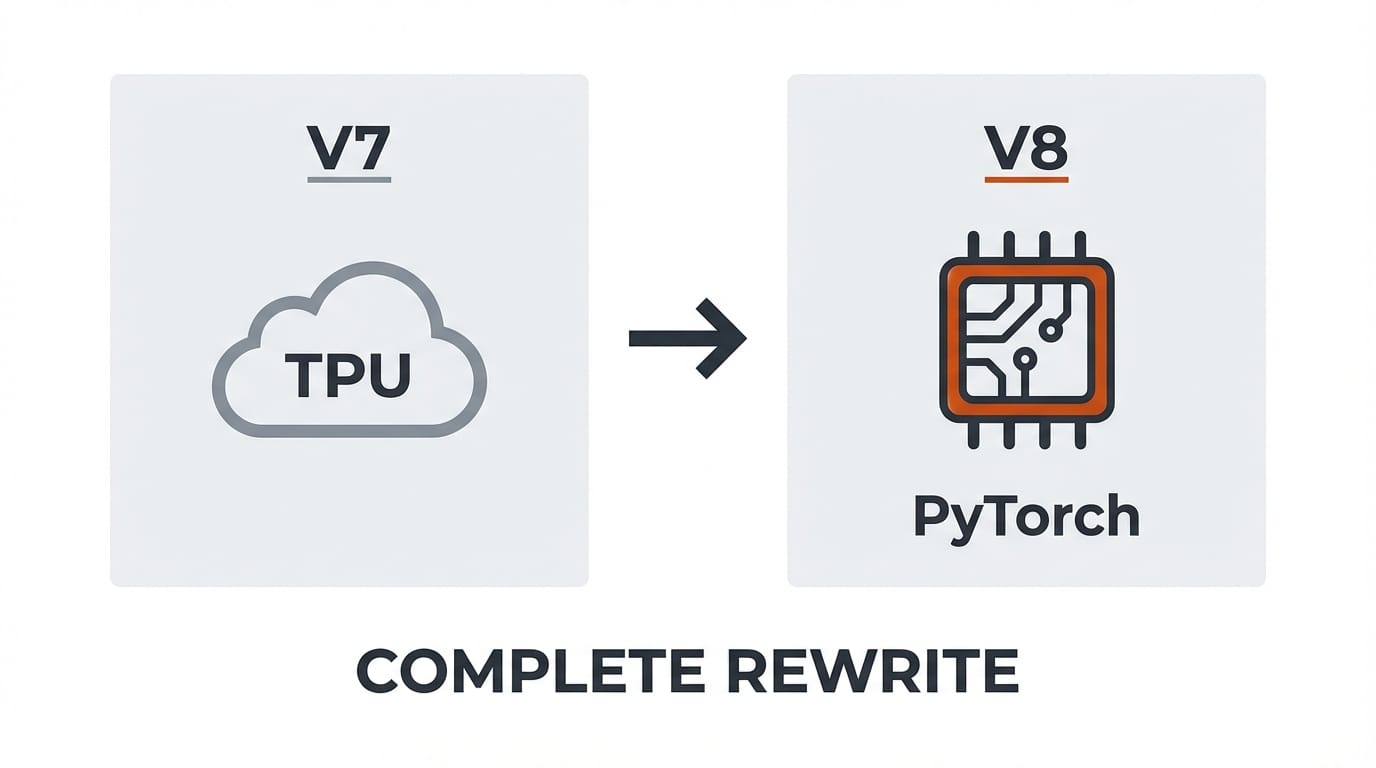
V8 is not a tuned version of V7. Midjourney rewrote the model from the ground up, moving from Google TPUs to NVIDIA GPUs and adopting PyTorch as the development framework. This is a strategic decision with implications that extend beyond image quality.
The move to PyTorch and GPUs gives Midjourney access to a larger developer talent pool. PyTorch remains the dominant ML framework in 2026, and GPU development workflows are more mature and better documented than TPU alternatives. For a team that has historically operated lean relative to competitors like OpenAI or Google, this hiring advantage matters. The migration also reflects a broader industry pattern: while TPUs excel at inference cost efficiency, GPUs and PyTorch win on development velocity and ecosystem support.
The infrastructure shift also sets up future capabilities. Midjourney has confirmed plans for a V8 "mini" variant designed for lower-tier hardware, an editing model, and a second-generation video model, all built on the new architecture. V9 is already in active development with clear scaling paths defined.
5x Faster, Natively 2K
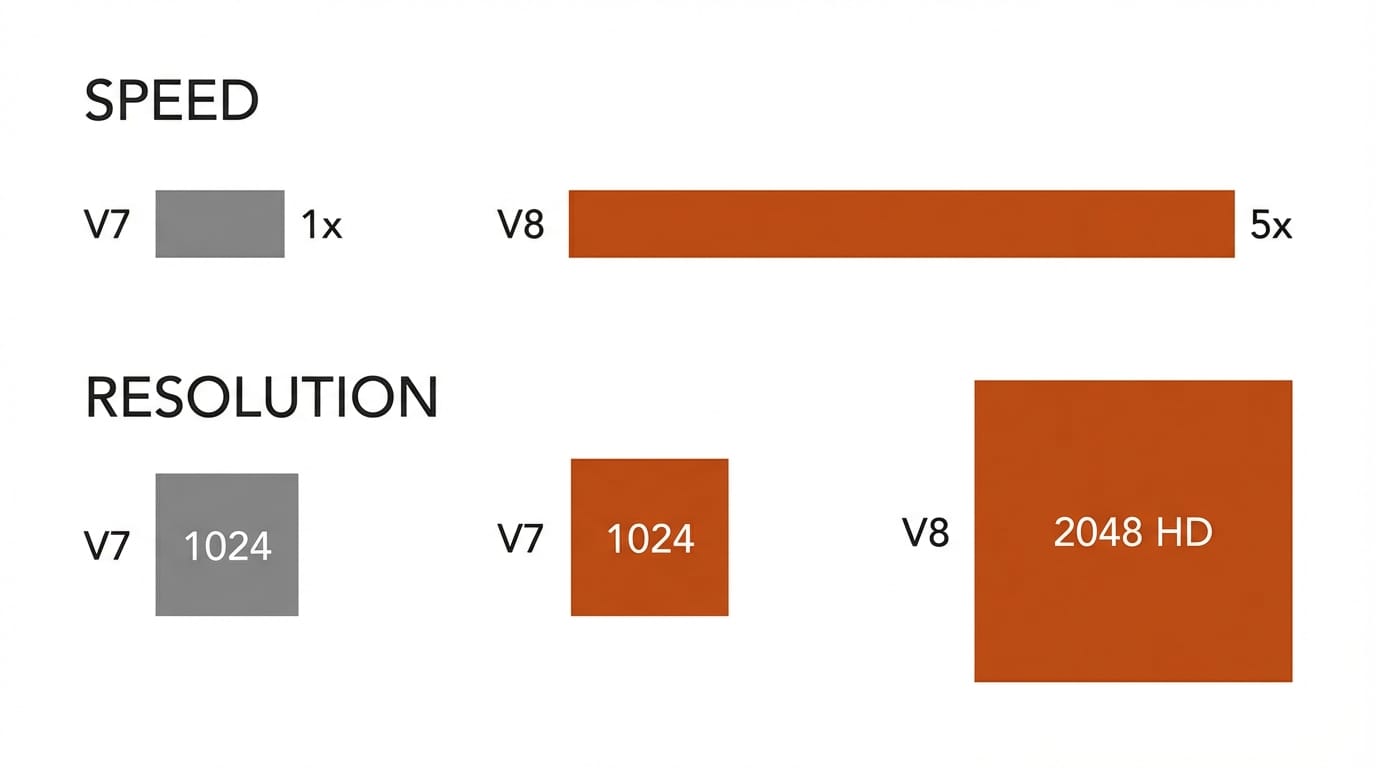
The headline performance numbers are substantial. Standard V8 Alpha jobs generate approximately 5x faster than V7, and the new --hd mode renders natively at 2K resolution (2048x2048, up from V7's 1024x1024) without requiring a separate upscaling step.
For commercial workflows, the speed improvement changes the economics of iteration. A designer who previously ran 20 generation cycles per hour can now run 100, testing more variations and converging on the right output faster. The native 2K rendering eliminates a common post-processing step, reducing toolchain complexity for creators who need print-ready or high-DPI output.
The --q 4 quality mode adds another layer, pushing coherence further for complex multi-subject scenes where previous versions struggled with structural consistency. Combined with HD mode, creators get results that approach production quality in a single generation pass.
The 4x Premium Problem
This is where V8 Alpha gets complicated. The features that distinguish V8 from its predecessor and competitors (HD rendering, quality mode, style references, and moodboards) all cost 4x the standard GPU time. Using --hd with --q 4 together costs 16x more than a regular generation.
For users on the $10/month Basic plan, premium features will eat through generation quotas rapidly. Even Mega plan subscribers at $120/month will need to be deliberate about when they deploy these modes. Relax mode, the free-generation option many users relied on for exploration and experimentation, is not available at launch. Midjourney says a new server cluster is in development to support it.
This pricing creates a two-tier experience within V8 Alpha. Standard generations are faster and cheaper than ever, but the features that actually differentiate V8 carry a significant cost premium. The question for creators: does native 2K with enhanced style control justify the GPU cost, especially when third-party upscalers and standalone style tools offer alternatives at lower cost?
Text Rendering: Better, Not Best
Text rendering has been AI image generation's most persistent weakness, and V8 shows meaningful progress. Short words and phrases render reliably when enclosed in quotation marks within prompts. Longer text strings are now possible where they were not before.
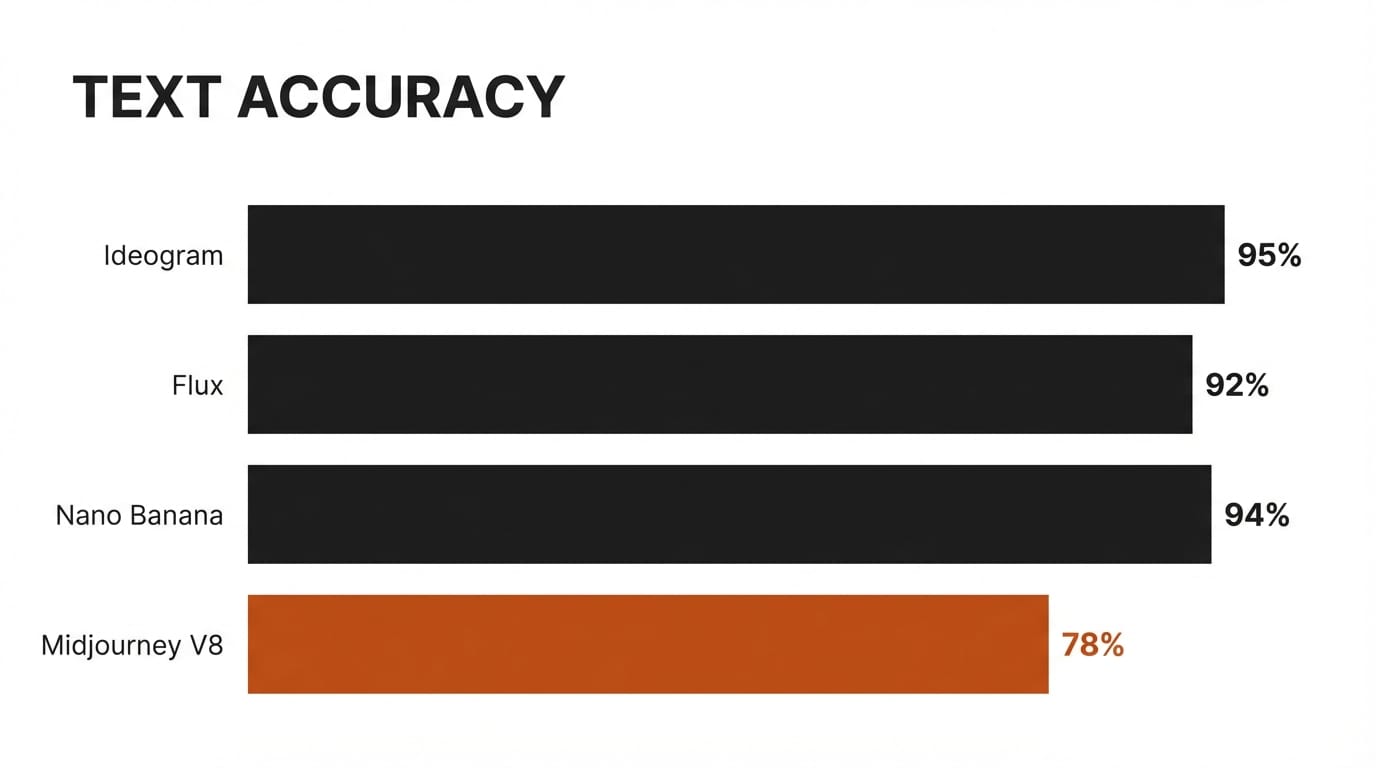
But V8 does not close the gap with specialized competitors. Early testing shows V8 sometimes nails text perfectly and sometimes misses, demonstrating clear improvement without reaching the consistency that production text-heavy work demands. Ideogram still leads in text accuracy. Flux handles complex typography more reliably. Google's Nano Banana Pro achieves 94-96% text accuracy with its hybrid architecture.
Midjourney's diffusion-only architecture is part of the constraint. Competitors using hybrid autoregressive-diffusion approaches have a structural advantage for precise prompt following, including text placement. V8's improvements are notable for a pure diffusion model, but the architectural gap remains visible.
Impact on Creators
For creative professionals who use Midjourney primarily for concept art, mood exploration, and aesthetic development, V8 Alpha is a clear upgrade. The 5x speed improvement makes exploratory workflows meaningfully more efficient. Backward compatibility with V7 personalization profiles, style references, and moodboards means existing creative libraries transfer immediately with no rebuilding required.
The cost structure demands workflow adjustments. Professional users will likely adopt a two-stage approach: use standard V8 for rapid exploration and ideation, then selectively apply --hd and --q 4 only for final-pass generations intended for delivery. This mirrors how photographers shoot in JPEG for scouting and switch to RAW only for the shots that matter.
Creators who depend on text rendering or precise prompt following for commercial work should test V8 against their current tools before switching. The aesthetic quality remains Midjourney's strongest differentiator, but for typography-heavy design work, combining V8 with a text-capable model like Flux or Ideogram may produce better results than relying on V8 alone.
Key Takeaways
1. V8 Alpha is a complete architectural rewrite on GPUs and PyTorch, not an incremental update to V7.
2. Standard generation runs 5x faster, but premium features (HD, quality, style references) cost 4x more GPU time.
3. Native 2K resolution eliminates the need for separate upscaling workflows in high-DPI and print-ready production.
4. Text rendering is improved but still trails specialized competitors like Ideogram and Flux for production-grade accuracy.
5. The pricing creates a deliberate two-tier workflow: fast and cheap for exploration, premium and expensive for final output.
What to Watch
V8 is still in alpha, and Midjourney has stated the model will change significantly as testing progresses. Relax mode support is coming once new server infrastructure is ready, which will lower the barrier for experimentation. The confirmed roadmap (editing model, V2 video, V8 mini for lower-tier hardware) suggests Midjourney is building a multi-modal creative platform, not just iterating on an image generator.
Two factors will determine whether V8 delivers on its promise. First, how quickly the 4x cost premium on HD and quality modes comes down as infrastructure scales. Second, whether Midjourney addresses the text rendering gap through architectural changes or accepts its position as the aesthetic-first option in the market, leaving precision work to competitors. For now, V8 Alpha is the fastest and most capable Midjourney has ever been, with a price tag to match.
Deep dive by Creative AI News.
Subscribe for free to get the weekly digest every Tuesday.