Forty-one percent of all code written in 2025 was AI-generated, yet 37-40% of the time "saved" got eaten by reviewing, correcting, and verifying AI output. Creative workflows are no different. The tools have matured. The question is no longer what AI can produce, but which combinations of tools actually deliver.
This analysis draws on HuggingFace Spaces trending data (showing what tools creators actually run), GitHub trending repositories (tracking the agent frameworks reshaping workflows), platform download numbers, and community surveys from ComfyUI, Midjourney, and Suno.
Key Findings
1. ComfyUI Is the Creative Workflow Operating System
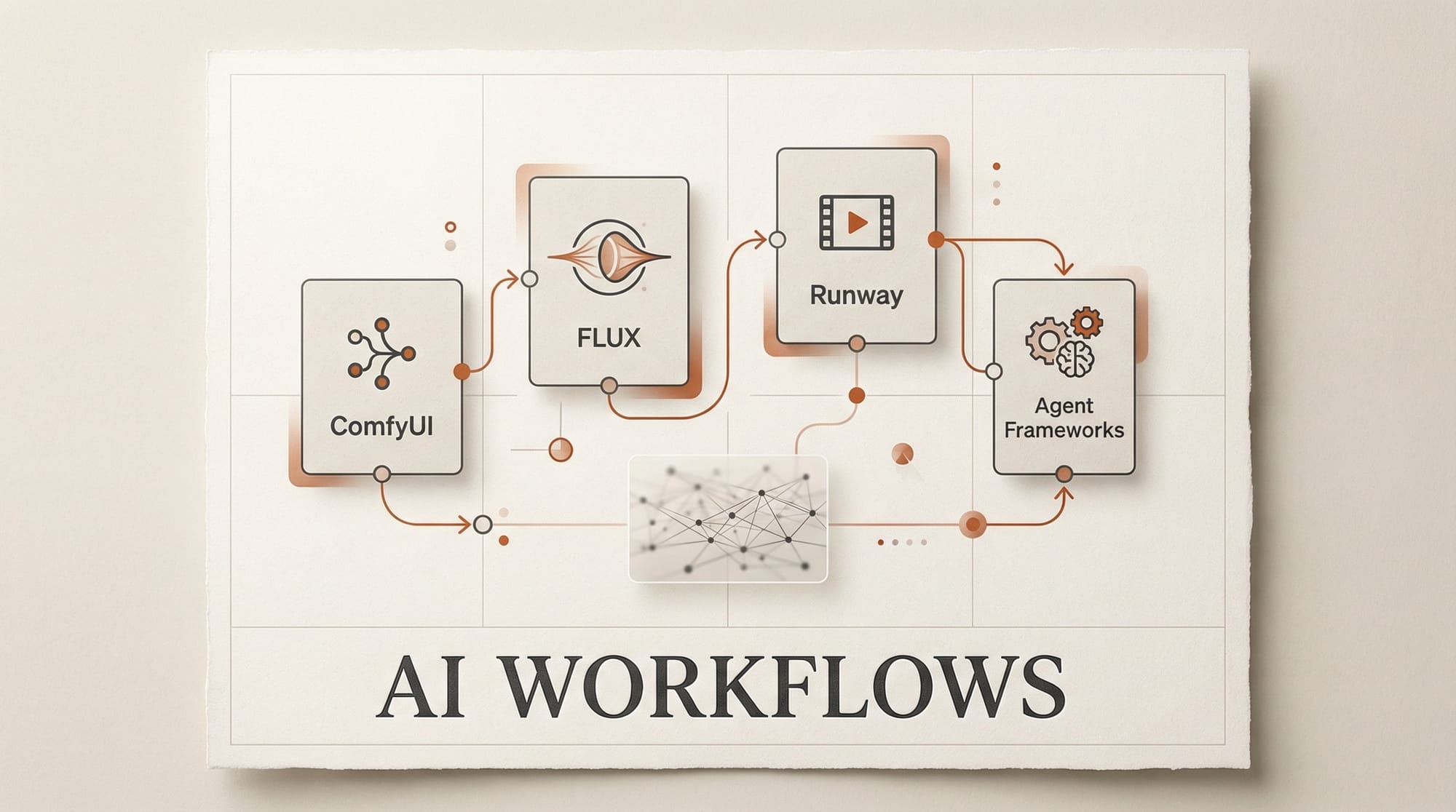
ComfyUI now serves over 4 million active users with 2,000+ custom nodes, 2.5 million shared workflows, and 120,000 Discord members. It has quietly become the default interface for anyone running multi-step image pipelines locally. The node-based visual system lets creators chain generation, upscaling, inpainting, and ControlNet conditioning into repeatable workflows without writing code.
What makes ComfyUI dominant is not any single feature but the ecosystem. With 12,000+ community components and over 1,000 custom node packages created this year alone, it functions less like an app and more like a creative operating system that adapts to whatever models ship next.
| Step | Node/Tool | Purpose |
|---|---|---|
| 1 | FLUX.1-dev or SDXL | Base image generation |
| 2 | ControlNet | Pose, depth, or edge conditioning |
| 3 | Inpaint node | Fix hands, faces, artifacts |
| 4 | Real-ESRGAN / Magnific | 4x upscale to print resolution |
| 5 | Post-process node | Color grading, sharpening, export |
2. FLUX Dethroned Stable Diffusion as the Default Generation Model
Black Forest Labs' FLUX models have reshaped the image generation landscape. On HuggingFace, FLUX.1-dev pulls 754,000 monthly downloads with 12,474 likes, while FLUX.1-schnell adds another 710,000 downloads. Together, they rival SDXL's 2.27 million downloads, but with far higher community engagement.
The November 2025 release of FLUX.2 (Pro, Flex, Dev, and the Apache 2.0-licensed Klein) accelerated adoption further. FLUX holds an estimated 26.8% share of the image generation market alongside Midjourney, but its open-weight models mean creators can run it locally, fine-tune it, and embed it in ComfyUI nodes without API costs.
| Model | Monthly Downloads | Likes | Released |
|---|---|---|---|
| SDXL Base 1.0 | 2,269,426 | 7,539 | Jul 2023 |
| SD v1.5 | 1,595,405 | 1,049 | Aug 2024 |
| Z-Image-Turbo | 876,154 | 4,276 | Nov 2025 |
| FLUX.1-dev | 754,240 | 12,474 | Jul 2024 |
| FLUX.1-schnell | 709,839 | 4,694 | Jul 2024 |
3. Video Creators Chain 4-5 Tools, Not 1
The idea of a single tool that handles script-to-final-export remains a marketing pitch. In practice, video creators in 2026 chain specialized tools into modular pipelines. The pattern is consistent: write with an LLM, voice with ElevenLabs, generate visuals with Runway or Kling, add music from Suno, and edit in traditional NLEs or AI-native editors like LTX Studio.
Teams using this approach report producing 5-10x more content with the same resources. The bottleneck has shifted from production capacity to editorial decision-making.
| Stage | Tool | Output | Time |
|---|---|---|---|
| Script | ChatGPT / Claude | Script + shot list | 5-10 min |
| Voiceover | ElevenLabs | Studio-quality narration | <30 sec |
| Visuals | Runway Gen-4.5 / Kling 2.6 | Video clips (8-120 sec) | 2-5 min |
| Music | Suno / ElevenLabs Music | Background score | 1-2 min |
| Edit + Caption | CapCut / LTX Studio | Final export | 10-20 min |
4. The "Image-First" Video Workflow Is Winning
A growing number of creators start with an AI-generated image and convert it to video, rather than jumping straight into text-to-video. The reason is control: an image gives you a verified visual starting point. You approve composition, lighting, subject appearance, and style before motion is added. This eliminates the visual surprise that text-to-video often delivers.
Kling ranks #1 for image-to-video generation in blind tests on the Artificial Analysis benchmark, and its 2-minute maximum video length dwarfs Runway's 16 seconds, Pika's 12, and Veo's 8. On HuggingFace Spaces, Wan2.2-Animate (4,986 likes) is one of the most popular creative tools, confirming the demand for image-to-video conversion in open-source form.
5. Agent Frameworks Are Entering Creative Workflows
The GitHub trending data tells a clear story: agent frameworks are the fastest-growing category in AI development. Repositories like LangChain DeepAgents (15,600 stars, +4,877 this month), OpenViking (16,400 stars, +10,158 this month), and Hermes Agent (9,176 stars) are building the infrastructure for AI systems that can plan, execute, and iterate on creative tasks autonomously.
This is not theoretical. n8n now offers nearly 70 AI-dedicated nodes and 5,800+ community AI workflows. Creators are building automations that generate social media content, resize and reformat images for multiple platforms, and schedule publishing, all without manual intervention. The pattern: human sets creative direction, agents handle execution and distribution.
| Repository | Stars | Monthly Growth | Focus |
|---|---|---|---|
| LangChain DeepAgents | 15,605 | +4,877 | Multi-agent task orchestration |
| OpenViking | 16,408 | +10,158 | Context database for agents |
| Hermes Agent | 9,176 | +3,241 | Self-evolving agent framework |
| Page Agent (Alibaba) | 11,827 | +6,243 | GUI automation via natural language |
| Impeccable | 10,964 | +6,432 | AI design language system |
6. Audio Generation Hit an Inflection Point
Suno crossed 12 million active users with 67% market share in AI music generation and a $2.4 billion valuation. ElevenLabs raised $500 million at an $11 billion valuation in February 2026, expanding from voice synthesis into a 14-product audio platform covering speech, music, sound effects, and dubbing across 70+ languages.
The shift is that audio is no longer a post-production afterthought. Creators generate voiceovers in under 30 seconds and produce full background scores while the video renders. On HuggingFace, Meta's MusicGen-medium still dominates open-source audio with 1.4 million monthly downloads, while newer entrants like Ace-Step 1.5 (33,000 downloads, 649 likes) are gaining fast.
7. 3D Generation Remains the Bottleneck
While image and video tools have crossed the usability threshold, 3D generation lags behind. Microsoft's TRELLIS leads with just 26,659 monthly downloads, two orders of magnitude below the top image models. Tencent's Hunyuan3D-2 (3,236 likes on Spaces) and OpenAI's Shap-E (3,196 downloads) round out a small but growing ecosystem.
The gap reflects both quality limitations and workflow friction. 3D assets require post-processing in Blender or specialized tools that image and video outputs do not. Until 3D generation produces game-ready or print-ready assets in a single pass, it will remain a niche rather than a mainstream creative workflow.
Trend Analysis
The Modular Pipeline Has Won
Every major creative category tells the same story: creators use specialized tools chained together rather than all-in-one platforms. The winning pattern is a base generation model (FLUX, Runway, Suno) feeding into refinement tools (inpainting, upscaling, editing) connected by either manual handoff or increasingly by automation platforms like n8n and Zapier.
Local-First Is Growing Faster Than Cloud
ComfyUI's 4 million users, FLUX's open weights, and Wan2.2's GGUF quantized models all point in the same direction: creators who can run models locally are choosing to do so. The economics are simple. A $1,500 GPU pays for itself in two months of avoided API costs at production volumes. The creative argument is equally strong: local runs mean no content policy filters, no rate limits, and full control over model fine-tuning.
The Verification Tax Is Real
Research from Workday's 2026 study found that 37-40% of time saved by AI gets consumed by reviewing and correcting output. This holds true for creative work too. Creators report spending as much time curating, regenerating, and fixing AI output as they save on initial generation. The workflows that perform best are those designed around fast iteration: generate many, select few, refine once.
Predictions
1. Agent-Orchestrated Pipelines Will Replace Manual Tool Chaining by Late 2026
The GitHub trending data shows explosive growth in agent frameworks. Within 12 months, expect mainstream creative tools to ship agent modes that handle multi-step workflows: "generate a product shoot, resize for Instagram/TikTok/LinkedIn, write captions, and schedule posts" as a single instruction.
2. Image-to-Video Will Overtake Text-to-Video as the Primary Generation Method
The image-first workflow gives creators a checkpoint before committing to expensive video generation. As Kling, Runway, and open-source models like Wan2.2 improve image-to-video quality, this two-step approach will become standard practice.
3. ComfyUI Will Ship an Agent Layer
With 4 million users and 12,000+ components, ComfyUI has the ecosystem density to support autonomous workflow execution. Expect a natural language interface that builds and runs node graphs from text descriptions, turning ComfyUI from a visual programming tool into a creative agent runtime.
4. Audio and Music AI Will Merge Into Unified Soundscape Tools
ElevenLabs already offers voice, music, and sound effects. Suno is expanding beyond music into voice. By late 2026, expect consolidated platforms where creators describe an entire audio landscape in one prompt and get narration, score, ambience, and sound effects as a single, layered output.
5. 3D Will Be the Next Category to Cross the Usability Threshold
Research papers on Gaussian splatting and 3D reconstruction appeared 10 times in the latest HuggingFace and arXiv trending lists. Academic momentum is high. When a 3D model achieves FLUX-level quality and ComfyUI-level integration, the creative workflow landscape will shift again.
What This Means for Creators
Invest in workflow design, not individual tools. The tools will keep changing. SDXL dominated 18 months ago; FLUX dominates now. What persists is the pipeline structure. Creators who build modular workflows with clear handoff points between tools can swap in new models without rebuilding everything.
Learn ComfyUI. It is the closest thing to a universal creative interface for AI. Even if you use cloud services for final production, understanding node-based workflows gives you the ability to prototype, experiment, and iterate faster than any web-based tool allows.
Start using automation platforms. n8n (self-hosted, free) or Zapier (cloud, paid) can connect your creative tools into automated pipelines. The 5-10x productivity gains video creators report come not from any single AI tool but from eliminating the manual glue between tools.
Budget for the verification tax. Plan for 30-40% of your time to go toward reviewing and refining AI output. Build this into project timelines. The creators who produce the best work are not those who generate the most but those who curate the most ruthlessly.
Full Data: Creative AI Tool Comparison
| Category | Tool | Users / Downloads | Best For | Workflow Fit |
|---|---|---|---|---|
| Image Gen | Midjourney | 19.8M users | Art direction, concept art | Cloud, Discord/web |
| Image Gen | FLUX.1-dev | 754K/mo downloads | Photorealism, local runs | Local, ComfyUI |
| Image Gen | SDXL | 2.27M/mo downloads | Fine-tuning, LoRA ecosystem | Local, ComfyUI |
| Video Gen | Runway Gen-4.5 | #1 benchmark | Cinematic, motion control | Cloud, API |
| Video Gen | Kling 2.6 | #1 image-to-video | Long-form (2 min), free tier | Cloud, web |
| Video Gen | Wan2.2 | 130K/mo downloads | Open-source video | Local, ComfyUI |
| Audio | ElevenLabs | $11B valuation | Voice, dubbing, music | Cloud, API |
| Music | Suno | 12M users | Full song generation | Cloud, web only |
| Music | MusicGen | 1.4M/mo downloads | Open-source music | Local, Python |
| 3D | TRELLIS | 26.6K/mo downloads | Text-to-3D | Local, research |
| Workflow | ComfyUI | 4M users | Pipeline orchestration | Local, nodes |
| Automation | n8n | 5,800+ AI workflows | Cross-tool automation | Self-hosted/cloud |
This research was produced by Creative AI News.
Subscribe for free to get the weekly digest every Tuesday.