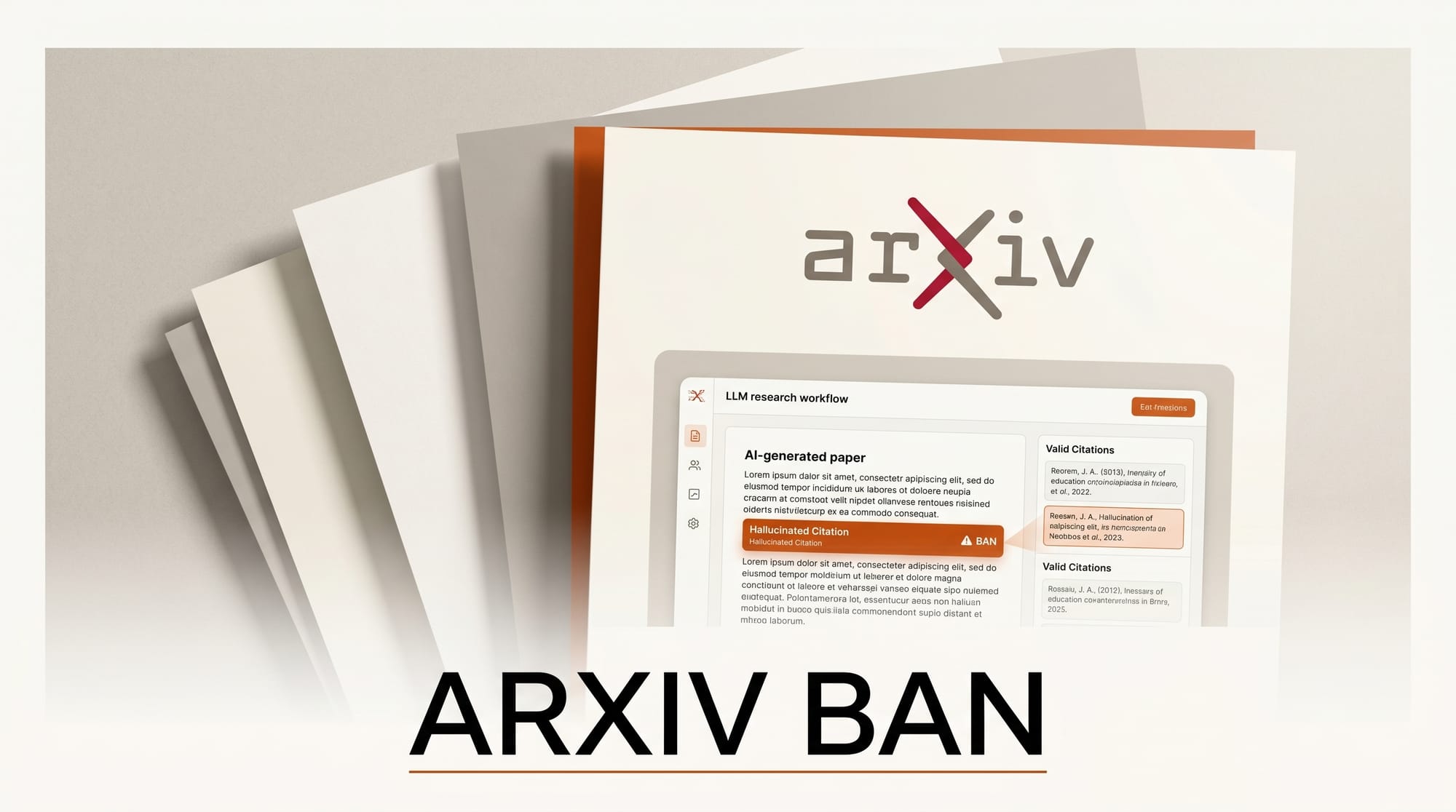
arXiv is now banning authors for one year when it detects AI-hallucinated citations in submitted papers. The preprint server made this enforcement public on May 15, 2026, after data showed fabricated references appearing in 1 in every 277 papers in early 2026, up from 1 in 2,828 in 2023. If you use AI tools to assist any research or writing, this directly affects how you work.
What Happened
arXiv moderator Thomas Dietterich announced on May 15 that the platform is enforcing a one-year submission ban for papers containing unmistakable evidence of unchecked large language model output, including hallucinated references, placeholder text left in, and invented results. After the one-year period, all future arXiv submissions from the banned author must first clear peer review at a reputable venue before they can post.
arXiv framed this not as a technology problem but as an authorship failure. The platform stated: "By signing your name as an author of a paper, each author takes full responsibility for all its contents, irrespective of how the contents were generated."
The announcement coincides with a major Lancet-published study of over 2 million papers and 97 million citations, which identified roughly 4,000 fabricated citations across 2,800 papers in a single sample, and a January 2026 preprint examining ACL conference papers that found nearly 300 papers at ACL, NAACL, and EMNLP 2024 and 2025 contained at least one hallucinated citation, with half of those concentrated at EMNLP 2025 alone.
The Scale of the Problem
The progression is steep. According to data cited in STAT News reporting on the Lancet study:
- 2023: roughly 1 in 2,828 papers contained a hallucinated reference
- 2025: 1 in 458 papers
- Early 2026: 1 in 277 papers, a tenfold increase in three years
That is not a gradual drift. The acceleration matches the mainstream rollout of LLM-assisted writing tools starting in late 2022 and accelerating through 2024 and 2025.
Across four major repositories in 2025, researchers detected over 140,000 hallucinated citations. By repository, SSRN leads with a 1.91 percent hallucination rate, followed by arXiv at 0.39 percent, PubMed Central at 0.27 percent, and bioRxiv at 0.21 percent, as detailed in a Nature analysis of cross-repository hallucination rates.
At NeurIPS 2025, the flagship AI conference, GPTZero scanned over 4,000 accepted papers and found more than 100 hallucinated citations in 53 papers, all of which had passed peer review by at least three human reviewers. These were not submitted without review. They were published.
Why This Matters to Every Creator Using AI
Most of the coverage has focused on academic researchers, but the underlying dynamic affects any creator who uses AI to produce factual content: blog posts, buyer guides, technical tutorials, product comparisons, or newsletter deep dives.
When you ask an AI to explain a topic, cite a statistic, or recommend a tool, the model draws on pattern-matched probability, not a live database lookup. It can and does generate plausible-sounding references to studies, articles, and tools that do not exist. The outputs look correct at a glance, especially when the topic is niche or recent.
The arXiv situation shows what happens when that trust goes unchecked at scale: a 12-fold surge in fabricated biomedical citations and a preprint ecosystem increasingly contaminated with invented references. Academic publishers, brands, and readers lose trust in the whole category.
For creators, the consequences are reputational and practical. A published tutorial that links to a tool that does not exist, or a deep dive citing a study that cannot be found, damages credibility faster than any algorithm update.
A Verified Workflow for AI-Assisted Writing
The solution is not to stop using AI. It is to use it as a drafting and synthesis engine while keeping a human in the verification loop for every factual claim. Here is a step-by-step workflow:
- Draft with AI, flag claims explicitly. When prompting, tell the model to mark any statistic, citation, or specific claim with [VERIFY]. This forces a clear audit trail rather than letting facts blend invisibly into the prose.
- Never accept a citation without checking the source URL directly. Paste every referenced URL into your browser. If the paper, article, or tool does not exist at that URL, the citation is hallucinated. This applies even when the title sounds plausible.
- Cross-reference statistics against primary sources. If an AI states a specific percentage or count, find the original study or press release. If you cannot locate the primary source within two minutes of searching, treat the number as unverified and either cut it or replace it with one you can confirm.
- Use Google Scholar or Semantic Scholar for paper verification. Both allow you to search by title. If a paper title does not appear in either, it does not exist as a published work. arXiv itself and SSRN are also directly searchable.
- Run a final fact pass before publishing. Read through your draft specifically looking for claims that start with "studies show," "research finds," "according to," or specific percentages. Each one requires a live URL you have visited and verified. No URL means no claim.
- For AI tool references, verify the feature exists today. AI products update rapidly. A feature your AI described as available in its training data may have been removed, renamed, or paywalled since. Always check the tool's current documentation or pricing page before publishing any how-to step that depends on it.
This workflow adds roughly 15 to 20 minutes to a deep dive but eliminates the risk of publishing content that links to nothing real. For more on building AI into your production workflow without cutting corners on accuracy, see the AI Content Creators 2026 master resource.
What to Do Starting Today
If you write regularly with AI assistance, run a quick audit on your last five published pieces. Pull up every external link. Check that every statistic has a traceable source. If you find broken links or uncited numbers, update or remove them before a reader or competitor flags them.
Going forward, the arXiv enforcement and the growing scrutiny of AI-generated content quality signal a broader shift. Platforms, editors, and audiences are starting to treat unchecked AI output as a credibility failure, not just a technical glitch. The creators who build verification into their process now will have a defensible track record when that scrutiny intensifies.
The tools that help you write faster are not going away. But the responsibility for what ships under your name stays with you. That is exactly what arXiv said in its enforcement statement, and it applies with equal force to anyone publishing under their own byline.
For a comparison of how different AI tools handle factual claims and when to use each, see the guide to Claude vs ChatGPT vs Gemini for creative work.

Frequently Asked Questions
What exactly is a hallucinated citation?
A hallucinated citation is a reference that an AI model generates that does not correspond to a real published paper, article, or source. The title sounds plausible, the author names look realistic, and the journal may be a real one, but the specific work cited does not exist. It is a statistical pattern completion by the model, not a retrieval of real information.
Does this arXiv policy apply to all fields or just computer science?
arXiv covers physics, mathematics, computer science, statistics, economics, biology, and other fields. The hallucinated citation problem is most documented in computer science and AI, where LLM-assisted writing is most common, but the 1-year ban applies across all arXiv categories for any submission showing clear evidence of unchecked LLM output.
Can I use AI to help write a paper or blog post and still be safe?
Yes. The issue is not using AI to assist with drafting or structuring content. The issue is publishing AI-generated factual claims, citations, or statistics without independent verification. Use AI to draft, outline, and synthesize. Use your own judgment and primary-source checks to verify every fact before it goes live.
How do AI models hallucinate citations specifically?
LLMs are trained on text that contains many real citations. When asked to cite sources, the model generates text that statistically resembles how citations appear in its training data: real author names, plausible titles, real journal names, and plausible publication years. The model has no access to a live bibliographic database, so it cannot distinguish between a real paper and a plausible-sounding fabrication. The result looks identical in structure to a valid citation.
Is this problem unique to academic writing?
No. The same dynamic applies to any long-form content where AI assists with facts, statistics, or references: product comparisons, investment analyses, medical summaries, legal briefs, and marketing copy. arXiv is simply the first major platform to formalize an enforcement mechanism with a defined penalty. Other publishers and platforms are watching, and similar policies will follow.