In the first quarter of 2026, the number of publicly available MCP (Model Context Protocol) server integrations surpassed 1,000 across the official registry and third-party repositories. Cursor shipped its agent workspace in version 3.0, letting AI agents run autonomously across entire codebases. Windsurf released SWE-1.5, a frontier coding model available free in its Wave 13 update. GitHub Copilot introduced /fleet, a command that spawns multiple AI agents working in parallel from the CLI. And Runway launched Gen-4.5, a video model backed by what it calls a General World Model. These are not incremental product updates. They represent a structural shift in how creative professionals build, design, compose, and ship work. The single-tool era of creative AI is ending. The agent era has arrived.
What Is an AI Creative Agent?
An AI agent, in the creative context, is a system that takes a goal, breaks it into steps, selects tools, executes actions, evaluates results, and iterates until the goal is met. This is fundamentally different from a single-model tool like a text-to-image generator, where the user provides a prompt and receives one output with no intermediate reasoning or tool selection.
Anthropic's research on building effective agents draws a clear distinction between workflows (predefined code paths orchestrating LLMs) and agents (systems where the LLM dynamically directs its own processes). In a workflow, a developer hardcodes step 1 then step 2 then step 3. In an agent, the model decides what step comes next based on what it observes.
For creative professionals, this distinction matters because creative work is inherently non-linear. A designer does not follow a fixed pipeline from brief to final asset. They explore, backtrack, reference existing work, test variations, and adapt. Agents mirror this process by maintaining context across steps, selecting the right tool for each sub-task, and adjusting their approach when something does not work.
The Agent Stack in 2026
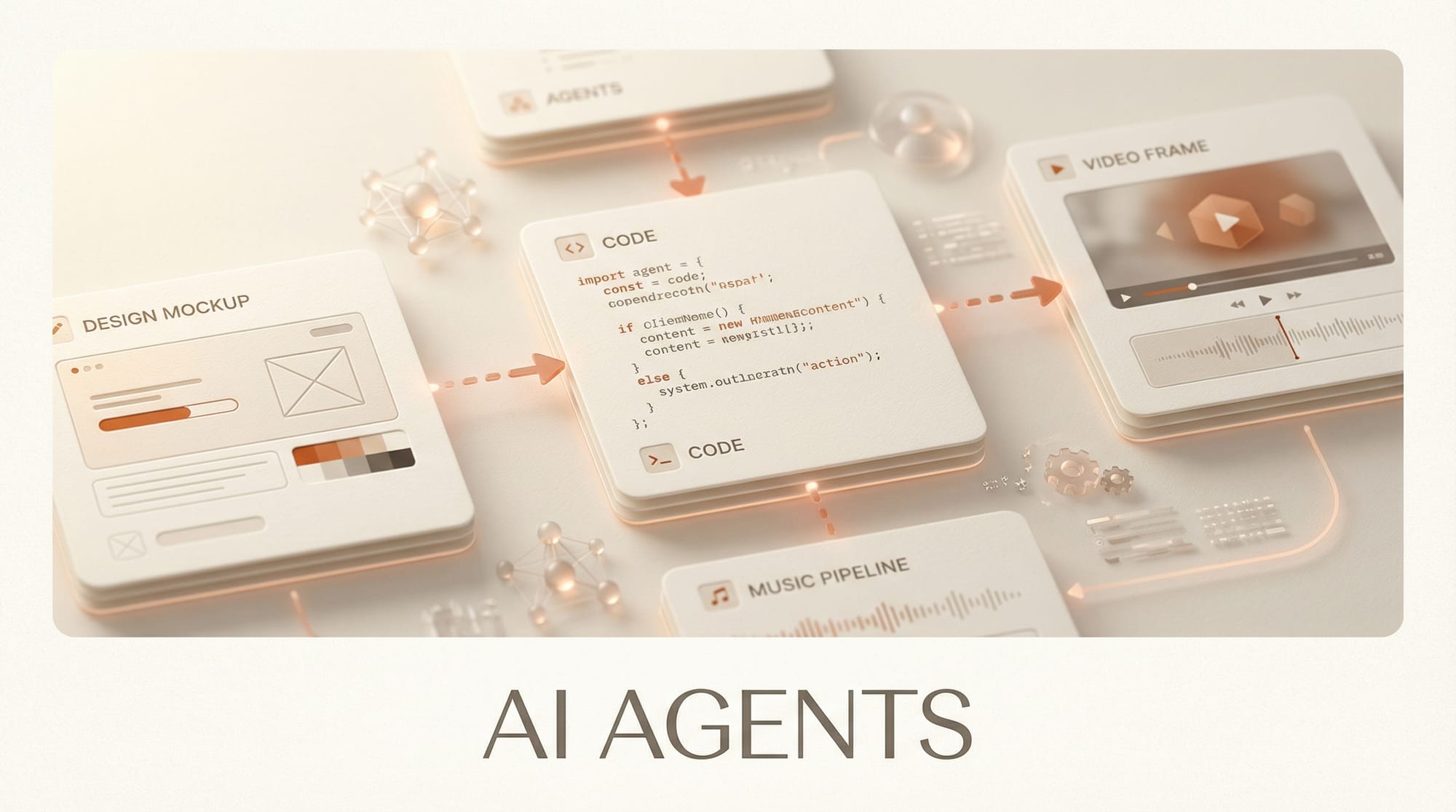
The current landscape of AI creative agents can be mapped across four domains: design, code, video, and audio. Each domain has moved from isolated model inference toward multi-step, tool-using agent systems at different speeds.
Design Agents
Figma's investment in its developer API and MCP server integration has made it the first major design tool to function as an agent-accessible resource. Through MCP, an AI agent can read a Figma file, extract component specifications, and generate production code without manual handoff. Figma's Make Kits feature, launched in early 2026, lets design systems power AI generation directly, turning component libraries into structured inputs for code agents.
Canva has expanded its Magic suite to include multi-step brand asset generation, where the system handles layout, copy, image selection, and format adaptation across dozens of output sizes from a single brief. Moda positions itself as a design agent for brand teams, automating the pipeline from brand guidelines to finished creative assets.
Coding Agents
Cursor version 3.0 rebuilt its entire editor around the agent paradigm. Its agents can autonomously build, test, and demo features end-to-end, operating in parallel on separate compute instances. The platform introduced what it calls an "autonomy slider," letting developers control how much independence the AI gets, from simple autocomplete to full autonomous development.
Windsurf (formerly Codeium) took a different approach with Wave 13, shipping parallel agents, Git worktrees for isolated agent workspaces, and its SWE-1.5 model in the free tier. The strategy: make agentic coding accessible to every developer, not just those on premium plans.
Claude Code, Anthropic's CLI tool, operates as a terminal-native agent that reads codebases, executes commands, manages files, and coordinates multi-step development tasks. Its architecture treats the entire development environment as the agent's workspace, with direct access to git, file systems, and build tools.
GitHub Copilot's /fleet command represents the industry's first mainstream multi-agent coding system, spawning parallel agents from the command line to work on different parts of a codebase simultaneously.
Video Agents
Runway has moved beyond single-shot video generation with Gen-4.5 and its General World Model architecture. GWM Worlds creates interactive, explorable environments. GWM Avatars power real-time conversational video characters that can be generated from a single reference image. This is agent-like behavior: the system maintains state, responds to input, and adapts its output in real time.
DeepBrain's AI Studios platform generates presenter-led videos from text scripts, handling avatar selection, lip sync, background generation, and final rendering as a multi-step pipeline. The user provides a script; the system orchestrates multiple models to produce a finished video.
Audio and Music Agents
Suno version 5.5 introduced voice cloning and custom model training, moving from a single generation endpoint to a multi-step creative system. Users can now clone a voice, train a custom style model, and generate songs that combine both, with the system managing the pipeline between these capabilities.
ElevenLabs has built what amounts to an audio agent ecosystem: text-to-speech, voice cloning, sound effects, music generation (via ElevenMusic), and dubbing across 32 languages. Each capability is available as an API endpoint, and their platform orchestrates them into multi-step workflows for content creators.
How Multi-Tool Pipelines Work
To understand what agent pipelines look like in practice, consider a real-world creative workflow: producing a branded marketing page from a brief.
Step 1: Brief Intake. The agent receives a natural language brief: "Create a landing page for our new AI photo editing feature. Use our brand guidelines. Include a hero image, feature grid, and email capture form."
Step 2: Design System Access. The agent connects to Figma via MCP, reads the team's component library, extracts color tokens, typography scales, spacing rules, and existing component patterns. No manual export required.
Step 3: Layout Generation. Using the design system data as constraints, the agent generates a page layout. This is not free-form image generation. It is constrained generation within the boundaries of an existing design system, producing structured output (HTML/CSS or a Figma frame).
Step 4: Asset Creation. The agent calls an image generation model to create the hero image, providing the brand color palette and style guidelines as part of the prompt. It generates multiple variants, evaluates them against the brief, and selects the best match.
Step 5: Code Generation. A coding agent (Cursor, Claude Code, or similar) takes the layout and converts it to production-ready code. It reads the project's existing codebase to match conventions, generates components, writes tests, and runs them.
Step 6: Review and Iteration. The agent evaluates the output against the original brief, identifies gaps (missing responsive breakpoints, accessibility issues, brand color deviations), and fixes them. This self-evaluation loop is what separates an agent from a one-shot tool.
The critical infrastructure enabling this pipeline is the Model Context Protocol. MCP provides a standardized interface (analogous to USB-C for hardware) that lets any AI application connect to any external tool or data source. Without MCP or a similar standard, each integration requires custom code, making multi-tool pipelines fragile and expensive to maintain.
What Actually Works vs What Does Not
After analyzing the current agent ecosystem, a clear pattern emerges: agents succeed where tasks are structured, verifiable, and decomposable. They struggle where tasks require subjective judgment, cross-domain context, or physical-world understanding.
Where Agents Deliver Today
| Task Category | Example | Success Rate | Why It Works |
|---|---|---|---|
| Code generation from specs | Cursor agent building a React component from a Figma design | High (with iteration) | Output is verifiable via tests and type checks |
| Format conversion | Video script to presenter video (DeepBrain) | High | Well-defined input/output, minimal subjective judgment |
| Brand-constrained design | Generating ad variants within brand guidelines | Medium-High | Constraints reduce the solution space |
| Audio production | ElevenLabs text-to-speech with voice clone | High | Clear quality metrics (naturalness, accuracy) |
| Multi-format adaptation | Resizing a design for 20 social platforms | High | Rule-based with clear constraints per format |
Where Agents Fall Short
| Task Category | Current Limitation | Root Cause |
|---|---|---|
| Original creative direction | Agents cannot replace a creative director's vision | Requires cultural context, taste, and strategic thinking that current models approximate but do not replicate |
| Cross-domain orchestration | No single agent handles design + code + video + audio | Context windows and tool integration limits; each domain uses different models and APIs |
| Subjective quality judgment | Agents cannot reliably distinguish "good enough" from "great" | Aesthetic judgment remains difficult to formalize |
| Error recovery in production | Agents can break live systems if given too much autonomy | Insufficient guardrails in most current agent frameworks |
The honest assessment: agents are excellent assistants and unreliable principals. They accelerate workflows by 2x to 5x when a skilled human sets direction and reviews output. They produce inconsistent results when given full autonomy over subjective creative decisions.
The Integration Problem
The biggest bottleneck in creative agent pipelines is not model quality. It is integration. Getting tools to talk to each other reliably, pass context accurately, and handle errors gracefully remains the primary engineering challenge.
The MCP specification (currently at version 2025-11-25) addresses this by defining a standard protocol for tool discovery, invocation, and context passing. The official MCP server registry now lists hundreds of integrations spanning databases, cloud platforms, design tools, development environments, and business applications.
But MCP adoption is uneven. Coding tools have embraced it aggressively: Cursor, VS Code (via Copilot), Windsurf, and Claude Code all support MCP servers natively. Design tools are catching up, with Figma leading. Video and audio tools lag behind, with most still relying on proprietary APIs rather than standardized protocols.
The practical consequence: building a pipeline that spans design, code, and media requires stitching together MCP connections (where available), REST APIs (where necessary), and custom glue code (where neither exists). This works for teams with engineering resources. It remains out of reach for solo creators and small studios.
The Context Window Bottleneck
Even when tools connect cleanly, agents face a fundamental constraint: context windows. A creative pipeline might involve a 50-page brand guide, a Figma file with 200 components, a codebase with thousands of files, and a library of existing assets. Current models with 128K to 1M token context windows can hold substantial information, but orchestrating which context to load at each step is an unsolved problem. Most agent frameworks use retrieval augmented generation (RAG) to manage this, but the quality of retrieval directly limits the quality of agent output.
What to Watch
Three developments will shape creative agent pipelines over the next 12 months.
Unified agent protocols. MCP is the leading candidate for a universal standard, but competitors exist. The trajectory mirrors the early web: multiple protocols will compete before consolidation. Watch for MCP adoption in video and audio tools as the signal that the protocol is becoming truly universal.
Vertical agent platforms. Expect tools that bundle design + code + deployment into a single agent-native platform, rather than requiring users to connect separate tools. Cursor's trajectory points this direction: starting as a code editor, expanding into design interpretation, moving toward full-stack autonomous development.
Human-agent collaboration patterns. The most productive creative workflows in 2026 are not fully autonomous. They involve humans setting direction, agents executing, humans reviewing, and agents iterating. The tools that win will be those that make this feedback loop fast and natural, not those that promise full automation.
Methodology
This analysis is based on publicly available product announcements, documentation, and API specifications from the tools discussed. Agent capability assessments are derived from documented features, official demos, and published benchmarks where available. Success rate characterizations (High, Medium-High, Medium) reflect the consistency of agent output quality as reported across developer communities, technical reviews, and our own testing. All data points are sourced from public information available as of April 2026. No proprietary benchmarks or paid research was used.
Frequently Asked Questions
Can AI agents replace creative professionals in 2026?
No. Current AI agents excel at executing well-defined creative tasks (code generation, format adaptation, brand-constrained design) but cannot replace the strategic thinking, cultural awareness, and subjective judgment that creative professionals bring. The most effective use of agents is as force multipliers: handling repetitive execution so humans can focus on direction, strategy, and quality decisions.
What is MCP and why does it matter for creative workflows?
The Model Context Protocol is an open standard created by Anthropic that lets AI applications connect to external tools and data sources through a unified interface. For creative workflows, MCP means an AI agent can access your Figma files, read your codebase, query your asset library, and execute build commands through a single, standardized connection layer instead of requiring custom integrations for each tool.
Which creative agent tools are worth trying today?
For coding: Cursor (strongest agent features), Claude Code (best terminal-native experience), and Windsurf (best free tier). For design: Figma with MCP integration for agent-accessible design systems. For video: Runway Gen-4.5 for generation, DeepBrain for presenter videos. For audio: ElevenLabs for voice and speech, Suno for music. Start with one domain where agents are strongest (coding) before attempting cross-domain pipelines.