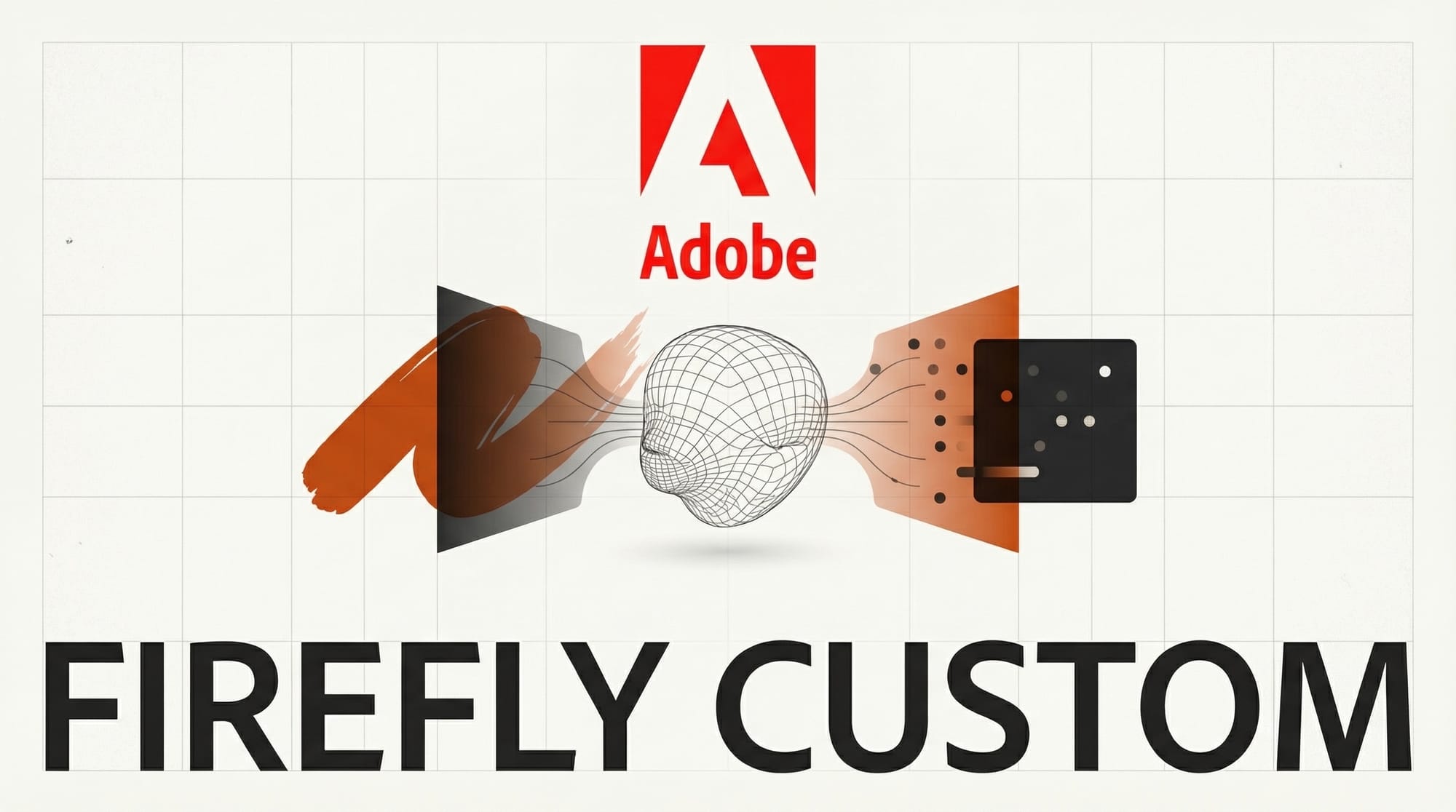
Adobe opened Firefly Custom Models to public beta on March 19, letting any Creative Cloud subscriber train a private AI model on their own images. The feature was previously restricted to enterprise customers through Firefly Foundry. Combined with Firefly Image Model 5 going generally available and 30-plus third-party models joining the platform, the announcement marks Adobe's clearest move yet from single AI tool to creative AI operating system.
Background
Adobe launched the original Firefly in March 2023 as a commercially safe text-to-image generator trained exclusively on Adobe Stock, openly licensed content, and public domain works. Each subsequent version improved quality and expanded capabilities: Image Model 2 and 3 brought better coherence, Model 4 and 4 Ultra in April 2025 introduced a two-tier strategy splitting rapid ideation from photorealistic detail, and Image Model 5 at MAX 2025 pushed output quality to match dedicated competitors.
Custom model training first appeared as Firefly Foundry in October 2025, a white-glove enterprise service where a dedicated team of Adobe experts handled model training across images, video, audio, vectors, and 3D assets. Foundry required contacting Adobe Sales, carried custom pricing, and served brands that needed multi-concept, multimodal generative output with IP indemnification. The public beta of Custom Models takes the core idea and makes it self-serve for individual creators.
Deep Analysis
How Custom Model Training Works
The process is deliberately simple. Creators choose one of three style types: illustration (capturing stroke weight and color palette), character consistency (maintaining the same character across scenes), or photographic looks (locking in a shooting style and mood). They upload 10 to 30 images in JPG or PNG format, at minimum 1000 pixels resolution, and add metadata including a name, description, and captions for each image.
The system generates a training set score from 1 to 100, with Adobe recommending a target of 85 or higher for quality results. Training takes 30 minutes to a couple of hours depending on complexity and queue position, and costs 500 generative credits per model with no refunds if canceled. Adobe does not disclose the underlying fine-tuning architecture. Official documentation makes no mention of LoRA, DreamBooth, or any specific technique. Given the 10-to-30 image requirement and short training time, the approach likely resembles LoRA-style fine-tuning, but Adobe treats the internals as a black box.
Once trained, the model generates new images in the learned style and feeds directly into Photoshop, Illustrator, and Adobe Express. Models are private by default and can be shared selectively via email. Retraining with updated or additional images is supported.
The Multi-Model Hub Strategy
The 30-plus third-party model integrations may be the more strategically significant announcement. Adobe's partner model catalog now includes image generators from Black Forest Labs (FLUX1.1 Pro, FLUX.1 Kontext, FLUX.2), Google (Imagen 3, Imagen 4 Preview, the Nano Banana family), OpenAI (GPT Image, GPT Image 1.5), and Ideogram 3.0. Video models span Google Veo 2 through Veo 3.1, Luma AI Ray2 through Ray3.14 HDR, Pika 2.2, Runway Gen-4.5, and OpenAI Sora 2. Topaz Labs contributes five image enhancement models, and ElevenLabs provides audio generation.
Runway holds the designation of Adobe's "preferred API creativity partner" with early access to new models. This is a notable alliance given that Runway competes directly with Firefly's own video generation capabilities.
The strategy repositions Firefly from a generation tool to a creative marketplace. Instead of forcing creators to switch between platforms to compare output from different models, Adobe brings the models into its own ecosystem. Every generation still runs through Adobe's interface with Content Credentials attached, maintaining the commercial safety layer regardless of which underlying model produced the output.
The Commercial Safety Moat
Adobe's IP indemnification remains its strongest competitive differentiator. Qualifying paid plans include legal protection against copyright claims for Firefly-generated assets, a guarantee that no major competitor matches at the individual creator level. The protection extends to custom model outputs as long as the training images are the creator's own work.
All Firefly outputs automatically include Content Credentials metadata, a tamper-evident record showing creation date, tools used, and AI involvement. Built on the C2PA open standard under the Linux Foundation, Content Credentials have gained adoption from Google (Search, YouTube, and ads), Meta, and Amazon. For commercial work where provenance matters, this is a structural advantage that standalone tools cannot replicate.
The training data story reinforces the moat. Firefly is trained on Adobe Stock with contributor consent and compensation, openly licensed content, and public domain works. Custom models train only on the images a creator uploads, not on other users' content. This contrasts sharply with the open-source ecosystem, where training data provenance is often unclear and legal exposure remains an open question for commercial use.
How It Compares to the Alternatives
The competitive landscape for custom model training breaks along a clear line: simplicity and safety versus control and flexibility.
Stable Diffusion's LoRA and DreamBooth ecosystem gives power users total control over training parameters, learning rates, and model weights. Models can be exported, shared, combined, and run locally with full privacy. But it requires technical knowledge of ComfyUI or similar interfaces, VRAM management, and parameter tuning. Adobe Custom Models eliminates all of that complexity at the cost of transparency and control.
Midjourney's approach is different entirely. V7's personalization system learns user preferences through image pair ratings, subtly calibrating output toward an aesthetic without training a dedicated model. Style References match per-prompt visual direction. Neither involves actual model training on the user's own work.
Leonardo.ai offers the closest direct comparison, allowing custom model training with 10 to 20 images at $30 per month on its Artisan plan. Leonardo provides more creative flexibility but lacks Adobe's IP indemnification and Creative Cloud integration. For creators already embedded in Adobe's ecosystem, Custom Models removes the need to evaluate third-party alternatives entirely.
Impact on Creators
For illustrators, Custom Models solves a persistent problem: maintaining visual consistency across projects without manually matching every stroke weight and color decision. Training a model on an existing body of work creates a reusable style engine that generates new compositions in a recognizable voice. For character designers working across comics, games, or animation, character consistency models maintain the same character across scenes and poses.
Photographers gain the ability to train models on their signature lighting and color grading style, generating mood boards and concept variations that match their look without starting from scratch. Brand designers can train on approved campaign visuals and generate on-brand assets at scale, from banner ads to social posts to packaging concepts.
The integration advantage is structural. Custom model outputs feed directly into Photoshop and Illustrator, so generated images go straight into professional editing workflows. Standalone tools require export, import, and format conversion steps that add friction. For the estimated 30 million Creative Cloud subscribers, this could be the first and only custom model training they need. The open-source LoRA ecosystem will continue to serve technical users and specialized use cases, but the mass market shifts toward Adobe's simplified approach.
The NVIDIA partnership announced at GTC provides the infrastructure foundation. NVIDIA Cosmos open models, CUDA-X acceleration, and NeMo libraries power the training pipeline, while Omniverse and RTX rendering support a new 3D digital twin solution entering public beta. The partnership positions Adobe to compete on video generation quality while maintaining its commercial safety layer.
Key Takeaways
1. Firefly Custom Models makes AI style training self-serve for any Creative Cloud subscriber, no longer restricted to enterprise Foundry customers.
2. The 30-plus partner model integrations transform Firefly from a single-vendor generator into a multi-model creative marketplace.
3. IP indemnification and Content Credentials remain Adobe's strongest competitive moat, particularly for commercial creators.
4. Training costs 500 credits per model (roughly $2.50 on the Standard plan), making it accessible for experimentation but not free.
5. The move does not make LoRA training obsolete for power users, but it eliminates the need for most mainstream creators to learn it.
What to Watch
Custom Models is still in beta, and several unknowns remain. Adobe has not disclosed pricing beyond the 500-credit training cost, so generation costs with custom models may carry a premium. The three-style limitation (illustration, character, photographic) will likely expand, but the timeline is unclear. And the quality ceiling of a model trained on just 10 to 30 images has yet to be tested at scale by the broader community.
The multi-model hub strategy introduces competitive dynamics worth tracking. Runway, Google, and OpenAI are all listed as partners, but each also competes with Adobe for creative professionals. How these relationships evolve as each company expands its own creative tools will shape whether Firefly becomes the default creative AI interface or one option among many. Project Moonlight, Adobe's conversational AI assistant now expanding to broader beta, adds another dimension: if creators can orchestrate multi-app workflows through natural language, the custom model becomes one component of a larger AI-powered creative pipeline.
Deep dive by Creative AI News.
Subscribe for free to get the weekly digest every Tuesday.