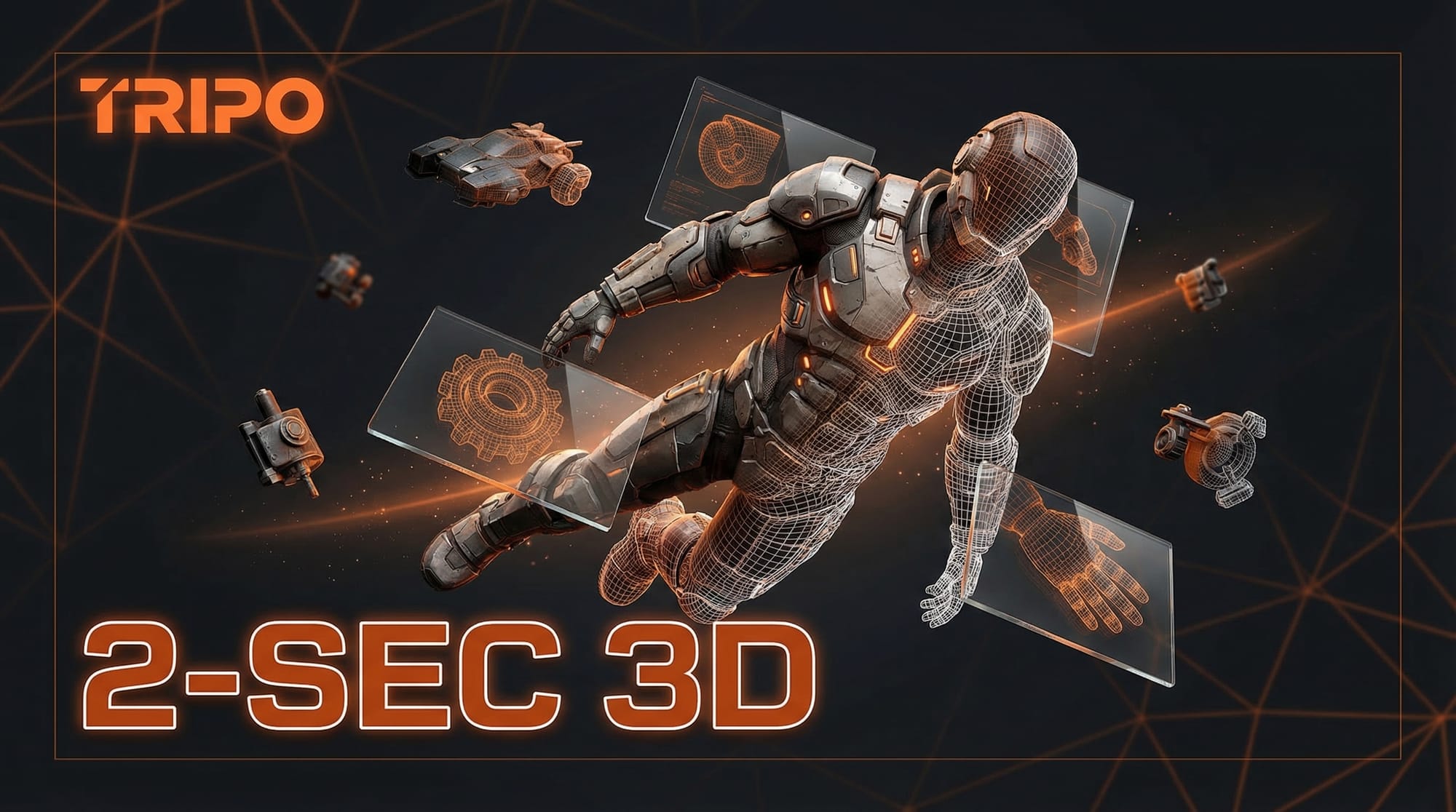
Tripo debuted P1.0, a native 3D diffusion model that generates production-ready 3D assets in roughly two seconds, at GDC 2026 in San Francisco. The model outputs clean geometry with stable topology that works directly in Unity and Unreal Engine, targeting the gap between fast AI generation and the quality bar required for shipping games and interactive experiences.
What Happened
At GDC 2026 (Booth 1141, Moscone Center), Tripo announced P1.0 as the core of what the company calls "AI 3D 2.0." Unlike earlier approaches that build 3D objects by sequentially generating and assembling 2D views, P1.0 uses a native 3D diffusion architecture that resolves the full holistic structure of a 3D object in one pass. The result is cleaner topology, more stable geometry, and significantly less manual cleanup compared to previous AI 3D generation tools.
P1.0 supports both prompt-based generation, where users describe what they want in text, and reference-based generation, where the model works from existing images or concepts. The two-second generation time puts it in a different category from tools that take minutes or require iterative refinement to reach usable quality.
Why It Matters
The 3D asset pipeline has been one of the slowest parts of game and interactive media production. Professional 3D modeling for a single game-ready asset can take hours or days depending on complexity. AI 3D tools have existed for several years, but most produce output that requires extensive manual cleanup before it meets production standards, limiting their use to concept exploration rather than final assets.
P1.0's direct compatibility with Unity and Unreal Engine is the critical detail. If the output genuinely requires minimal cleanup and integrates cleanly into standard game engine workflows, it compresses the asset creation timeline from days to seconds for certain categories of objects. That has real implications for indie studios and small teams that lack dedicated 3D artists, as well as for larger studios looking to accelerate prototyping.
Tripo already serves over 6.5 million creators and more than 90,000 developers, giving P1.0 an established distribution channel. The GDC debut is a deliberate signal that Tripo sees game development as its primary market, not just general-purpose 3D generation. This positions the company alongside NVIDIA's own GDC 2026 announcements in the push to bring AI tooling directly into game production pipelines.
Key Details
- Model: P1.0, a native 3D diffusion model (not multi-view reconstruction)
- Speed: Approximately 2 seconds per generation
- Output quality: Clean topology, stable geometry, production-grade meshes
- Engine support: Direct Unity and Unreal Engine compatibility
- Input modes: Text prompt-based and reference image-based generation
- Architecture: Holistic 3D structure resolution in a single pass
- User base: 6.5M+ creators, 90K+ developers
- Announced: GDC 2026, Booth 1141, Moscone Center, San Francisco
What to Do Next
Game developers and 3D artists should visit Tripo's platform to test P1.0 output quality against their specific production requirements. The key question is whether the generated assets hold up under real engine lighting, animation rigging, and LOD (level of detail) workflows without extensive manual rework.
For teams attending GDC 2026, Booth 1141 offers hands-on demos. If you are evaluating AI 3D tools for your pipeline, comparing P1.0 output directly against your current modeling workflow will give a clearer picture of where it fits: full replacement for certain asset types, or a faster starting point that still needs artist polish.
Studios already using AI for concept art and 2D generation should consider whether P1.0 closes the loop on their AI-assisted production pipeline, taking concepts from text to rendered 3D asset in a single toolchain.