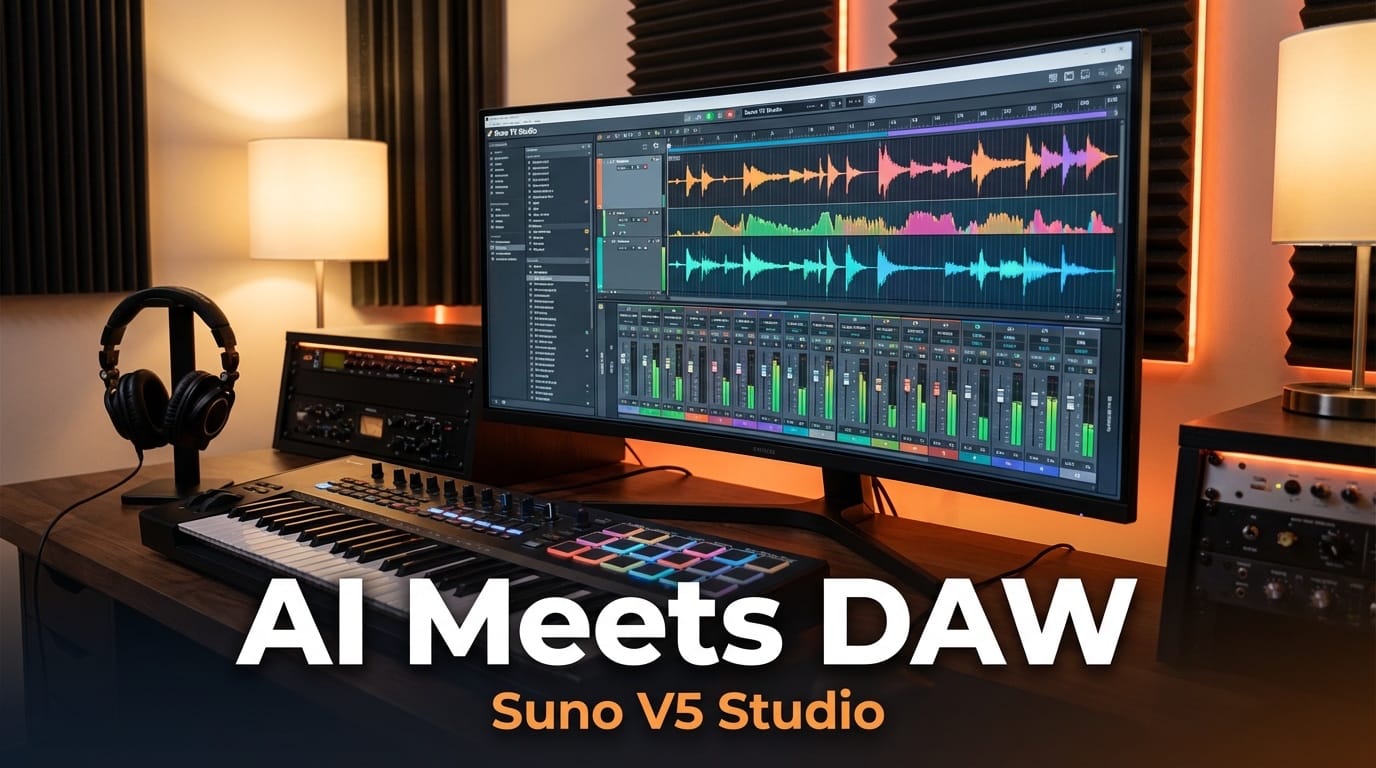
For years, AI music generation was a party trick. You typed a prompt, waited a few seconds, and got something that sounded like a song recorded through a hotel wall. It was fun for memes. It was useless for production. Suno V5 Studio, updated on February 6, 2026, changes the equation entirely. With warp markers, FX removal, alternate takes, MIDI export, and 12-stem separation, the platform has crossed the line from novelty generator to functional Digital Audio Workstation. For the millions of creators who need music but cannot afford composers or stock library subscriptions, this is the most significant shift in accessible music production since GarageBand.
Background: The AI Music Landscape in Early 2026
The AI music generation market has consolidated around two major players. Suno leads in complete song generation with vocals, while Udio has carved out a niche in high-fidelity instrumentals at 48kHz output. Behind them, tools like Stable Audio, AIVA, and Beatoven.ai serve specific verticals, but none have attempted what Suno is now building: a full production environment around AI-generated music.
Suno launched its original Studio in September 2025 as a web-based workspace for arranging and editing AI-generated tracks. The concept was ambitious but limited. You could generate sections and arrange them on a timeline, but fine-grained control over timing, effects, and individual stems was missing. Producers who tried Studio reported the same frustration: the output was close to usable, but the last 20% of polish required exporting to Logic Pro, Ableton Live, or FL Studio and rebuilding from scratch.
The February 6 update addresses that gap directly. Four new features push Studio from "arrange and export" to "produce and finish." The timing is strategic. Udio is dealing with licensing complications after Universal Music Group's settlement forced the platform to disable downloads and stem exports while it builds a licensed experience. Suno, which struck a separate licensing deal with Warner Music Group, is using the window to establish itself as the professional-grade option.
Deep Analysis
The DAW Features That Actually Matter
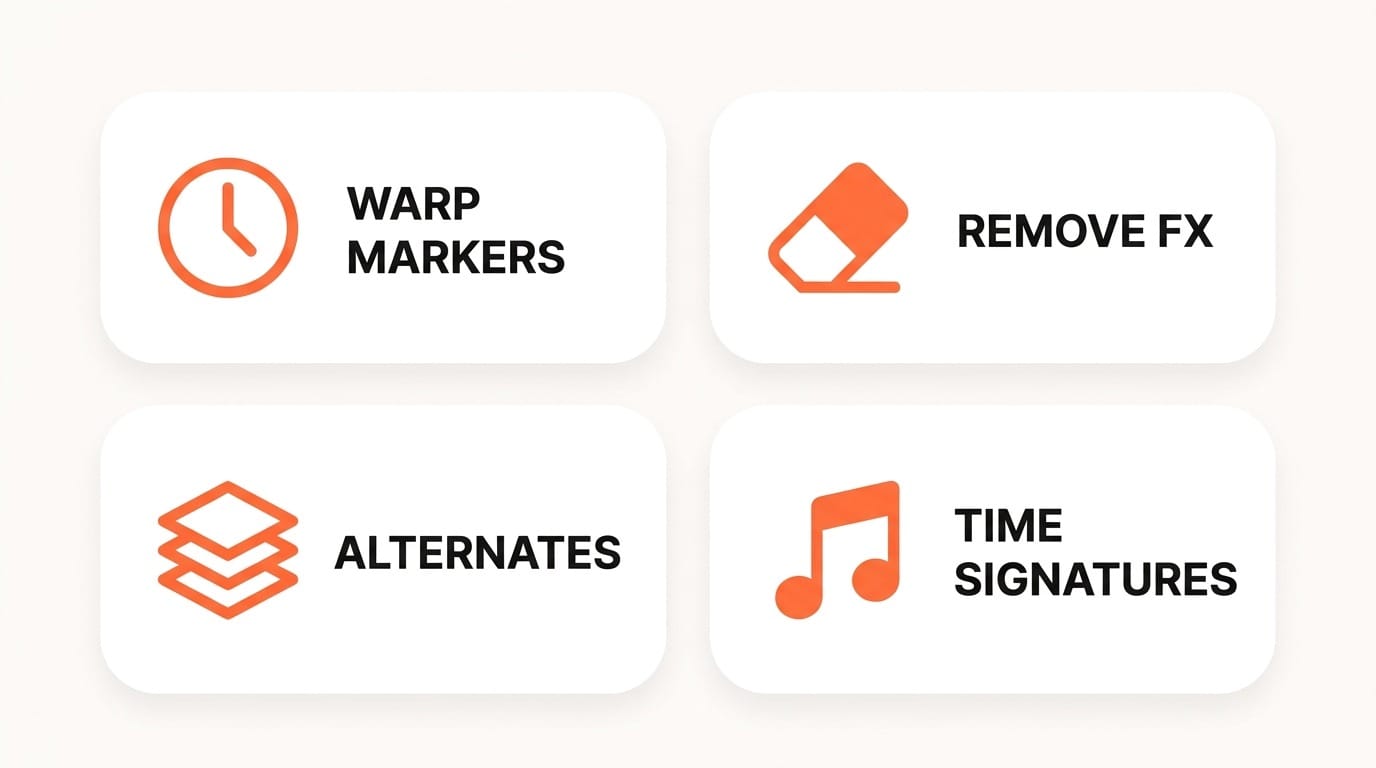
Warp Markers are the headline feature and the most technically impressive. Borrowed conceptually from Ableton Live's Warp and Logic Pro's Flex Time, warp markers let you grab transients on a waveform and shift them forward or backward without regenerating the audio. Double-click a clip, set markers on each transient automatically or manually, and time-stretch the audio to fit your arrangement. You can lock elements tightly to the grid or intentionally build in swing and groove. For creators assembling tracks from multiple generated sections, this eliminates the timing inconsistencies that made AI music sound "off" when layered.
Remove FX solves a problem that plagued every previous AI music tool. Generated audio arrives with baked-in reverb, compression, and spatial effects. If you wanted to mix a Suno vocal with your own production, the competing reverb tails created mud. Remove FX strips effects from any clip and generates a dry version directly on your timeline. Select the clip, choose "Remove FX" from the context menu, and Studio produces a clean version ready for your own processing chain. This is the feature that makes Suno output genuinely usable as raw material for professional production.
Alternates mirror a core professional workflow. Generate a section and Studio creates multiple variations automatically. Flip through them in an alternates lane and select the best performance. This is how session musicians work in real studios: record multiple takes, comp the best one. Applying this logic to AI generation transforms the creative process from "hope this one is good" to "choose the best from several options."
Time Signature Support moves beyond the 4/4 constraint that limited AI music to pop and rock structures. Waltz time (3/4), compound meters (6/8), and odd time signatures are now possible. For creators scoring film, games, or experimental content, this opens up musical territory that was previously off-limits.
ELO Benchmarks and What They Mean
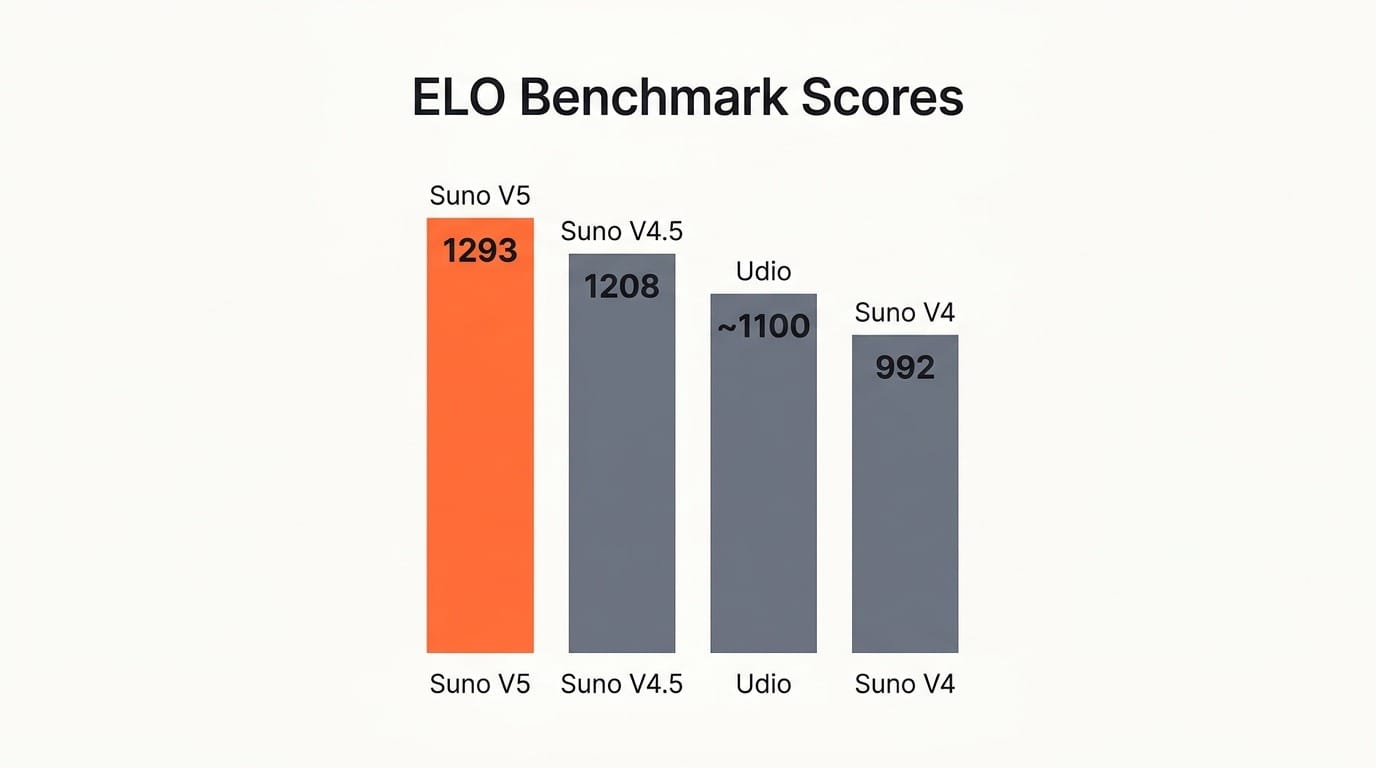
Suno V5 achieved an ELO benchmark score of 1,293 in head-to-head comparisons, the highest of any AI music generation platform. For context, V4.5+ scored 1,208, and V4 scored 992. The jump from V4 to V5 represents a 30% improvement in listener-rated quality.
The ELO system evaluates melody retention (does the song maintain coherent musical themes), structural coherence (does it follow verse-chorus-bridge logic), vocal realism (can listeners distinguish AI vocals from human recordings), and audio fidelity (overall production quality). V5 scores highest on vocal realism and structural coherence, two areas where AI music historically fell apart.
Independent testing confirms the benchmark claims. Prompt adherence sits at 88%, meaning nearly 9 out of 10 generated songs accurately reflect the requested genre, mood, and style tags. Lyric hallucination, where the model invents or garbles lyrics, dropped below 5%. Generation speed averages 22 seconds for a 2-minute clip, fast enough for real-time creative iteration.
Stem Exports and the Production Workflow
Studio now separates generated audio into up to 12 individual stems: vocals, drums, bass, guitars, synths, keys, strings, and more. Each stem exports as MP3, WAV, tempo-locked WAV (quantized to the song's average BPM), or MIDI. The MIDI export is particularly significant. It extracts the underlying melodic and rhythmic data from AI-generated parts, letting you trigger your own virtual instruments and synthesizers in any standard DAW.
The multitrack export option bundles all stems within the context of your Studio mix, preserving levels, panning, and arrangement. For producers who want to start in Suno and finish in Ableton or Logic, this creates a clean handoff. No more bouncing a stereo mix and trying to reverse-engineer the individual parts.
Free Tier and Pricing Strategy
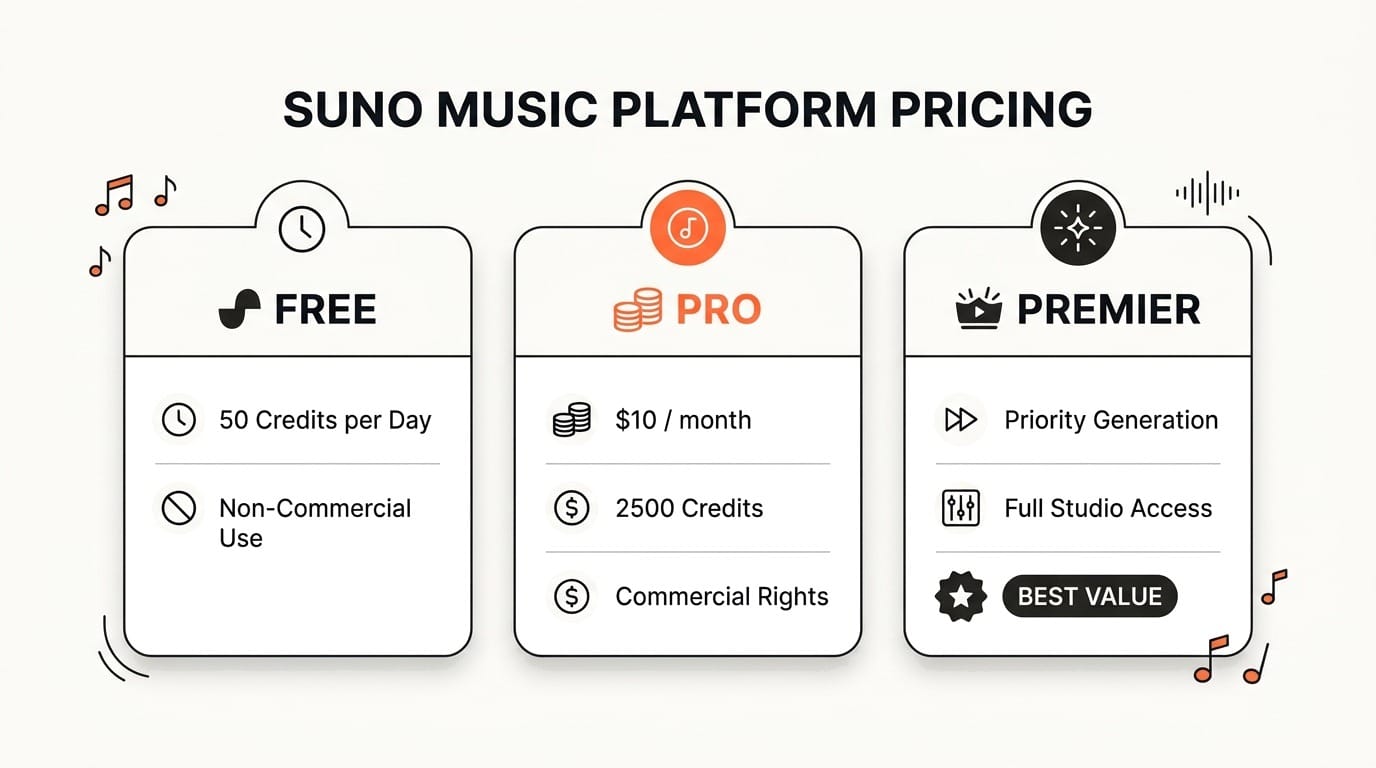
Suno operates on a three-tier model. The free tier provides 50 credits per day for non-commercial use. The Pro tier at $10/month (or $8/month annually) provides 2,500 credits with commercial rights, access to V5, the Song Editor, and 12-stem separation. The Premier tier at an undisclosed higher price adds full Studio access with all DAW features, priority generation, and expanded export options.
With 2,500 Pro credits, users can create approximately 250 full songs, 125 songs plus 250 extensions, or 500 short clips per month. For a content creator producing daily videos, that is roughly 8 unique background tracks per day at the Pro level.
The free instrumental generator, announced March 3, 2026, targets the largest creator use case directly. Video producers, podcasters, and social media creators who need royalty-free background music can generate custom tracks without paying anything. The strategy is clear: hook creators with free instrumentals, convert them to Pro when they need commercial rights and production features.
The Competitive Landscape
Suno and Udio occupy different niches despite surface-level similarity. Suno generates complete songs with vocals in under 60 seconds, produces tracks up to 4 minutes long, and now offers a full DAW environment. Udio outputs at 48kHz with superior instrumental separation and cleaner individual instrument definition, but caps tracks at 2 minutes and currently has its download and export features disabled due to licensing restructuring.
The licensing dimension is critical. Universal Music Group settled with Udio and is pushing it toward a fully licensed model. Warner Music Group struck a separate deal with Suno. These deals legitimize AI music generation but create different constraints. Suno users with Pro or Premier plans have commercial rights today. Udio users are waiting for the new licensed experience to launch before they can export or use generated music commercially.
For creators who need music now, for actual projects with deadlines, this distinction matters more than any benchmark score. Suno is the only platform offering both professional production tools and clear commercial rights simultaneously.
Impact on Creators
Video Creators and Filmmakers
Background music is the largest ongoing cost and time sink for video creators after editing software. Stock music libraries charge $15-50 per track for commercial licenses, and finding the right track for a specific scene can take hours. Suno's free instrumental generator eliminates the search entirely. Describe the mood, tempo, and style. Get a custom track in seconds. If it is close but not perfect, warp markers and alternates let you fine-tune without starting over.
Podcasters and Audio Producers
Intro music, segment transitions, and background beds are essential for professional podcasts. Most podcasters use the same stock track for months because finding and licensing new music is not worth the effort. With 50 free credits daily, a podcaster can generate fresh intros and transitions for every episode at zero cost. The stem export feature also lets audio producers isolate specific elements and mix them into their existing production template.
Musicians and Composers
For working musicians, Suno V5 Studio is not a replacement. It is a sketchpad. Generate melodic ideas in seconds, export the MIDI, and develop them with your own instruments and production chain. The alternates feature functions as a brainstorming partner that never gets tired. The Remove FX tool gives you clean source material to process with your own creative vision. Musicians who view AI as a collaborator rather than a competitor gain a significant speed advantage in composition and demo production.
Content Producers at Scale
Brands, agencies, and content teams producing dozens of videos per week face a constant music licensing headache. Suno's Pro tier at $10/month provides 250 commercially licensed tracks, roughly $0.04 per track compared to $15-50 from stock libraries. For teams producing at volume, this is not an incremental improvement. It is an order-of-magnitude cost reduction.
Key Takeaways
1. Suno V5 Studio's February 6 update added warp markers, FX removal, alternates, and time signature support, transforming it from a music generator into a functional DAW.
2. The V5 model achieved an ELO score of 1,293, the highest of any AI music platform, with 88% prompt adherence and sub-5% lyric hallucination.
3. Twelve-stem separation with WAV, MIDI, and tempo-locked export creates a clean bridge between AI generation and professional DAW production.
4. Commercial rights are available now on Pro ($10/month) and Premier plans. Competitor Udio currently has exports disabled during its licensing restructuring.
5. The free instrumental generator targets the largest creator use case: royalty-free background music for videos, podcasts, and social content. This positions Suno as the default music tool for non-musicians who need custom audio.
What to Watch
The next 90 days will determine whether Suno Studio can retain professional users or remains a starting point for tracks finished elsewhere. Watch for latency improvements in warp marker processing, expanded MIDI export accuracy, and whether the alternates feature evolves to accept more specific creative direction.
On the competitive front, Udio's new licensed platform launch date will be the most important announcement in AI music this quarter. If Udio restores exports with 48kHz fidelity and clear commercial rights, Suno's current advantage narrows significantly. If the launch delays, Suno has an open runway to lock in creators and build switching costs through Studio workflows.
For creators, the practical advice is simple: try the free tier today. Generate background music for your next project. If the quality meets your standard, the production tools justify the Pro subscription. If it does not, check back in 90 days. At the current rate of improvement, what falls short today will likely be production-ready by summer.
Deep dive by Creative AI News.
Subscribe for free to get the weekly digest.