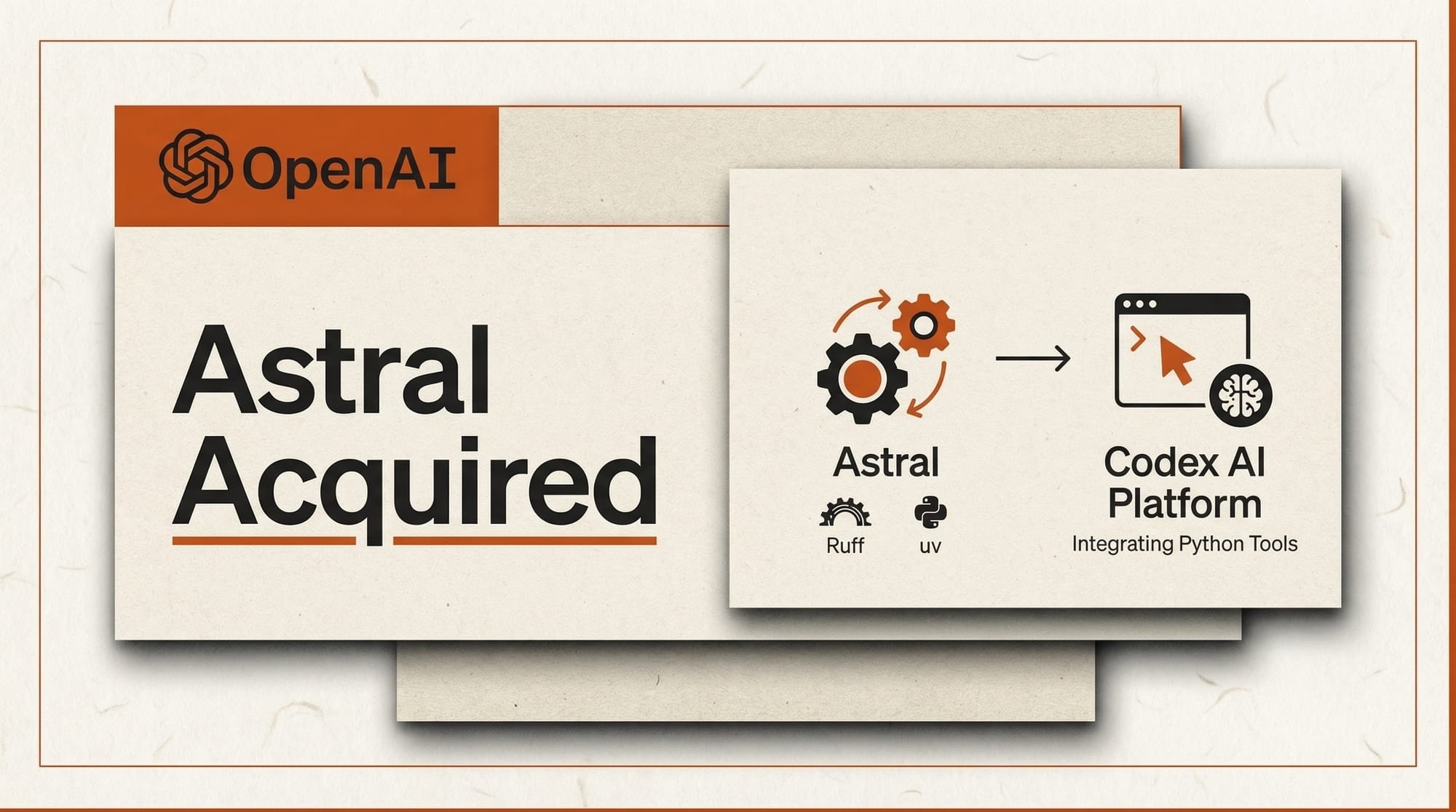
OpenAI has agreed to acquire Astral, the company behind uv, Ruff, and ty, three of the most widely used Python developer tools. The Astral team will join OpenAI's Codex division, which now has over 2 million weekly active users. All tools will remain open source.
What Happened
OpenAI announced the acquisition on March 19, bringing in the team that built uv, a Python package manager with over 126 million monthly downloads, Ruff, a linter and formatter that runs roughly 1,000 times faster than traditional alternatives, and ty, a new type checker. All three tools are written in Rust and have become standard infrastructure across the Python ecosystem.
Astral founder Charlie Marsh confirmed the deal in a blog post, writing: "Open source is at the heart of that impact. We'll keep building in the open, alongside our community."
The acquisition is subject to regulatory approval. No price was disclosed.
Why It Matters
Codex, OpenAI's AI coding product, has tripled its user base and grown usage fivefold since the start of 2026. Adding Astral's tooling expertise directly into the Codex team signals that OpenAI views developer tooling as a core competitive layer, not just a feature of its AI models.
For creators who build with Python, whether scripting ComfyUI workflows, training LoRAs, or automating content pipelines, the quality of these tools affects daily work. uv already handles dependency management for thousands of Python projects, from AI model training scripts to creative automation pipelines. Keeping these tools open source matters.
The move mirrors Anthropic's acquisition of Bun, the JavaScript runtime, in December 2025. AI companies are now competing on developer infrastructure, not just model capabilities.
Key Details
- Tools acquired: uv (package manager), Ruff (linter/formatter), ty (type checker)
- Codex stats: 2M+ weekly active users, 3x user growth in 2026
- Open source: All tools remain open source under existing licenses
- Team: Astral team joins OpenAI's Codex division
- Investors: Astral previously raised from Accel (Series A) and a16z (Series B)
What to Do Next
Nothing changes for current uv and Ruff users in the short term. The tools will continue to receive updates and remain open source. If you have not tried uv for managing Python environments and dependencies, now is a reasonable time to evaluate it, as the project will likely see increased investment under OpenAI.
The broader signal is worth watching. As AI coding valuations climb past $75 billion, the companies building AI assistants are acquiring the developer tools those assistants depend on. Expect more acquisitions in this space through 2026.