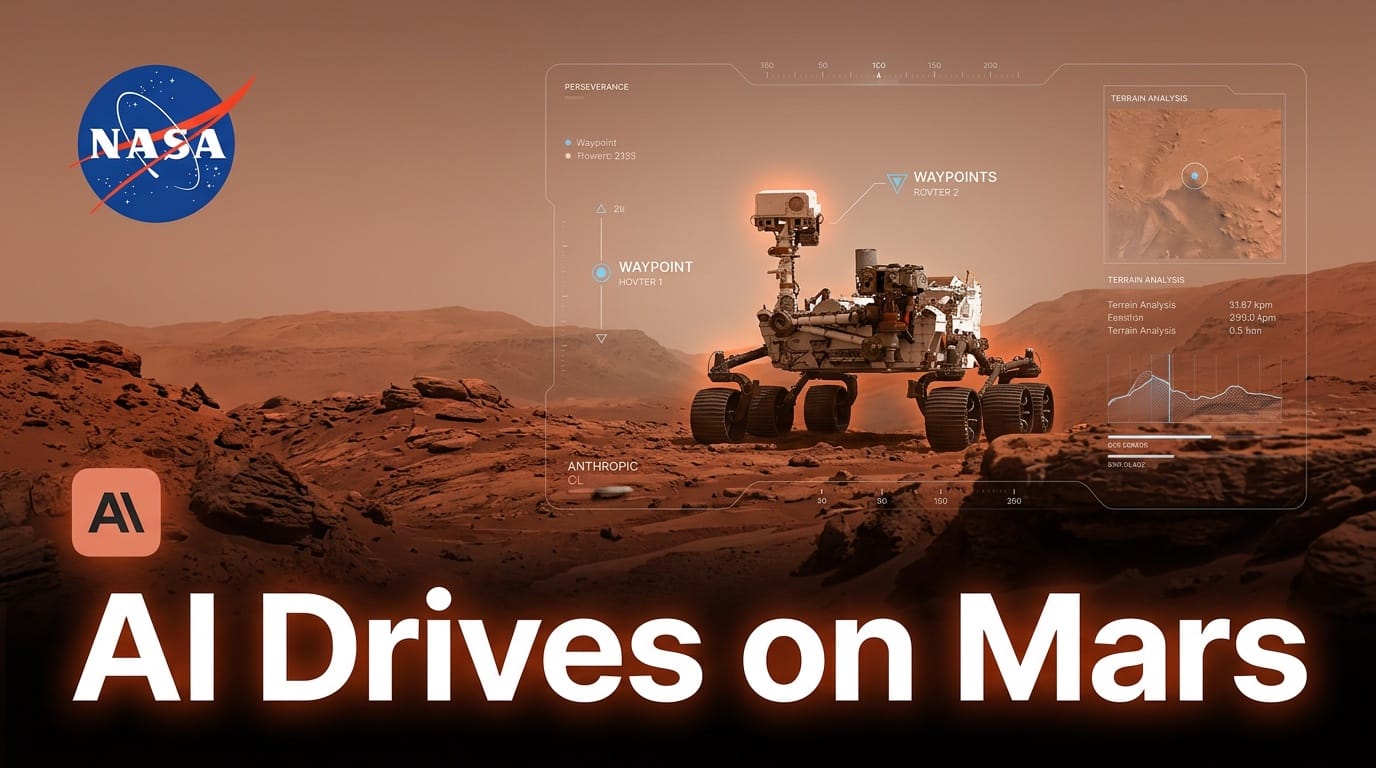
NASA's Jet Propulsion Laboratory successfully completed the first autonomous drive on Mars where the rover's path was planned using Anthropic's Claude AI. Perseverance completed two separate drives totaling nearly 1,500 feet, with the first drive covering 689 feet and the second spanning 807 feet.
The AI-assisted planning process is estimated to reduce route-planning time by approximately half compared to traditional manual planning methods.
What Happened
JPL engineers used Claude to analyze terrain data from rover cameras and orbital imagery, generate safe waypoints accounting for obstacles and slope hazards, and write Rover Markup Language commands that direct the rover's movements.
The process involved several steps. First, engineers input terrain data and imagery from Perseverance's cameras and Mars Reconnaissance Orbiter observations into Claude. The AI analyzed this data to identify potential hazards including steep slopes, rocky outcrops, and unstable terrain.
Claude then generated safe route options, calculating waypoints that balanced multiple constraints: reaching scientific objectives, avoiding hazards, and minimizing energy expenditure.
Once Claude generated candidate routes, engineers reviewed and selected preferred paths. Claude then wrote the specific Rover Markup Language commands required to execute the planned path. The AI successfully generated syntactically correct, logically sound rover commands without requiring manual programming corrections.
The two successful drives confirmed that this AI-assisted approach works reliably in real-world Martian conditions. The first drive of 689 feet demonstrated basic functionality. The second drive of 807 feet showed the system could handle a longer, more complex route.
Why It Matters for Creative Professionals
This NASA achievement demonstrates how AI systems are becoming essential tools across industries from space exploration to creative work. The successful deployment of Claude for rover navigation validates AI's capacity to handle complex spatial reasoning, risk assessment, and precise instruction generation.
The route-planning workflow that Claude managed on Mars mirrors creative problem-solving processes that designers, architects, and visual artists undertake regularly. When creatives plan compositions, design layouts, or structure narratives, they perform complex spatial reasoning and constraint optimization.
Claude's effectiveness at rover planning suggests similar applications in creative workflows: generating design concepts that satisfy multiple constraints, optimizing composition layouts, or planning narrative structures that meet specific creative objectives.
More broadly, this accomplishment demonstrates that AI systems can now handle tasks requiring sequential logic, external constraint recognition, and precise output formatting. Professionals can increasingly delegate complex planning and optimization tasks to AI systems, freeing time for higher-level creative decision-making.
Key Details
First drive distance: 689 feet
Second drive distance: 807 feet
Total distance: ~1,500 feet
Planning time reduction: ~50% vs manual planning
AI model used: Anthropic Claude
Output format: Rover Markup Language commands
Manual corrections needed: None
The estimated 50 percent reduction in route-planning time provides significant operational benefits. Mars rover operations face strict time constraints due to limited command windows and communication delays between Earth and Mars. Reducing planning time means more mission resources available for actual science.
What to Do Next
Creative professionals should recognize this development as evidence that AI planning systems have matured beyond simple generation into authentic constraint-solving. If you use AI tools in your current workflow, experiment with tasks involving multiple constraints and specific output requirements.
Consider how spatial reasoning capabilities might enhance your work. If you create visual designs, architectural layouts, or work with spatial composition, explore whether AI planning tools can help generate initial options that satisfy your constraints, which you then refine based on creative judgment.
Document AI-assisted planning outcomes against your previous manual approaches. How much time did AI planning save? How did the quality of generated options compare to manual brainstorming? Building this evidence helps you determine whether and how to integrate AI planning into your regular workflow.
This story was featured in Creative AI News, Week of February 4-9, 2026.
Subscribe for free to get the weekly digest.