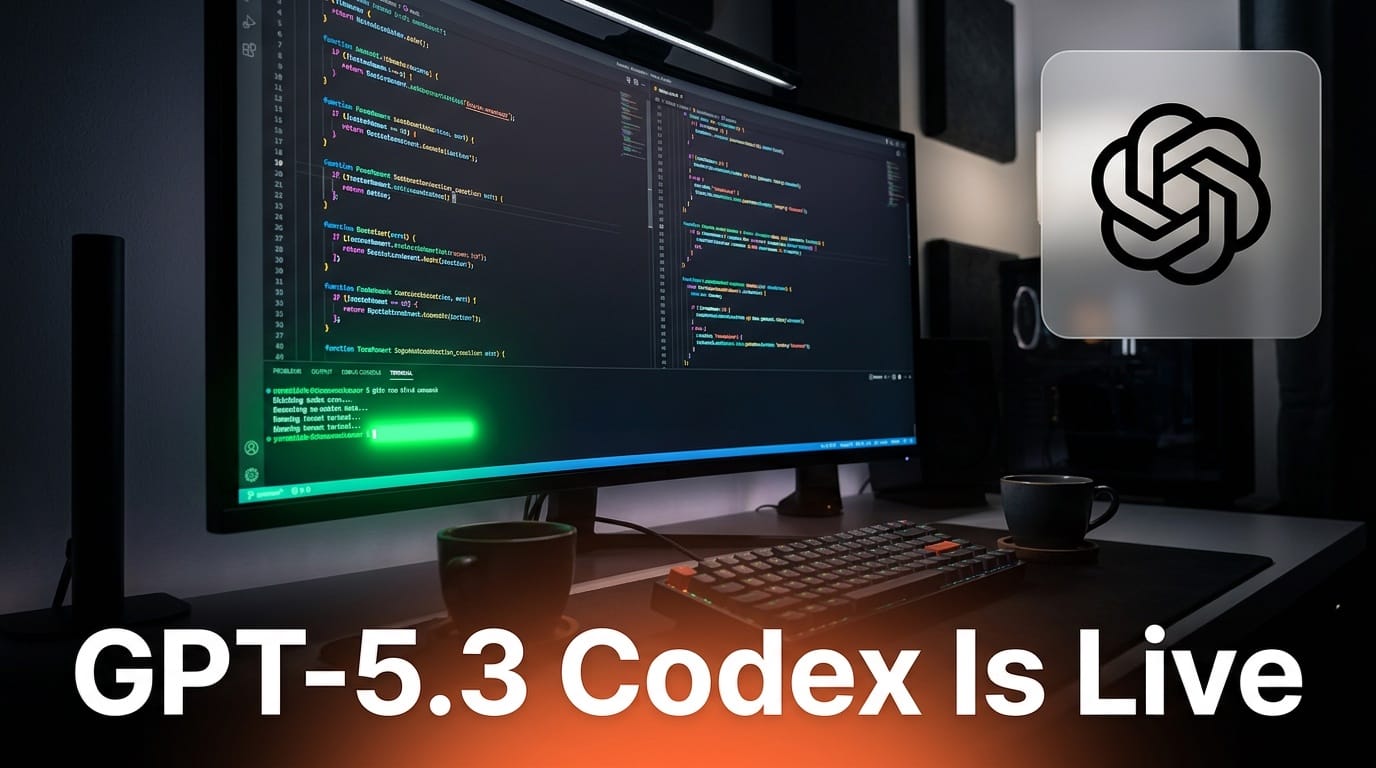
On February 5, 2026, OpenAI shipped GPT-5.3-Codex within minutes of Anthropic's Claude Opus 4.6 release. This wasn't coincidence. OpenAI's latest coding-focused model represents a significant leap in AI capabilities, combining the specialized coding power of 5.2-Codex with the broad reasoning abilities of GPT-5.2, all while running 25% faster than its predecessors.
The standout fact: GPT-5.3-Codex helped build itself during development. This recursive improvement cycle resulted in a model that achieves 65.4% on TerminalBench 2, a demanding benchmark measuring real-world coding capabilities.
What Happened
OpenAI positions 5.3-Codex as a tool that evolves from "an agent that writes code" to "one that can do nearly anything developers do on a computer." Higher token efficiency means developers can work with longer contexts without hitting rate limits or incurring massive API costs.
The timing and positioning leave no doubt: this model is engineered as a direct competitor to Claude's Code agent teams.
Why It Matters for Creative Professionals
The AI landscape just shifted. For months, Claude Opus and its Code agent capabilities set the standard for AI-assisted development and technical problem-solving. GPT-5.3-Codex directly challenges that dominance with demonstrable performance improvements and architectural innovations.
Three developments matter most:
Self-improving development process. The fact that the model contributed to its own refinement during training signals OpenAI's commitment to pushing boundaries. This approach, if repeated and improved, could accelerate the development cycle for future models. For professionals, it suggests that coding AI will continue improving at an accelerating pace.
Practical speed and efficiency gains. A 25% speed improvement compounds across workflows. When you're iterating on code, debugging, or building complex systems, faster response times aren't luxury features, they're foundational to productivity. Combined with higher token efficiency, 5.3-Codex reduces friction in developer workflows.
Convergence on multi-capability models. The previous generation split capabilities: specialized models for coding, generalist models for reasoning. 5.3-Codex merges these domains. This convergence matters because real development work requires both. Your AI assistant needs to write syntax-perfect code AND reason through architectural decisions, edge cases, and project constraints.
Key Details
Release date: February 5, 2026 (same-day as Claude Opus 4.6)
TerminalBench 2 score: 65.4%
Speed improvement: 25% faster than 5.2-Codex
Token efficiency: Improved across all context sizes
Reasoning: Integrated from GPT-5.2
Capabilities: Writing, debugging, testing, refactoring code
The TerminalBench 2 score is important context. This benchmark measures how well models perform actual development tasks in simulated terminal environments. A 65.4% score reflects real capability, not theoretical performance.
Token efficiency gains affect everyone who uses API-based tools. Lower token consumption means longer conversations about the same project without hitting context limits or accruing massive costs.
What to Do Next
If you work with AI for coding, now is the moment to evaluate your tools deliberately rather than by inertia.
Start by testing GPT-5.3-Codex on a real project. Not a toy example, but actual work you're doing. Run it through the same workflow you'd use with Claude Opus 4.6 or your current tool. Time the responses. Note the quality. Assess whether the 25% speed improvement actually changes how you work.
Document differences in code quality, reasoning clarity, and how each model handles edge cases in your specific domain. Some developers will find that 5.3-Codex works better for their use cases. Others will prefer Claude's approach. The goal isn't to pick a permanent winner, but to understand which tool serves your work best.
The same-day launch itself is worth attention. This level of competitive response, with demonstrable improvements, signals that the frontier of AI capabilities is advancing rapidly. If you're building products, services, or workflows that depend on specific AI capabilities, expect significant changes every few months, not every few years.
This story was featured in Creative AI News, Week of February 4-9, 2026.
Subscribe for free to get the weekly digest.