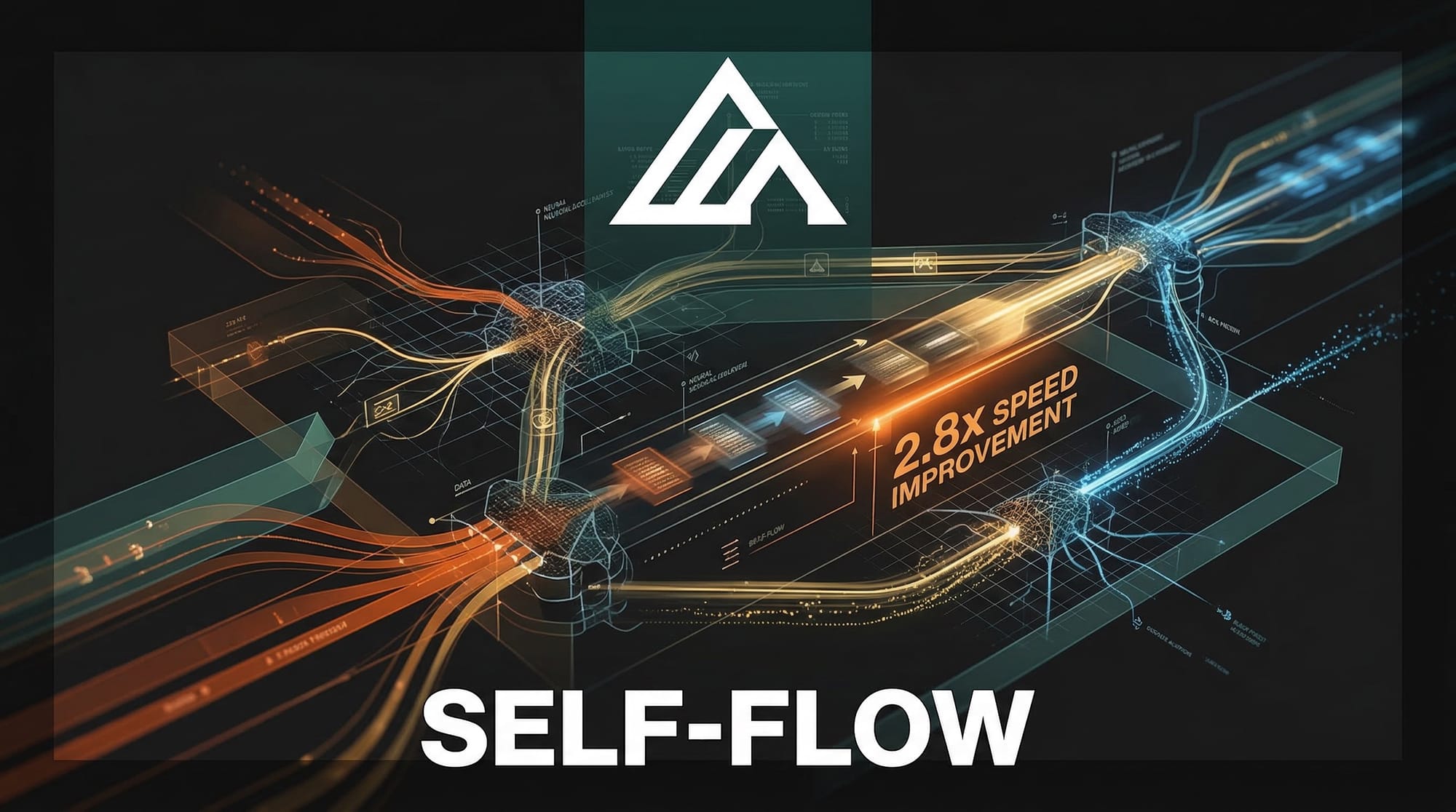
Black Forest Labs, the team behind the FLUX image generation models, published Self-Flow on March 10, 2026: an open-source framework that trains image, video, and audio generation models 2.8x faster without requiring external encoders.
What Happened
Black Forest Labs released Self-Flow on GitHub alongside a research paper introducing a self-supervised flow matching framework. The key innovation is Dual-Timestep Scheduling, which allows a single model to learn representation and generation simultaneously rather than relying on separate encoder models trained in advance.
The result is a training pipeline that converges 2.8x faster than the current industry standard flow matching approach. In image generation, Self-Flow outperforms vanilla flow matching specifically on complex text rendering: signs, labels, and legible typography in generated images. In video generation, it reduces the hallucinated artifacts that commonly appear in current open-source models.
Why It Matters
This is a research release aimed at developers and researchers building generation models, not an end-user product. But the downstream impact on creative AI is real. Faster training means smaller teams can fine-tune or build on top of Self-Flow architecture, and the improvements to text rendering address one of the most persistent complaints about AI image generators.
FLUX models already dominate the open-source image generation space, and FLUX.2 is the current state-of-the-art for commercial open-weight image generation. If Black Forest Labs incorporates Self-Flow into future FLUX releases, it would mean higher-quality text in images and reduced video artifacts with no increase in model size. The framework's audio generation extension is also new territory for a team primarily known for image work.
The Apache 2.0 release of both the code and training scripts signals BFL's intent to grow the developer ecosystem around its architecture rather than keeping training methods proprietary.
Key Details
- Release date: March 10, 2026 (code on GitHub)
- Research paper: arXiv (Self-Flow: Self-Supervised Flow Matching for Scalable Multi-Modal Synthesis)
- Key improvement: 2.8x faster training convergence vs. standard flow matching
- Innovation: Dual-Timestep Scheduling: single model learns representation and generation together
- Modalities: Images, video, and audio
- Text rendering: Superior legibility vs. vanilla flow matching
- Video: Fewer hallucination artifacts in generated output
- License: Apache 2.0
- Code: github.com/black-forest-labs/Self-Flow
What to Do Next
For developers building custom generation pipelines, the Self-Flow GitHub repo includes the full training code and paper. This is not a plug-and-play tool for end users. It requires ML infrastructure and significant compute to train models from scratch. If you are an end user who wants better text rendering in images today, the existing FLUX.2 API already offers state-of-the-art results without waiting for Self-Flow to reach production models. Watch Black Forest Labs' announcements for when this research translates into updated FLUX model weights.