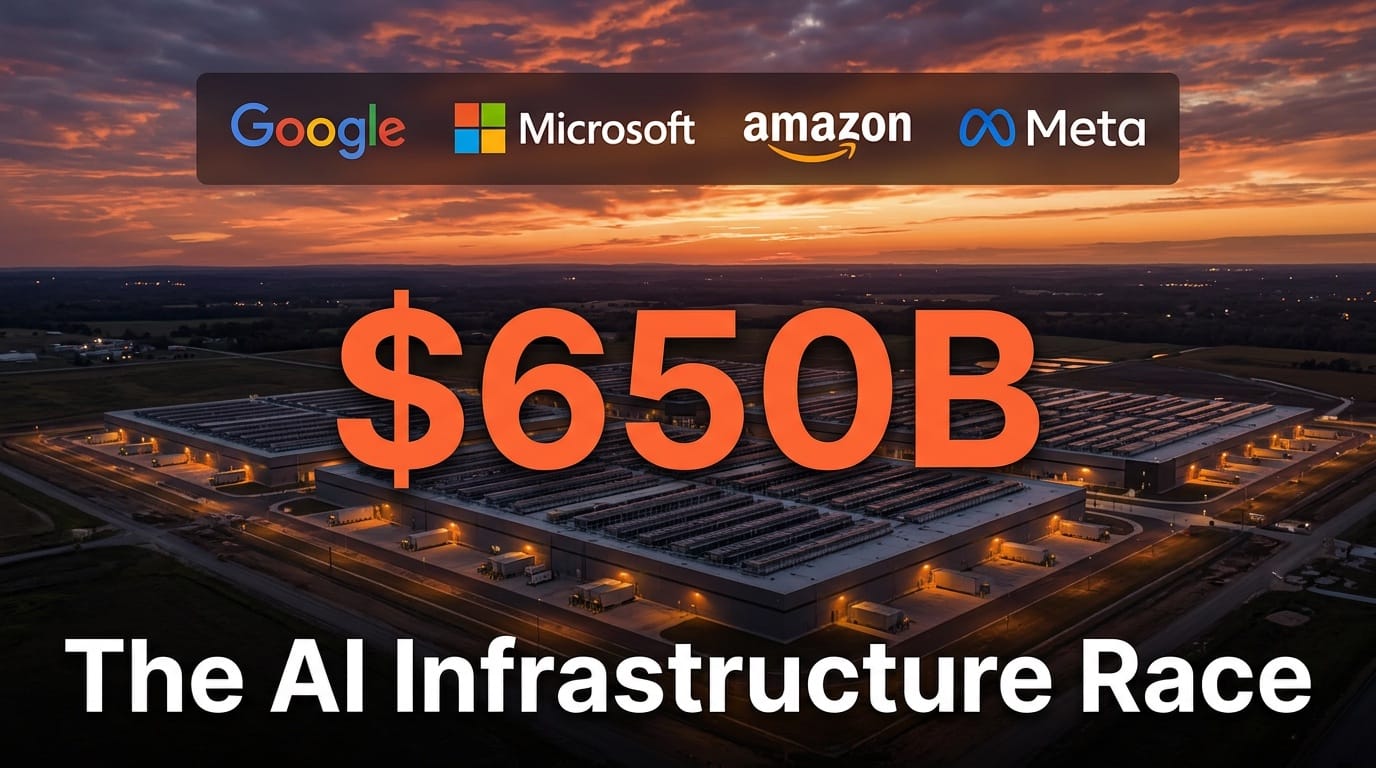
The four largest technology companies have collectively committed $650 billion toward AI infrastructure spending in 2026, marking a dramatic 67 percent increase from 2025 investments. This unprecedented level of capital expenditure exceeds historical infrastructure booms, including the 1990s telecommunications expansion and nineteenth-century railroad development combined.
What Happened
Amazon plans to spend $200 billion, Alphabet (Google's parent company) will invest $175 to $185 billion, Meta will allocate $115 to $135 billion, and Microsoft will invest $105 billion in data centers and computing infrastructure specifically designed to power AI development and deployment.
The 67 percent year-over-year increase from 2025 reflects acceleration, not simply linear growth. Companies are building data centers, acquiring specialized computing hardware including graphics processing units and custom AI chips, and constructing the supporting infrastructure needed to cool, power, and network massive computing facilities.
Capital spending of this magnitude requires long-term strategic commitment. This spending happens across multiple years as facilities are constructed and brought online.
Why It Matters for Creative Professionals
The scale of infrastructure investment directly impacts what AI tools become available to creative professionals. When companies spend billions on computing infrastructure, they do so to enable specific capabilities and service large user bases. This capital deployment shapes which AI features reach creators fastest.
Infrastructure investment determines latency, speed, and reliability of AI services. A company with superior data center architecture can offer faster image generation, quicker text processing, and more responsive real-time collaboration features. For creators working on tight deadlines, these performance differences translate into measurable productivity gains.
Increased infrastructure spending also enables companies to serve more users simultaneously, reducing waiting times and service interruptions that currently plague high-demand periods.
Beyond performance, infrastructure spending signals company confidence in AI's near-term revenue potential. Expect announcements of new generative tools, improved integrations with creative software, and enhanced features across AI platforms throughout 2026.
Key Details
Amazon: $200 billion: AWS infrastructure market share
Alphabet (Google): $175-185 billion: Consumer AI (Gemini) + enterprise
Meta: $115-135 billion: LLMs, vision models, content generation
Microsoft: $105 billion: OpenAI partnership + internal AI
Total: ~$650 billion (67% increase from 2025)
Historical comparisons illustrate the unprecedented nature of this investment. The 1990s telecommunications infrastructure buildout cost less in inflation-adjusted terms, and that decade established the foundational networks for modern internet commerce.
What to Do Next
Evaluate your current AI tools and platforms with infrastructure investment in mind. Companies with substantial data center budgets will likely offer more reliable services, faster processing speeds, and more frequent feature updates throughout 2026.
Monitor announcements from these four companies regarding new AI capabilities aimed at creative professionals. With these investment levels, expect regular announcements of new features, expanded integrations with creative software, and improved performance metrics.
Assess your creative workflow for potential AI enhancements that may become feasible as infrastructure scales. What tasks currently feel limited by processing speed, accuracy, or availability? Having this assessment ready allows you to implement new tools effectively as they become available.
This story was featured in Creative AI News, Week of February 4-9, 2026.
Subscribe for free to get the weekly digest.