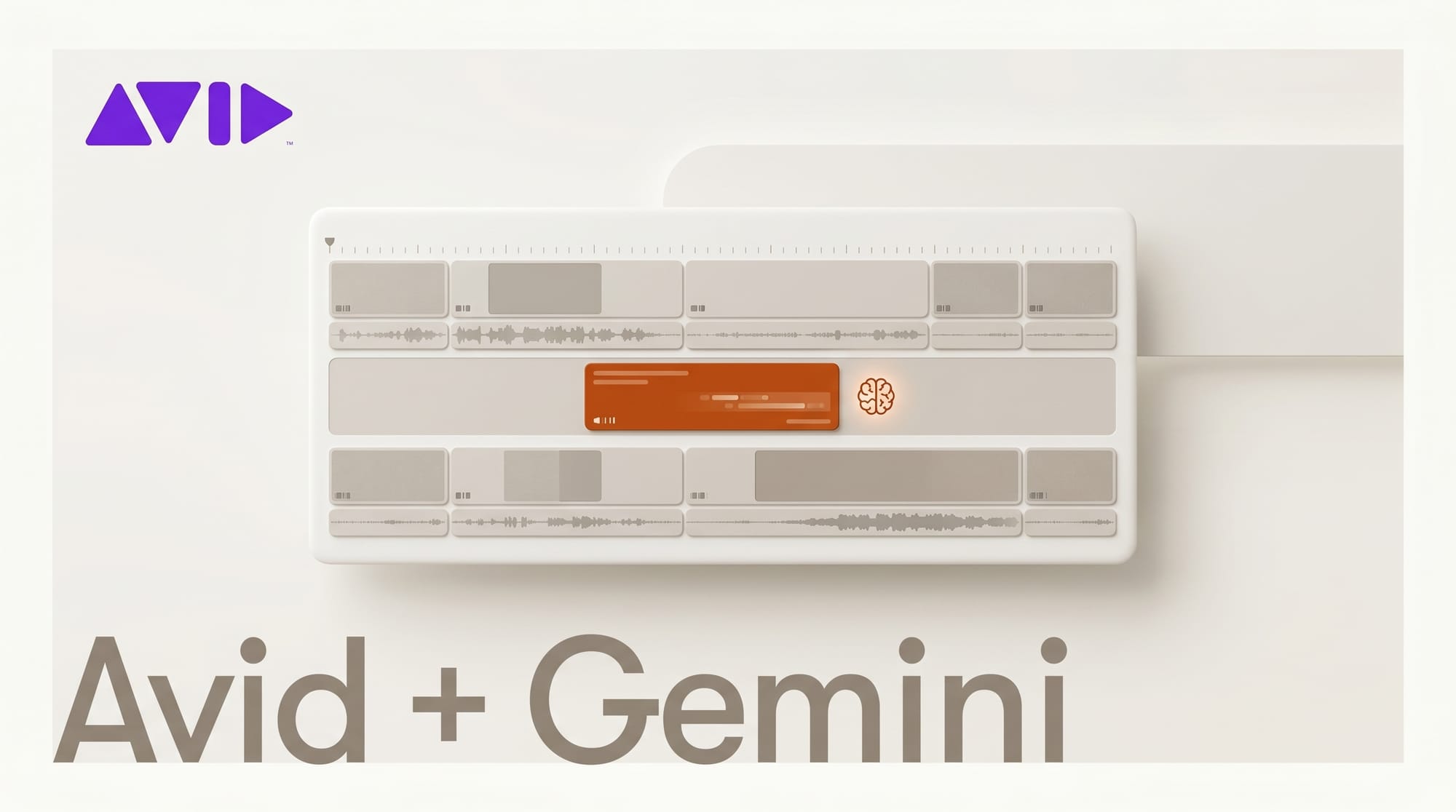
Avid and Google Cloud announced a multi-year strategic partnership on April 16, 2026, embedding Google's Gemini models and Vertex AI directly into Avid's flagship editing tools. The integration targets Media Composer, the industry-standard nonlinear editor used on most studio features and broadcast shows, plus Avid Content Core, the company's new cloud-native asset layer. Live demos begin at NAB Show 2026 in Las Vegas.
What Happened
The partnership turns Gemini into a native agent inside Media Composer. Editors can search raw footage by describing what they need in plain language, including visual actions, spoken dialogue, and emotional cues, rather than scrubbing timelines or relying on rigid metadata schemas. Multimodal prompts pull matching clips from Content Core in seconds, and agentic workflows can then auto-assemble B-roll, log metadata, and match visual styles across scenes without a human cutting each clip manually.
Both companies will stage the first public demos at the NAB Show in Las Vegas from April 19 to 22. Google Cloud is showing the integration at booth W2731 in the West Hall. Avid is running live edit sessions at booth N2226 in the North Hall. The partnership covers both Media Composer on-prem installs and cloud workflows routed through Content Core.
Why It Matters
Media Composer still runs a large share of professional film, television, and news post-production, which means this is the first time most working film editors will see agentic AI wired into the timeline they already use. Avid's move puts direct pressure on DaVinci Resolve 21, which is landing its own AI feature set at the same NAB show, and on Adobe's Firefly AI Assistant push inside Premiere. Every major pro NLE now has an agentic layer, and editors will judge them on real timeline speed, not demo reels.
The bigger shift is how raw footage gets organized. Weeks-long archive searches collapse into a single prompt when a model can read dialogue and recognize emotional beats, which changes how documentary teams, news cutters, and trailer houses staff projects. That also means assistants, loggers, and metadata specialists are the roles most exposed, while senior editors who know what story beat they want gain leverage.
Key Details
- Announced: April 16, 2026, with multi-year contract terms
- Avid products: Media Composer (nonlinear editor) and Avid Content Core (cloud-native media asset platform)
- Google stack: Gemini multimodal models plus Vertex AI for agent orchestration
- Agentic capabilities: Visual style matching, emotional cue detection, automated B-roll generation, intelligent metadata logging, and natural language archive search
- Public demo: NAB Show 2026, April 19 to 22, Google Cloud booth W2731 (West Hall) and Avid booth N2226 (North Hall)
- Availability: Rollout timing tied to Media Composer release cycles and Content Core onboarding, not announced in the press release
What to Do Next
If you cut on Media Composer, plan a week at NAB or book a follow-up demo with your Avid rep to see how search-by-emotion and auto B-roll behave on real project rushes, not marketing plates. If you are evaluating NLEs for a new pipeline, this announcement raises the floor on what counts as "AI-assisted" editing, so compare the Avid, Resolve, and Premiere agentic stories side by side before committing. Deadline's coverage frames the deal as Google's first deep move into Hollywood post-production, which suggests more studio integrations are likely to follow this quarter.