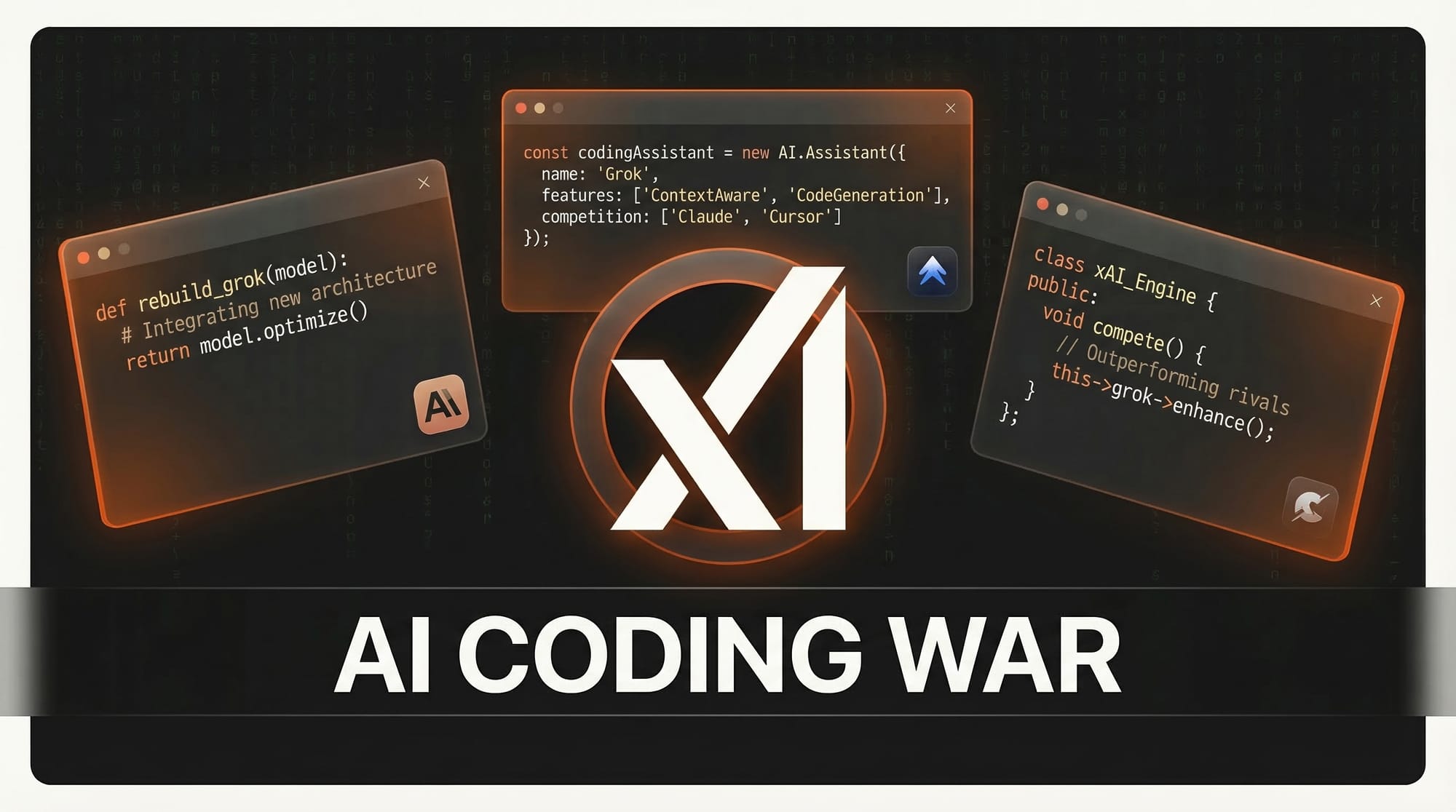
When Elon Musk publicly admitted on March 13 that "xAI was not built right first time around, so is being rebuilt from the foundations up," he confirmed what the numbers already showed: the AI coding assistant market has clear winners, and Grok is not among them. With Claude Code crossing $2.5 billion in annualized revenue, Cursor targeting a $50 billion valuation, and OpenAI's Codex gaining users faster than any competitor expected, xAI's pivot tells a bigger story about where AI value is concentrating, and what it means for creators building with these tools.
Background
xAI launched in 2023 with 12 co-founders. As of March 2026, only two remain: Manuel Kroiss and Ross Nordeen. The most recent departures, Zihang Dai and Guodong Zhang, left after Musk expressed frustration that Grok's coding capabilities were not keeping pace with Claude Code and Codex, the rival programming assistants from Anthropic and OpenAI.
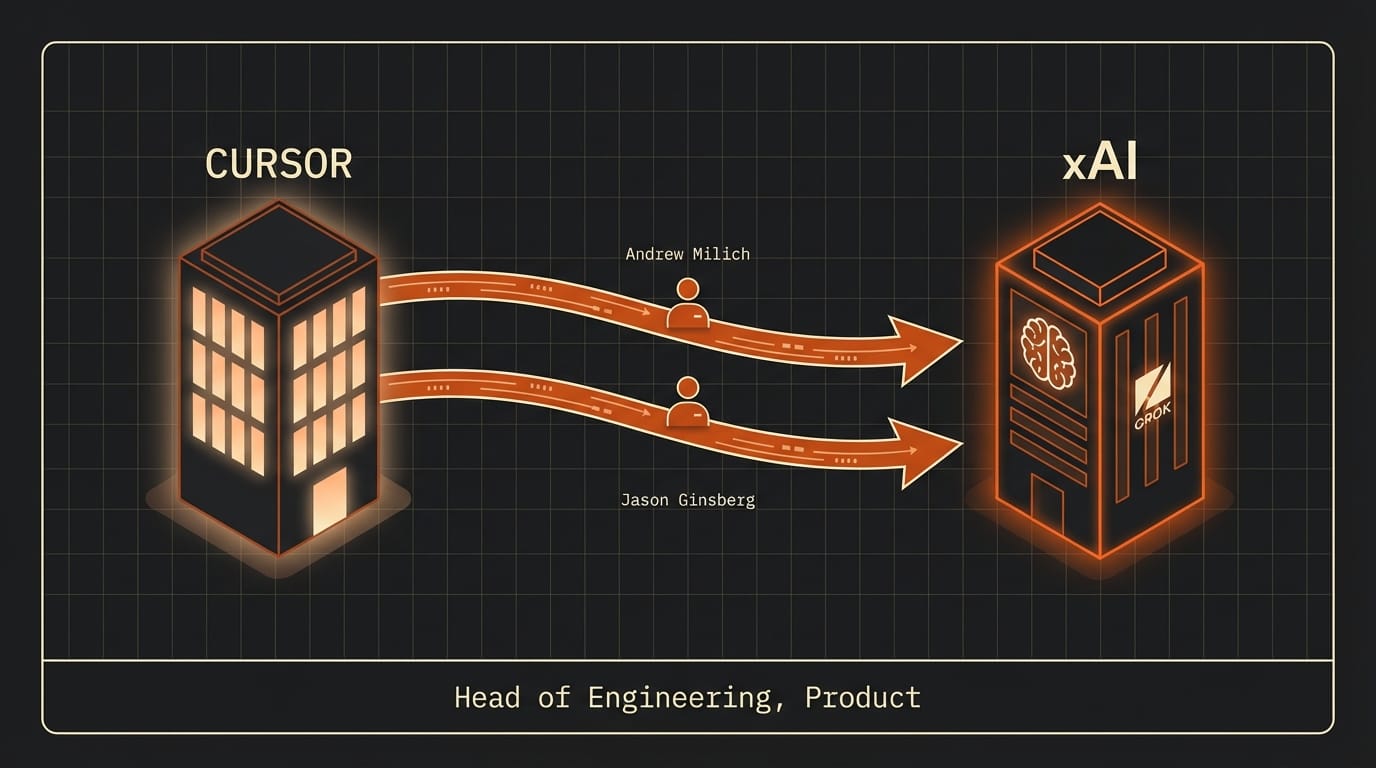
The rebuild coincides with a $1.25 trillion merger between SpaceX and xAI finalized in February 2026, giving xAI access to SpaceX's infrastructure and capital. Musk's response to the talent drain was aggressive: he hired Andrew Milich and Jason Ginsberg from Cursor, where they co-led product engineering, to rebuild Grok's coding tools from scratch. Both report directly to Musk.
Deep Analysis
The Talent War That Defines the Market
Andrew Milich and Jason Ginsberg joined Cursor together in June 2025, sharing the title Head of Engineering, Product. Before Cursor, both co-founded Skiff, a privacy-focused workspace later acquired by Notion. Their move to xAI is significant for two reasons.
First, it confirms that Cursor's product engineering talent is considered the best in the AI coding space. xAI could have hired from anywhere. Musk chose the people who built the product that defined the category.
Second, their decision to leave Cursor, which is reportedly raising at a $50 billion valuation, suggests they were offered something Cursor couldn't provide: direct access to a frontier LLM and the compute infrastructure to train it. At Cursor, the product depends on third-party models from Anthropic and OpenAI. At xAI, they can shape the model itself.
The Revenue Race: Three Leaders, One Explosive Market
The AI coding assistant market has produced three clear revenue leaders in early 2026, each growing at a pace that would be remarkable in any software category.
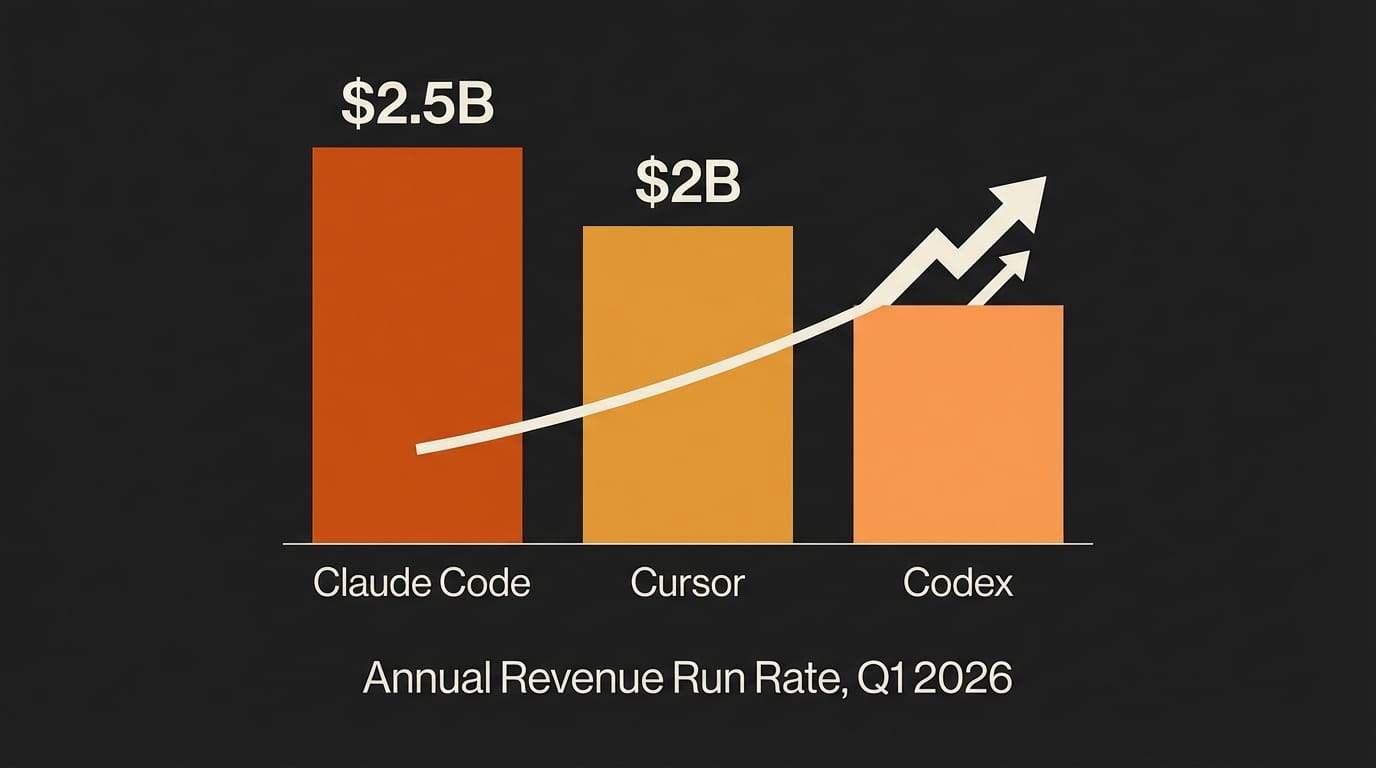
Claude Code leads with over $2.5 billion in annualized revenue, a figure that has doubled since January 1. Business subscriptions have quadrupled in the same period. Claude Code now accounts for more than half of all enterprise spending on Anthropic products, making it the company's most important revenue driver.
Cursor hit $2 billion in annualized revenue in February, doubling its run rate in three months. The company has over 360,000 paying users, with roughly 60% of revenue from enterprise customers. Its proposed $50 billion valuation would make it one of the most valuable private software companies in the world.
OpenAI's Codex, launched on macOS just six weeks ago on February 2, has already captured 60% of Cursor's usage volume according to developer surveys. That trajectory, if sustained, would make Codex the fastest-growing AI coding tool by adoption rate.
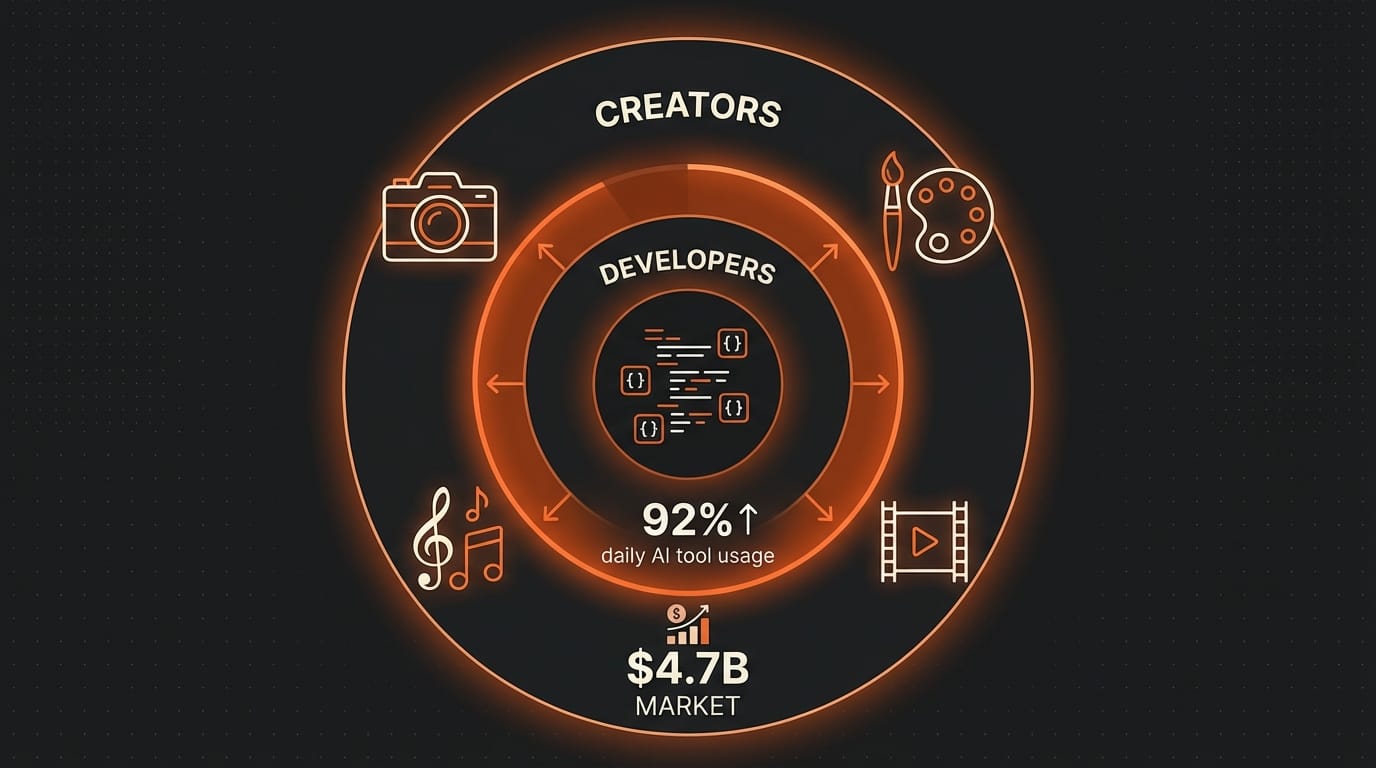
The total addressable market has expanded rapidly. The AI coding tool segment is valued at $4.7 billion globally and is projected to reach $12.3 billion by 2027, representing a 38% compound annual growth rate.
Vibe Coding Reaches the Creator Economy
The term "vibe coding," coined by Andrej Karpathy in early 2025 to describe building software through natural language conversation with AI, has moved from developer buzzword to mainstream creative workflow. The $4.7 billion market now extends well beyond professional developers.
The evidence is in the numbers. Lovable hit $400 million in annualized revenue with just 146 employees. The company's growth came largely from non-developers: designers, content creators, and small business owners using natural language to build web applications without writing traditional code.
For creative professionals specifically, AI coding tools are enabling a new category of work: custom tools built by the people who use them. Video editors writing automation scripts for their render pipelines. Motion designers building custom plugins for After Effects. Photographers creating batch processing tools for their image workflows. The barrier between "creator" and "developer" is dissolving, and the companies winning the AI coding race are the ones best positioned to serve this hybrid audience.
How Each Tool Serves Creators Differently
Claude Code excels at complex, multi-file projects. Its agent capabilities (reading entire repositories, making coordinated changes across files, running tests) make it the strongest choice for creators building production-grade tools and integrations.
Cursor is the daily driver for creators who already code. Its inline suggestions, chat-driven editing, and Automations feature (always-on agents that respond to triggers from GitHub, Slack, and PagerDuty) make it the most ergonomic development environment available.
Codex lowers the barrier furthest. Its macOS app and tight integration with ChatGPT offer the most accessible entry point for creators who are new to coding. The "describe what you want, get a working app" flow is closest to the vibe coding ideal.
Grok's coding capabilities are the weakest of the four, which is precisely why Musk is rebuilding. But xAI has one card none of the competitors can match: direct integration with X's 600 million monthly users gives it distribution at a scale that Claude Code, Cursor, and Codex must build organically.
Impact on Creators
The AI coding war is directly improving the tools creative professionals use every day. Competition between Claude Code, Cursor, Codex, and soon a rebuilt Grok means faster iteration cycles, lower prices, and better capabilities across the board. Every time one platform ships a new feature, the others respond within weeks.
If you write code, even occasionally, the practical takeaway is straightforward: use more than one tool. Developer surveys show that 70% of engineers now use between two and four AI coding tools simultaneously. Use Claude Code for complex multi-file projects, Cursor for daily development inside your IDE, and Codex when you want to prototype quickly from a conversation.
If you do not code but want to start, vibe coding platforms like Lovable, Replit, and Bolt are the lowest-friction entry point. You do not need to understand syntax to describe what you want built. The AI coding race is making this path more viable every month.
Key Takeaways
1. xAI's Grok coding tool is being rebuilt from scratch with former Cursor engineering leaders, confirming that AI coding is now the central battleground in AI.
2. Claude Code ($2.5B ARR) and Cursor ($2B ARR, $50B valuation) are the current market leaders, with Codex growing fastest by adoption.
3. Vibe coding has crossed from developer niche to creator mainstream, with Lovable's $400M ARR proving non-developers are a massive market.
4. Creative professionals should use multiple AI coding tools for different tasks rather than committing to a single platform.
What to Watch
The next six months will determine whether xAI's rebuild succeeds. Andrew Milich and Jason Ginsberg need to ship a competitive coding product while integrating with X's distribution network. Cursor's response to losing key talent, and its ability to justify a $50 billion valuation through sustained growth, will be equally telling.
For creators, the milestone to watch is when AI coding tools start understanding domain-specific creative workflows natively, not just writing generic code, but understanding After Effects expressions, Blender scripts, and audio processing pipelines without detailed prompting. The first tool to crack that will capture the creator market.
Deep dive by Creative AI News.
Subscribe for free to get the weekly digest every Tuesday.