Mistral just raised $830 million in debt financing to build its first owned data center near Paris, equipped with 13,800 NVIDIA GB300 Grace Blackwell GPUs. The deal, backed by seven European and global banks, marks the single largest infrastructure bet by a European AI company and signals a fundamental shift in how the continent plans to compete with American AI giants.
Background
Mistral AI, founded in April 2023 by former Google DeepMind and Meta researchers, has grown into Europe's most prominent AI company in under three years. The Paris-based startup has raised over $3 billion across seven funding rounds, reaching a valuation of roughly $14 billion after its $2 billion Series C in September 2025. Its open-weight models, including Mistral Large, Codestral, and Voxtral TTS, are widely used across creative and enterprise workflows.
Until now, Mistral has relied entirely on rented cloud capacity from US hyperscalers to train and serve its models. That changes with this financing. The $830 million debt facility, provided by Bpifrance, BNP Paribas, Credit Agricole CIB, HSBC, La Banque Postale, MUFG, and Natixis CIB, will fund a 44-megawatt data center at Bruyeres-le-Chatel, south of Paris, operated by French firm Eclairion. Operations are targeted for the end of June 2026.
Deep Analysis
Why Debt, Not Equity

The most unusual aspect of this deal is the instrument. AI startups overwhelmingly raise equity or, increasingly, sign capacity agreements with cloud providers. Mistral chose traditional debt financing from commercial banks. This is a deliberate strategic choice. Debt preserves existing shareholder ownership at Mistral's $14 billion valuation, avoids further dilution after $3 billion in equity raises, and signals to the market that Mistral expects the infrastructure to generate enough revenue to service the loans.
The seven-bank consortium also reflects something equity rounds do not: institutional confidence in the asset itself. Banks lend against collateral and cash flow projections, not growth narratives. Bpifrance, France's public investment bank, anchoring the deal gives it a quasi-sovereign endorsement. HSBC and MUFG's participation shows international banks see European AI infrastructure as a viable lending category, not just a venture capital experiment.
For comparison, OpenAI signed a $4 billion credit facility in late 2024, and xAI has secured similar structured financing. Mistral is the first European AI company to execute a deal at this scale, and it establishes a template that other European AI labs could follow.
The European Compute Gap
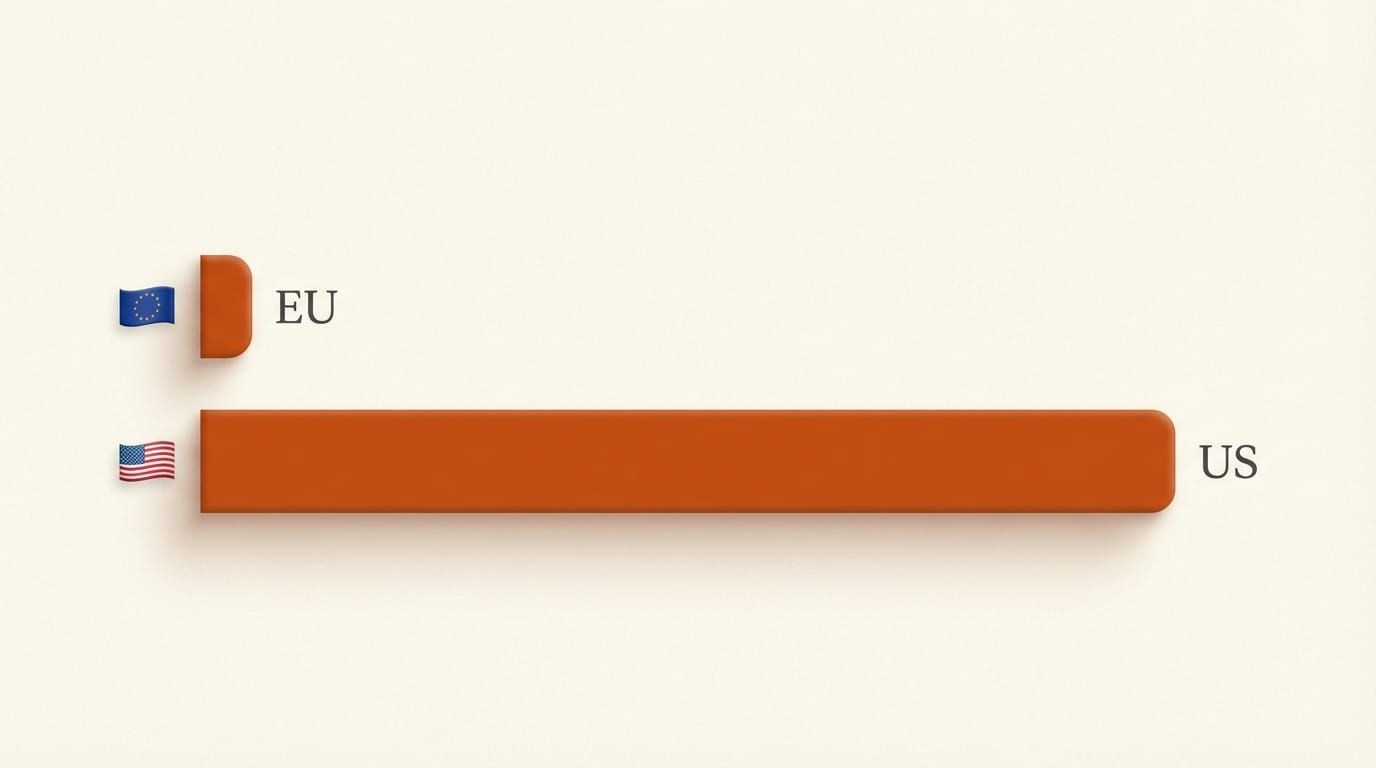
Europe's AI problem is not a talent problem. It is a compute problem. The continent controls less than 5% of global AI training capacity, while US hyperscalers collectively operate over 60%. Every European AI company training frontier models today does so on infrastructure owned and controlled by American companies, subject to US export regulations, pricing decisions, and capacity allocation priorities.
This dependency creates real business risk. When cloud capacity tightens during training surges, European customers compete for GPU hours against the hyperscalers' own AI divisions. Pricing is opaque and volatile. Data sovereignty is theoretical at best when training runs execute on servers in Virginia or Oregon.
Mistral's 44-megawatt facility, powered by 13,800 NVIDIA GB300 GPUs, addresses this directly. The GB300 Grace Blackwell architecture combines CPU and GPU in a single module optimized for large-scale AI training and inference. CEO Arthur Mensch has stated that scaling infrastructure in Europe is "critical to empower our customers and to ensure AI innovation and autonomy remain at the heart of Europe."
The 44MW facility is just the beginning. Mistral aims to deploy 200 megawatts of compute capacity across Europe by the end of 2027, having already announced a 1.2 billion euro plan for data centers in Sweden.
CampusAI and the 1.4-Gigawatt Vision

The $830 million data center is a stepping stone to something far larger. In March 2026, Mistral joined a joint venture called CampusAI alongside MGX (Abu Dhabi's $100 billion AI investment fund), Bpifrance, and NVIDIA. The project: a 1.4-gigawatt AI campus near Paris, Europe's largest planned AI facility, with a $9.6 billion price tag. Construction begins in the second half of 2026, with operations expected by 2028.
Partners include Bouygues (construction), EDF Group (energy), and Ecole Polytechnique (academic research). The campus is designed as a full-lifecycle AI facility covering model training, fine-tuning, inference, and sovereign cloud services. The scale is significant: 1.4 gigawatts is roughly 32 times the capacity of Mistral's new 44MW facility, and would rival the largest planned AI campuses globally.
The involvement of MGX brings Gulf capital and diplomatic weight, while NVIDIA's participation ensures priority access to next-generation GPU architectures. For Mistral, CampusAI transforms the company from a model lab that rents compute into an infrastructure operator that controls its own destiny. That is a fundamentally different business with fundamentally different economics.
Sovereign AI in Practice
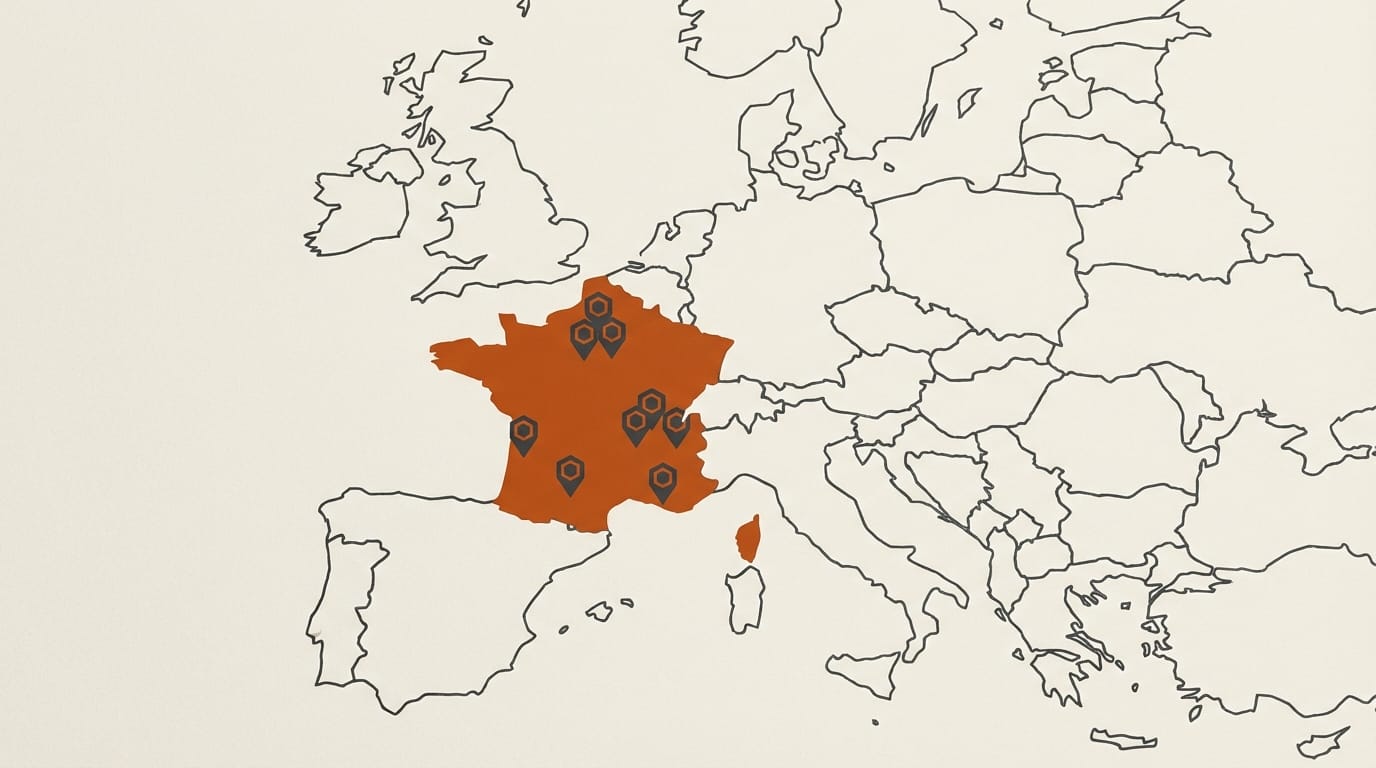
"Sovereign AI" has been a buzzword since 2024, but it is becoming a practical requirement. The EU AI Act begins enforcement in August 2026, requiring classification of all AI systems and imposing strict rules on high-risk applications. Big Tech has committed over $650 billion to AI infrastructure globally, but the vast majority of that spending is concentrated in the United States.
For European enterprises and governments, the regulatory landscape creates a demand for AI services where data never leaves EU jurisdiction, where model training happens on European soil, and where the infrastructure operator is subject to European law. Mistral is positioning itself as the company that can deliver all three.
This is not just about compliance. It is about market capture. McKinsey estimates Europe's sovereign AI opportunity could unlock up to 480 billion euros in annual value by 2030. The European Commission's AI factories initiative targets at least 15 operational AI computing facilities by the end of 2026. France's national France 2030 plan allocates 2.22 billion euros specifically for AI research and development. Deutsche Telekom has already launched an Industrial AI Cloud with 10,000 NVIDIA Blackwell GPUs.
Mistral is not building infrastructure for the sake of sovereignty. It is building infrastructure because the market for sovereign AI services in Europe is about to grow rapidly, and the company that controls the compute layer will capture the largest share of that value.
Impact on Creators
For creative professionals using Mistral's models through tools like ComfyUI, Continue.dev, or direct API integrations, this infrastructure investment has three practical implications.
First, capacity and reliability. Mistral's open-weight models are popular in creative workflows for image generation pipelines, code assistance, and audio synthesis. Owning GPU capacity means Mistral can guarantee inference availability without competing for cloud allocations against other tenants, especially during peak demand periods when US providers prioritize their own services.
Second, pricing stability. Cloud GPU costs are volatile and trend upward during capacity crunches. Owned infrastructure gives Mistral fixed costs that can be passed through as more predictable API pricing. For studios and independent developers budgeting around API costs, this matters.
Third, data residency. European creative studios working with client data, proprietary assets, or content subject to GDPR now have a credible option for AI processing that stays on European soil. This is particularly relevant for advertising agencies, film production houses, and enterprise creative teams handling sensitive brand materials.
Key Takeaways
- Scale: 13,800 NVIDIA GB300 GPUs across 44 megawatts, with a roadmap to 200MW by end of 2027 and participation in a 1.4GW campus by 2028.
- Financing model: $830M in bank debt from seven lenders, preserving equity and establishing a template for European AI infrastructure lending.
- Strategic logic: Vertical integration from model lab to infrastructure operator, reducing dependency on US hyperscalers.
- Market timing: EU AI Act enforcement (August 2026) creates regulatory demand for sovereign AI compute, while European governments are actively funding the buildout.
- Creative impact: More stable API pricing, better inference availability, and compliant data residency for European creative workflows.
What to Watch
The Bruyeres-le-Chatel facility is targeted for Q2 2026 operations. Monitor Mistral's news page for capacity announcements and new inference endpoints tied to this infrastructure. The CampusAI joint venture construction timeline, beginning in H2 2026, will signal whether the 1.4GW vision is progressing on schedule. European creators should track whether Mistral introduces region-specific API pricing or latency improvements as the sovereign infrastructure comes online. And watch for other European AI companies to follow Mistral's debt financing playbook, which could accelerate the broader sovereign AI buildout across the continent.