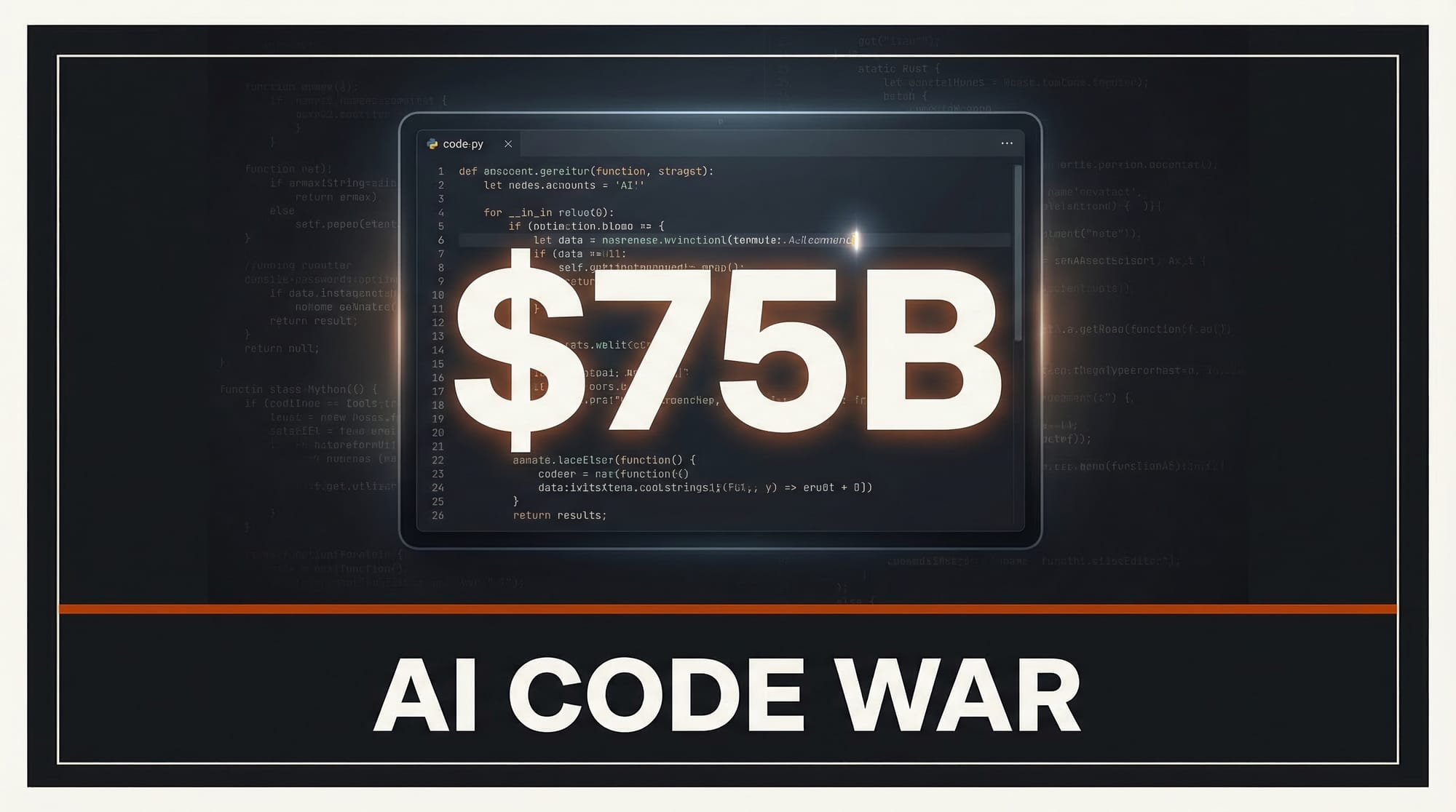
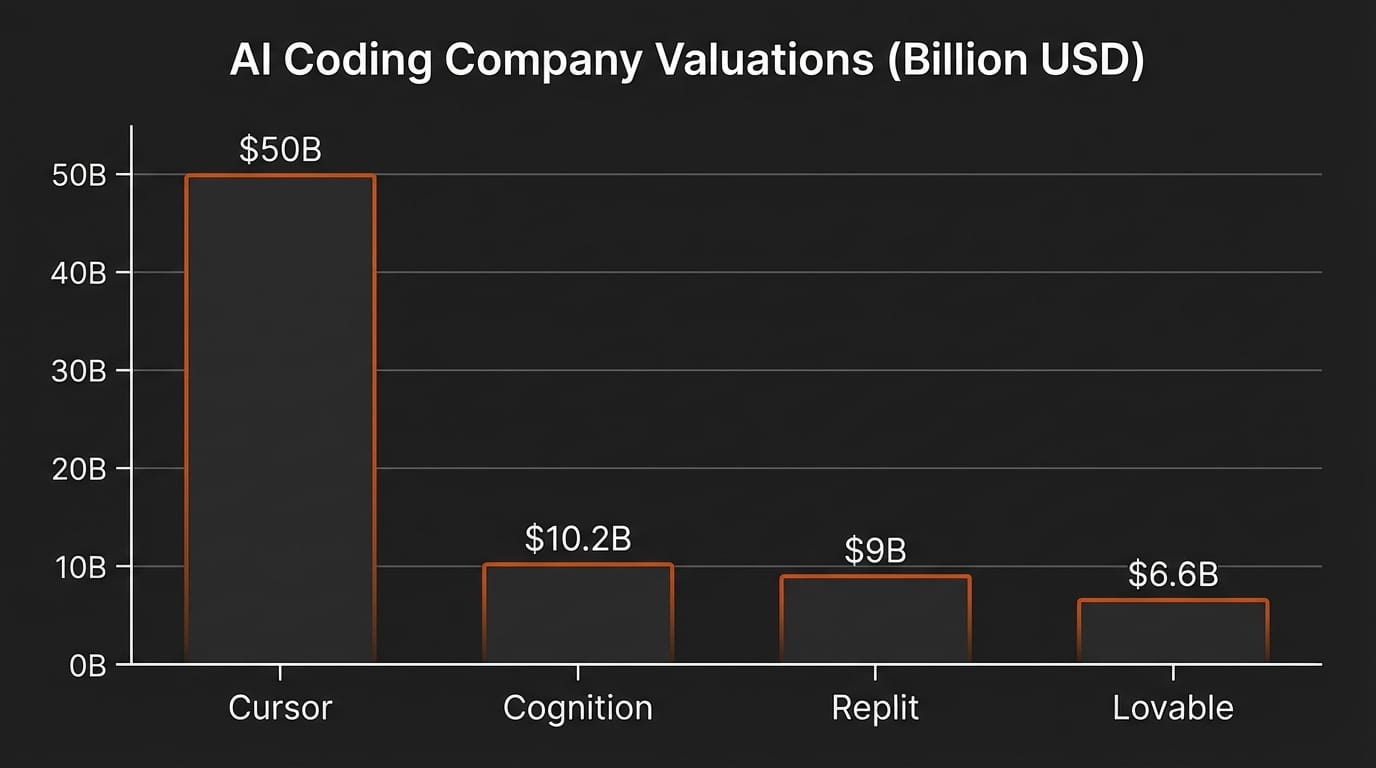
In a single week this March, the AI coding market announced numbers that would have seemed absurd 18 months ago. Cursor is negotiating a $50 billion valuation. Replit closed a $400 million Series D at $9 billion. Lovable added $100 million in revenue in a single month. Combined with Cognition's $10.2 billion valuation, the top four AI coding startups now command more than $75 billion in combined value. For creators, solo founders, and small studios, this arms race is not just a spectator sport. It is reshaping who gets to build software and how fast they can ship.
Background: How We Got to $75 Billion
The AI coding market barely existed three years ago. GitHub Copilot launched as a novelty in 2022. By 2024, it had millions of users but remained a developer's tool, an autocomplete on steroids. The real inflection point came in early 2025, when former OpenAI co-founder Andrej Karpathy coined the term "vibe coding" to describe a new workflow: describe what you want in plain English, accept the AI-generated code without reading it, and iterate based on results rather than diffs.
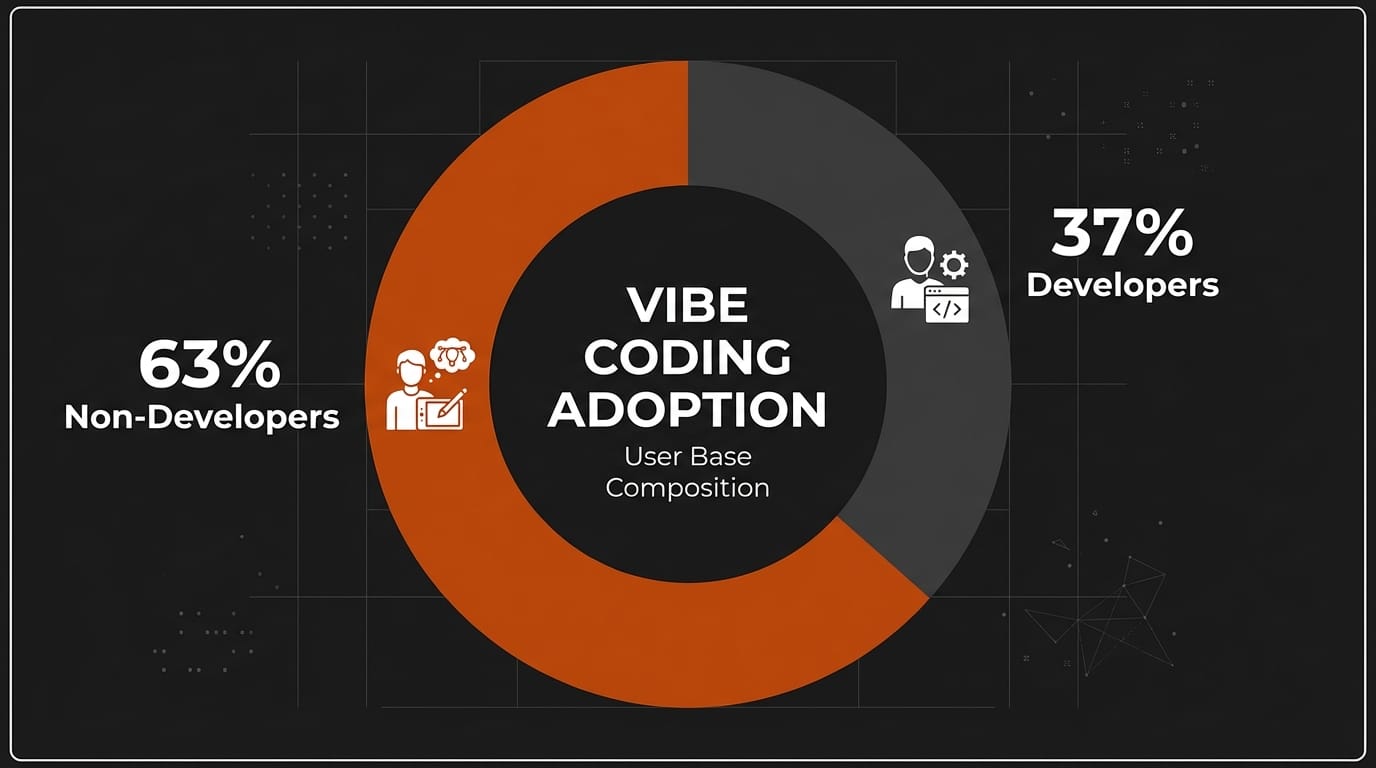
What started as a weekend-project philosophy became a movement. By early 2026, 63% of vibe coding users identify as non-developers, and Collins Dictionary named "vibe coding" its Word of the Year. The market followed the momentum. The AI code tools sector reached an estimated $34.5 billion in 2026, and investors are betting that the ceiling is far higher. The question for creators is not whether these tools matter. It is which one to pick.
Deep Analysis
The Valuation Explosion: Four Companies, Four Strategies
Each company at the top of this market is pursuing a distinct theory of who builds software and how.
Cursor ($50B valuation, $2B+ ARR) is the professional developer's tool. Built as a fork of VS Code, it integrates AI directly into an existing coding workflow. About 60% of its revenue comes from enterprise customers, and it holds the fastest revenue ramp in SaaS history, crossing $1 billion ARR in under 24 months and doubling to $2 billion in three months. Cursor's bet: professional developers will pay a premium for an AI that understands their codebase deeply.
Replit ($9B valuation, targeting $1B ARR) takes the opposite approach. Its newly launched Agent 4 is an autonomous system that builds, tests, and deploys complete applications from natural language descriptions. CEO Amjad Masad has positioned Replit as the platform where "imagination becomes software," targeting creators and non-technical founders who want working apps, not code editors. Its valuation tripled from $3 billion to $9 billion in six months.
Lovable ($6.6B valuation, $400M ARR) is the growth story that defies convention. The Stockholm-based startup added $100 million in revenue in February alone with just 146 employees, translating to roughly $2.7 million in ARR per employee. With 15 million daily active users and 200,000 new projects created daily, Lovable has become the default entry point for non-technical builders who want to go from idea to deployed app in minutes.
Cognition ($10.2B valuation) made a different play entirely. After building Devin, the first AI "software engineer" capable of handling multi-step engineering tasks autonomously, Cognition acquired Windsurf in July 2025, gaining an AI-powered IDE and 350+ enterprise customers. The combined company saw ARR more than double post-acquisition, positioning Cognition as both an autonomous agent and an editor platform.
The Creator's Decision Matrix: Which Tool for Which Builder
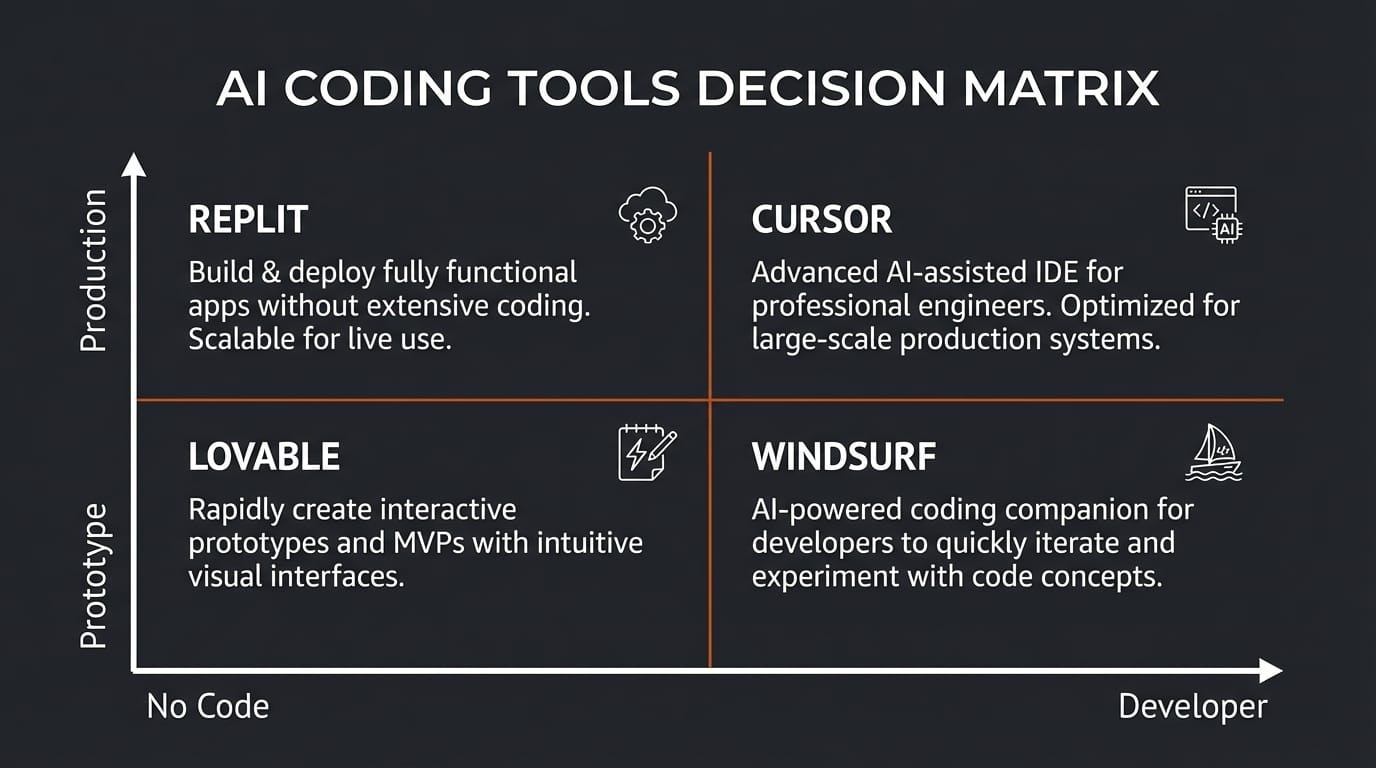
For creators, the real question is practical: which platform fits your workflow? The answer depends on two factors: your technical comfort level and what you are shipping.
If you have never written code and want a working app fast, Lovable and Replit Agent are your primary options. Both let you describe what you want in plain language and deliver deployed applications. Lovable excels at web apps and landing pages with polished UI. Replit Agent 4 goes further with full-stack applications including databases and authentication. Lovable starts at $20/month; Replit offers a free tier with paid plans around $25/month.
If you are a creator who can read code but does not write it daily, Cursor and Windsurf (now part of Cognition) are the sweet spot. Both integrate into VS Code-style editors, letting you prompt your way through features while maintaining the ability to review and adjust the output. Cursor Pro runs $20/month with 500 fast AI requests. Windsurf starts free with a $15/month pro tier.
If you are a developer building AI-powered creative tools, Cursor remains the strongest option for production codebases, with SOC 2 Type II compliance and deep codebase understanding. GitHub Copilot ($10-19/month) is the safe enterprise choice, deployed at 90% of Fortune 100 companies with 4.7 million paid subscribers.
The most effective approach for many creators is using two tools together: a vibe coding platform like Lovable or Replit for rapid prototyping, then moving to Cursor or an AI IDE for production refinement. As our coverage of Cursor's $50 billion milestone noted, the best results come from combining speed with control.
Vibe Coding: Revolution or Bubble?
The skeptics have a point. Karpathy himself recently said vibe coding is "now passe" as AI agents mature into professional-grade tools. Code generated without review accumulates technical debt. Apps built by non-developers can have security vulnerabilities, performance issues, and architectural problems that are invisible until they scale.
But dismissing vibe coding misses the larger trend. The 63% of vibe coders who are non-developers are not trying to replace engineering teams. They are building internal tools, prototypes, personal projects, and MVPs that would never have been built at all. A solo creator who ships a functional app in an afternoon, even an imperfect one, has accomplished something that previously required hiring a developer or learning to code for months.
The data supports this. Lovable's trajectory from $300M to $400M ARR in a single month is not driven by enterprise procurement cycles. It is driven by individuals and small teams who see immediate value. When 87% of Fortune 500 companies are also using at least one vibe coding tool, the signal is clear: this is not a fad. It is a new layer of the software creation stack.
The more honest framing: vibe coding is real for prototyping and internal tools. For production applications that handle user data, money, or critical workflows, you still need code review, whether by a human or by a more sophisticated AI agent like Claude Code's multi-agent system.
The Consolidation Signal: What the Windsurf Deal Tells Us
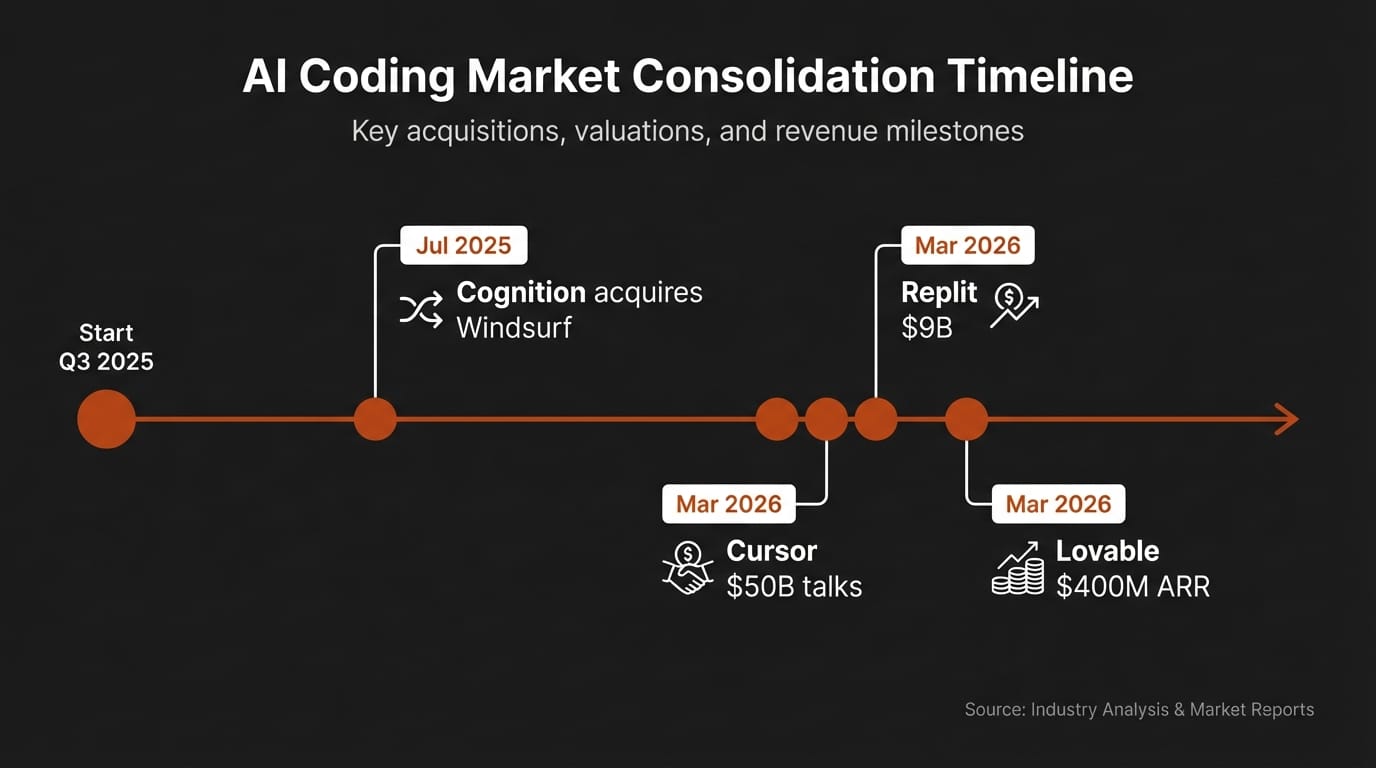
Cognition's acquisition of Windsurf is the first major consolidation move in this market, and it will not be the last. The deal happened after Google DeepMind hired Windsurf's CEO and key researchers, and just hours after OpenAI's $3 billion acquisition offer expired. In other words, three of the biggest companies in AI were fighting over a single coding startup.
For creators, consolidation has practical implications. Windsurf users now have access to Devin's autonomous agent capabilities. But the deal also means fewer independent options. As the market matures, expect more acquisitions. Cursor's $50 billion valuation talks suggest it is likely too expensive to acquire, positioning it as a potential public company. Smaller players like Bolt.new and V0 by Vercel could become acquisition targets.
The pattern mirrors what happened with cloud infrastructure a decade ago: a land grab followed by consolidation into a few dominant platforms. Creators who build on one platform should understand that switching costs will increase as these tools become more deeply integrated into workflows.
Impact on Creators
The practical impact is already measurable. Solo creators and small studios can now:
- Ship MVPs in hours, not weeks. A creator who previously needed to hire a freelance developer for $5,000-15,000 can now build a working prototype with Lovable or Replit for under $50/month.
- Iterate based on user feedback, not developer availability. When modifying an app takes a conversation instead of a sprint cycle, the feedback loop compresses from weeks to minutes.
- Build custom tools for their own workflows. Internal dashboards, content pipelines, data analyzers, and automation scripts that would never justify hiring a developer are now buildable by the people who need them.
- Compete with funded startups on product speed. The gap between a solo creator with AI coding tools and a 5-person engineering team is narrower than it has ever been.
The risk is overconfidence. An app that works in a demo may fail under real user load. Security, accessibility, and performance optimization still require expertise. The wisest creators are using these tools to move faster while investing the time savings into learning enough about code to evaluate what the AI produces.
Key Takeaways
- The top four AI coding startups (Cursor, Cognition, Replit, Lovable) command $75B+ in combined valuations, a number that was zero three years ago.
- Cursor ($2B+ ARR) and Lovable ($400M ARR) are growing at rates unprecedented in software history.
- 63% of vibe coding users are non-developers, making this a genuine expansion of who builds software, not just a new tool for existing developers.
- No single tool covers every use case. The best approach for creators is pairing a vibe coding platform (prototyping) with an AI IDE (production refinement).
- Market consolidation has begun. Cognition acquired Windsurf, and more deals are likely as the market matures.
What to Watch
- Cursor's funding round: If the $50B valuation closes, it will be the largest private valuation for a developer tools company in history. Watch for enterprise features and potential IPO signals.
- Replit Agent 4 adoption: Can Replit convert its $9B valuation into the $1B ARR target by year-end? The answer will determine whether autonomous app-building agents are a product category or a feature.
- Lovable's enterprise push: With Klarna and HubSpot already using the platform, watch whether large companies adopt vibe coding for internal tools at scale.
- Security and reliability standards: As more production applications are built with AI coding tools, expect new frameworks for validating AI-generated code, likely led by the platforms themselves.
- The next acquisition: With Google, OpenAI, and Cognition all making moves, smaller AI coding startups are in play. Any acquisition reshuffles the options available to creators.