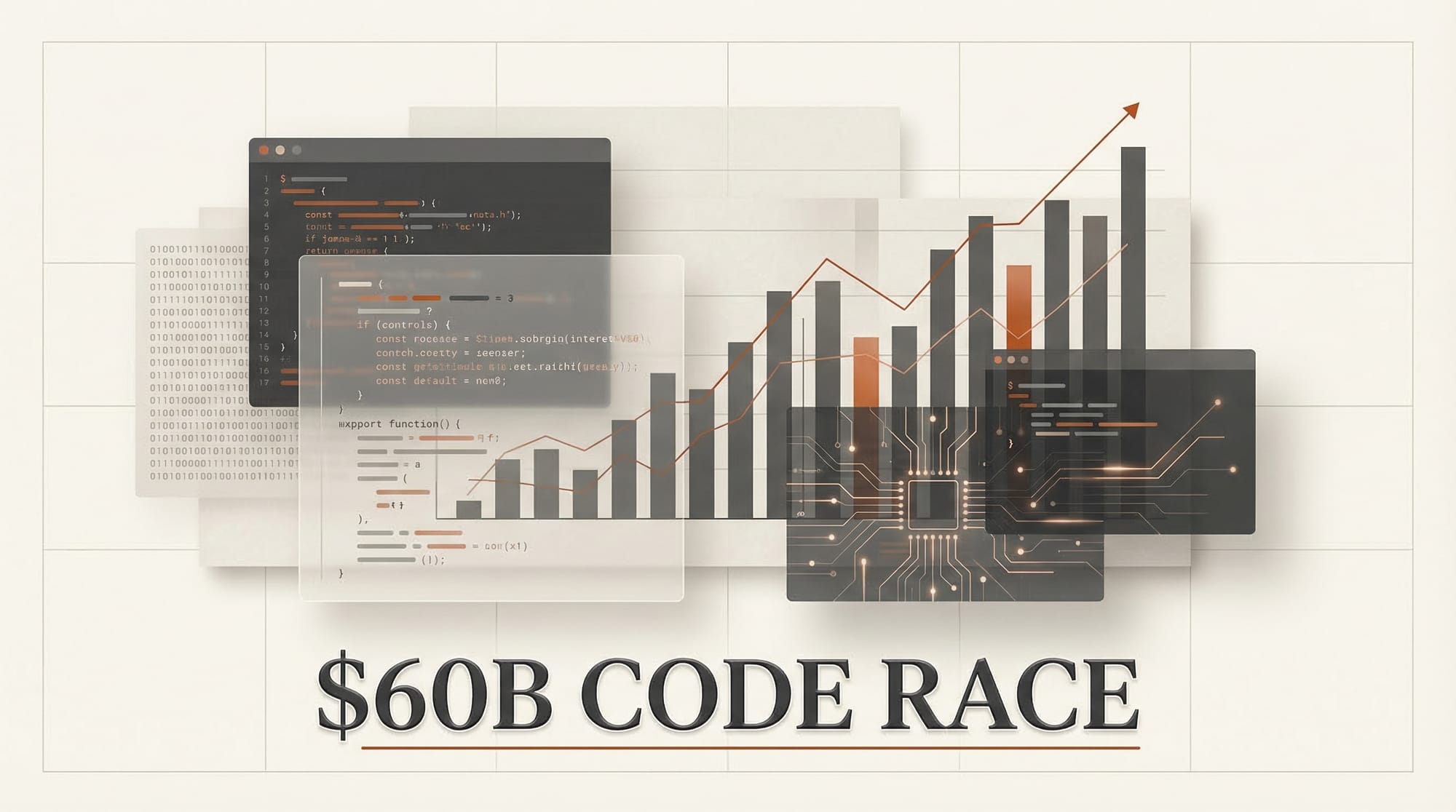
In the span of 48 hours this March, two AI coding startups collectively sought nearly $60 billion in valuation. Cursor entered talks at $50 billion after crossing $2 billion in annual revenue. Replit closed a $400 million round at $9 billion, tripling its valuation in six months. Meanwhile, Lovable hit $400 million in annual revenue with just 146 employees. These are not incremental numbers. They represent a fundamental rewiring of how software gets built, and creators are at the center of it.
Background
The AI coding tools market barely existed three years ago. GitHub Copilot launched as a novelty in 2022, and most developers treated it as a curiosity. By early 2025, Andrej Karpathy coined the term "vibe coding" to describe a new approach: instead of writing code line by line, you describe what you want and AI builds it. Collins Dictionary named it the Word of the Year for 2026.
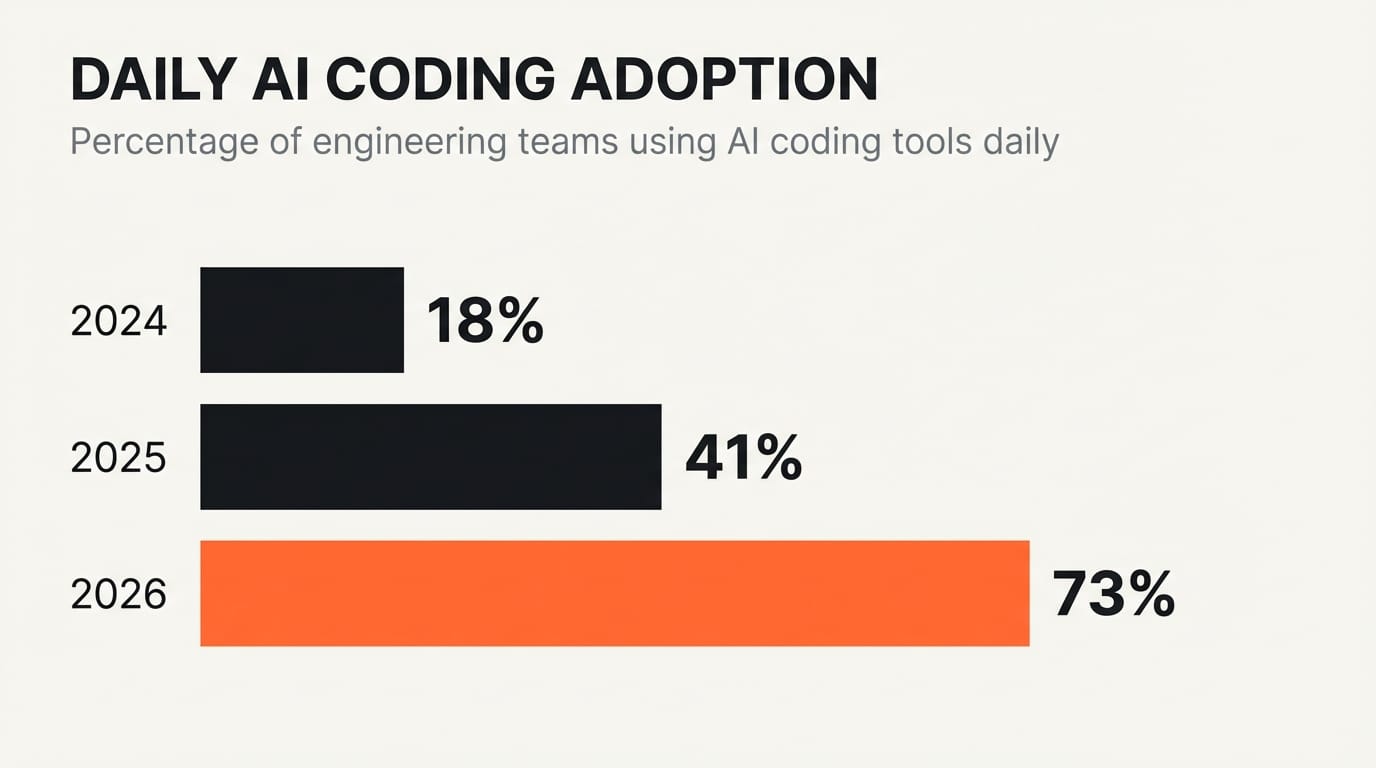
The market responded. The AI coding assistant market reached an estimated $8.5 billion in 2026, according to Grand View Research, on pace for $47.3 billion by 2034 at a 24% compound annual growth rate. A February 2026 developer survey found that 73% of engineering teams now use AI coding tools daily, up from 41% in 2025 and 18% in 2024. An estimated 41% of all code written globally is now AI-generated.
What makes this moment different is the sheer speed of revenue growth. Cursor doubled its annual revenue from $1 billion to $2 billion in three months. Replit went from $10 million to $240 million in annual revenue in under two years. Lovable added $100 million in revenue in a single month. These trajectories have no precedent in enterprise software.
Deep Analysis
The Valuation Arms Race
The combined valuation of the top AI coding startups now exceeds $60 billion. Cursor leads at $50 billion (pending), followed by Replit at $9 billion after its March 11 Series D. For context, Cursor's proposed valuation would make it more valuable than Shopify was at the same age. Replit tripled from $3 billion to $9 billion in just six months.
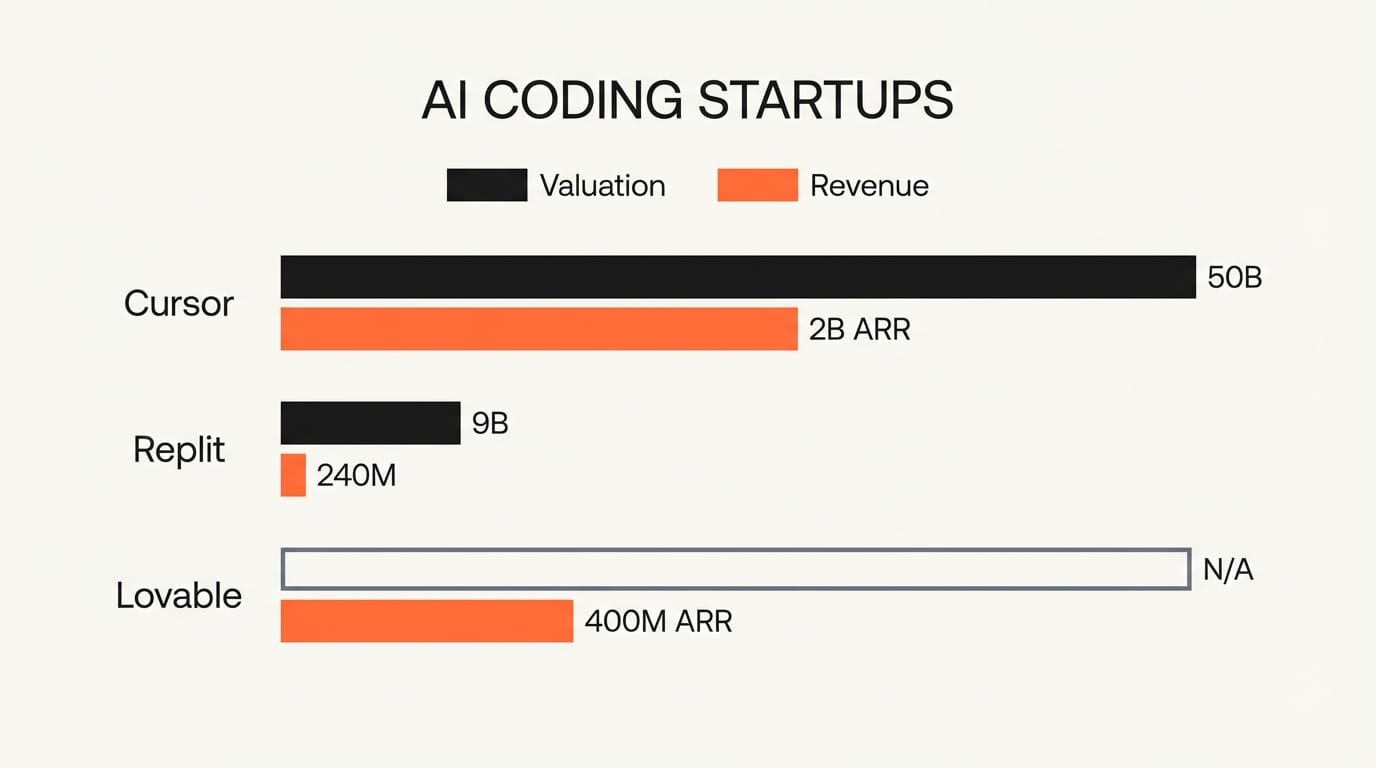
The revenue numbers behind these valuations are genuine. Cursor crossed $2 billion in annualized revenue in February 2026, with 60% of revenue coming from enterprise customers. Replit reported $240 million in 2025 revenue and targets $1 billion in run-rate revenue by the end of 2026. Lovable reached $400 million ARR with $2.7 million in revenue per employee, roughly five times the benchmark for a high-performing SaaS company.
The investor roster tells its own story. Cursor counts Accel, Andreessen Horowitz, NVIDIA, and Alphabet among its backers. Replit's Series D brought in Georgian Partners, a16z, Coatue, Qatar's sovereign wealth fund QIA, and Databricks Ventures. When Google, NVIDIA, and sovereign wealth funds are all placing bets on the same category, the market has moved past speculation into conviction.
Three Platforms, Three Strategies
These companies are not interchangeable. Each targets a different user and workflow, and the distinctions matter for creators choosing where to invest their time.
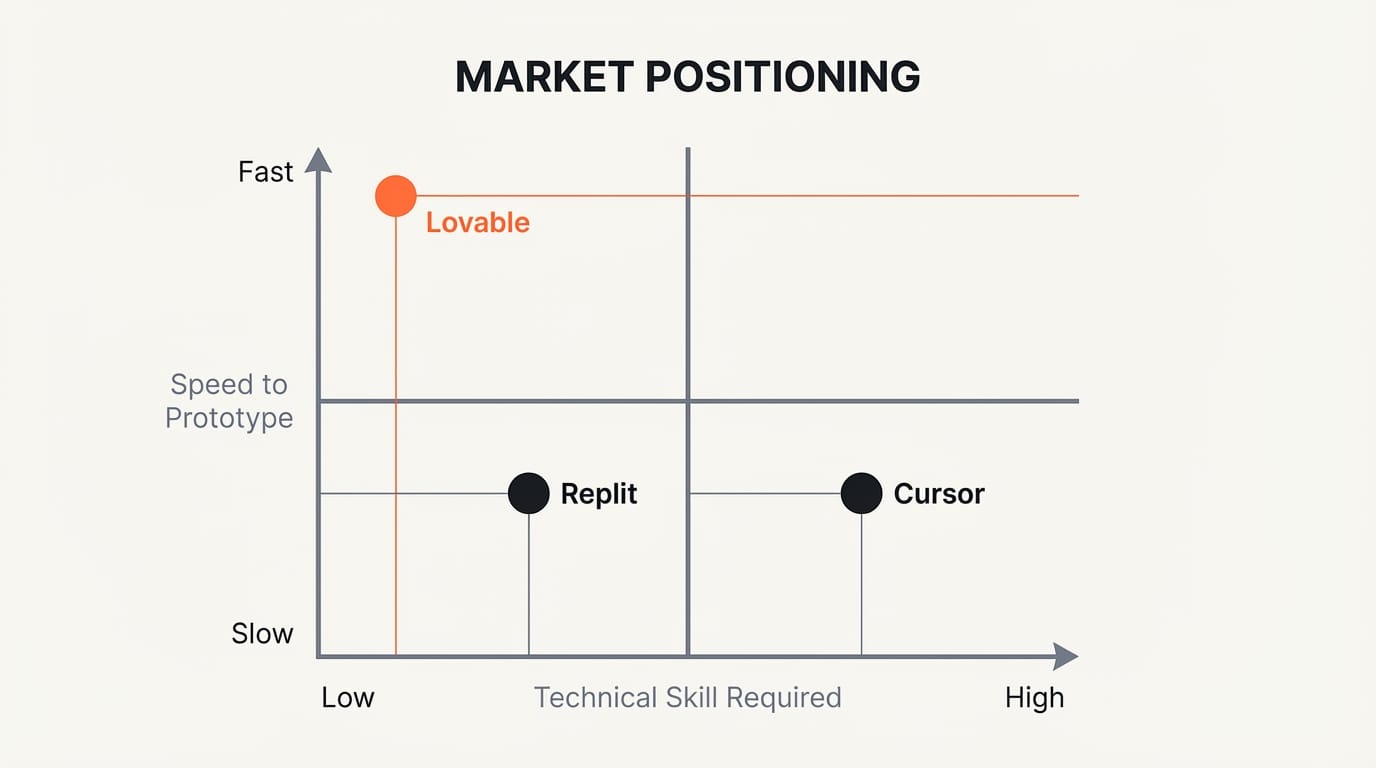
Cursor is built for professional developers who already know how to code. It is a VS Code fork rebuilt around AI, with features like multi-file editing, persistent agent memory, and Automations that let agents run autonomously on schedules or respond to triggers from Slack, Linear, and GitHub. Its sweet spot is experienced engineers who want to move faster, not people who have never written code.
Replit targets the opposite end of the spectrum. CEO Amjad Masad has described the company's mission as making software creation accessible to "the next billion developers" who are not developers in the traditional sense. Agent 4, launched alongside the funding round, introduces an infinite design canvas, parallel agents that handle frontend, backend, and database work simultaneously, and team collaboration where multiple people submit requests that the AI sequences and executes. Replit is betting that the future of software creation looks more like graphic design than programming.
Lovable occupies the fast-prototyping lane. Users describe an app in natural language and get a working version within minutes. Its 146-person team and $2.7 million revenue per employee make it the most capital-efficient player in the category. Enterprise adoption from companies like Klarna and HubSpot suggests the tool is moving beyond weekend projects into real business use cases.
The Talent War Beneath the Surface
Beyond funding and product launches, a fierce talent war is reshaping this market. xAI admitted it was "not built right" and began aggressively recruiting engineers from Cursor, Anthropic, and other AI coding companies to rebuild its development tools from scratch. The company recruited a co-founder of Mistral as part of this effort.
OpenAI acquired Windsurf (formerly Codeium) to bolster its developer tools portfolio. Anthropic's Claude Code became the fastest-growing AI coding tool, rising from 4% developer adoption in May 2025 to 63% by February 2026. GitHub Copilot, the incumbent, reached 4.7 million paid subscribers. Every major AI lab now treats coding tools as a core product line, not an experiment.
Replit, meanwhile, plans to nearly triple its headcount from 350 to 900 employees by year-end, a signal that the company sees a window to grab market share before the competition consolidates. The talent war is not just about building better AI. It is about building the environments where that AI operates, the editors, canvases, and agent frameworks that shape how millions of people create software.
Impact on Creators
For creative professionals, the AI coding race creates both opportunity and complexity. The opportunity is clear: tools that once required a software engineering degree are now accessible through natural language. Motion designers can script complex After Effects workflows through conversation. 3D artists can build custom pipeline tools without learning Python from scratch. Web designers can generate production-ready applications directly from mockups. The barrier between "I have an idea" and "I have a working product" has never been thinner.
The complexity is in choosing the right tool for the job. If you code professionally and want to accelerate your existing workflow, Cursor's deep IDE integration and autonomous agents fit that use case. If you are a non-technical creator who wants to build apps, dashboards, or internal tools, Replit's canvas-based approach is designed for you. If you need a quick prototype to validate an idea or pitch a client, Lovable's speed-first approach gets you there fastest. The emerging best practice among power users is to prototype in Lovable or Replit, then graduate to Cursor for production refinement.
There is also a cautionary note. Amazon recently investigated service outages potentially linked to AI-generated code, and research has shown that AI coding tools can actually slow down experienced developers by 19% when used without discipline. The tools are powerful, but they do not eliminate the need for code review, testing, and careful deployment practices, especially for anything that touches production users.
Key Takeaways
1. The AI coding market is on a trajectory to become the largest category in developer tools, with the top three startups alone holding nearly $60 billion in combined valuation and $2.6 billion in annual revenue.
2. Cursor, Replit, and Lovable target fundamentally different users, so creators should match the tool to their skill level and workflow rather than defaulting to the most-hyped option.
3. The talent and acquisition war (xAI recruiting from Cursor, OpenAI acquiring Windsurf, Anthropic's Claude Code surge) signals that every major AI company views coding tools as a must-win category.
4. Non-technical creators now have legitimate paths to building production software, but the speed of AI coding does not remove the need for testing, review, and deployment discipline.
What to Watch
The next six months will determine whether this market consolidates around a few winners or fragments into specialized niches. Cursor's $50 billion funding round, if it closes, will set the benchmark for the entire category. Replit's ability to hit its $1 billion revenue target by year-end will test whether the "vibe coding" approach scales beyond early adopters. And the open question hanging over all of this: as AI writes an ever-larger share of the world's code, who is responsible when that code breaks?
For creators, the practical move is to start experimenting now. Pick one tool, build something real with it, and evaluate the output critically. The AI coding race is moving faster than any category in tech history, and the creators who learn to work with these tools early will have a meaningful advantage as the market matures.
Deep dive by Creative AI News.
Subscribe for free to get the weekly digest every Tuesday.